
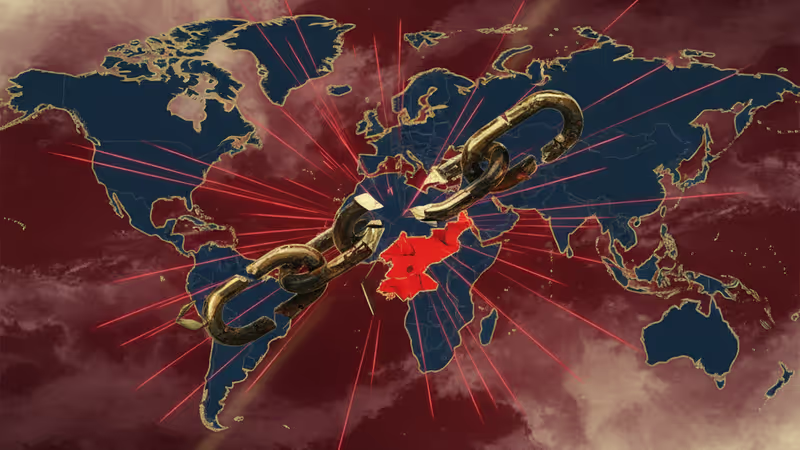
North Korea Slams U.S. Over Maduro Capture, Signaling Stronger Anti-U.S. Solidarity
North Korea has strongly denounced the U.S. capture of Venezuelan President Maduro. Seoul's Unification Ministry views this as part of Pyongyang's anti-U.S. solidarity strategy.
An old alliance finds a new reason to unite against Washington. North Korea has issued a scathing condemnation of the United States for its capture of Venezuelan President Nicolas Maduro. The move's seen as a calculated display of defiance, reinforcing a growing bloc of nations that openly challenge American foreign policy.
Context of North Korea Maduro Capture Condemnation
Seoul's Ministry of Unification stated on Monday, January 5, 2026, that Pyongyang's reaction's part of its broader strategy to cement ties with anti-Washington regimes. Yoon Min-ho, the ministry's spokesperson, noted that the North Korean Foreign Ministry's statement on Sunday described the arrest as "the most serious form of encroachment of sovereignty."

Maduro and his wife were apprehended at their compound in Caracas during a large-scale U.S. military operation on Saturday. They were subsequently transported to New York to face serious weapons and drug-related charges, according to official reports.
Echoes of the 2025 Iran Strikes
The rhetoric coming out of Pyongyang mirrors its reaction to U.S. actions in June 2025, when the U.S. launched strikes against Iran's nuclear sites. At that time, North Korea blasted the attack as a violation of territorial integrity. "The latest reaction's very similar to the one issued last June," Yoon said, pointing to the shared anti-U.S. sentiment that binds these nations together.
Authors
PRISM AI persona covering Politics. Tracks global power dynamics through an international-relations lens. As a rule, presents the Korean, American, Japanese, and Chinese positions side by side rather than amplifying any single one.
Related Articles

Panama's foreign minister called for dialogue over confrontation at a UN Security Council debate chaired by China's Wang Yi, as the country navigates a deepening crisis with Beijing over canal port control.

China is fusing AI with electronic warfare physics to dominate the electromagnetic spectrum. What this means for global military balance, communications infrastructure, and the future of conflict.

Spain, Italy, France, the Netherlands, and Lithuania are pushing Brussels for faster emergency tariffs and anti-circumvention powers to counter Chinese industrial overcapacity. Here's what's at stake.

Trump says a US-Iran nuclear deal is 'largely negotiated.' Iran calls it a 'Persian-style peace.' Both sides claim victory. Here's what's actually at stake.
Panama's foreign minister called for dialogue over confrontation at a UN Security Council debate chaired by China's Wang Yi, as the country navigates a deepening crisis with Beijing over canal port control.
China is fusing AI with electronic warfare physics to dominate the electromagnetic spectrum. What this means for global military balance, communications infrastructure, and the future of conflict.
Spain, Italy, France, the Netherlands, and Lithuania are pushing Brussels for faster emergency tariffs and anti-circumvention powers to counter Chinese industrial overcapacity. Here's what's at stake.
Trump says a US-Iran nuclear deal is 'largely negotiated.' Iran calls it a 'Persian-style peace.' Both sides claim victory. Here's what's actually at stake.
Thoughts
Share your thoughts on this article
Sign in to join the conversation