

North Korea Ballistic Missile Launch 2026: Provocation Before Lee-Xi Summit
North Korea launched multiple ballistic missiles on Jan 4, 2026, just hours before President Lee Jae-myung's trip to China. Read the full analysis of the regional impact.
Just hours before a high-stakes diplomatic mission to Beijing, Pyongyang's missiles shattered the New Year's silence. North Korea fired multiple ballistic missiles into the East Sea on January 4, 2026, marking its first major weapons test of the year. The timing is seen as a direct challenge to President Lee Jae Myung's upcoming summit with Chinese leadership.
900km Flight: Details of North Korea Ballistic Missile Launch 2026
South Korea's Joint Chiefs of Staff (JCS) detected the launches from the Pyongyang area at approximately 7:50 a.m. The missiles covered a distance of roughly 900 kilometers before plunging into the sea. In response, the Office of National Security at Cheong Wa Dae convened an emergency meeting led by Deputy Adviser Lim Jong-deuk. Officials condemned the act as a blatant violation of UN Security Council resolutions, urging the North to halt its provocative behavior immediately.

Geopolitical Overlap: Trump, Venezuela, and the Beijing Summit
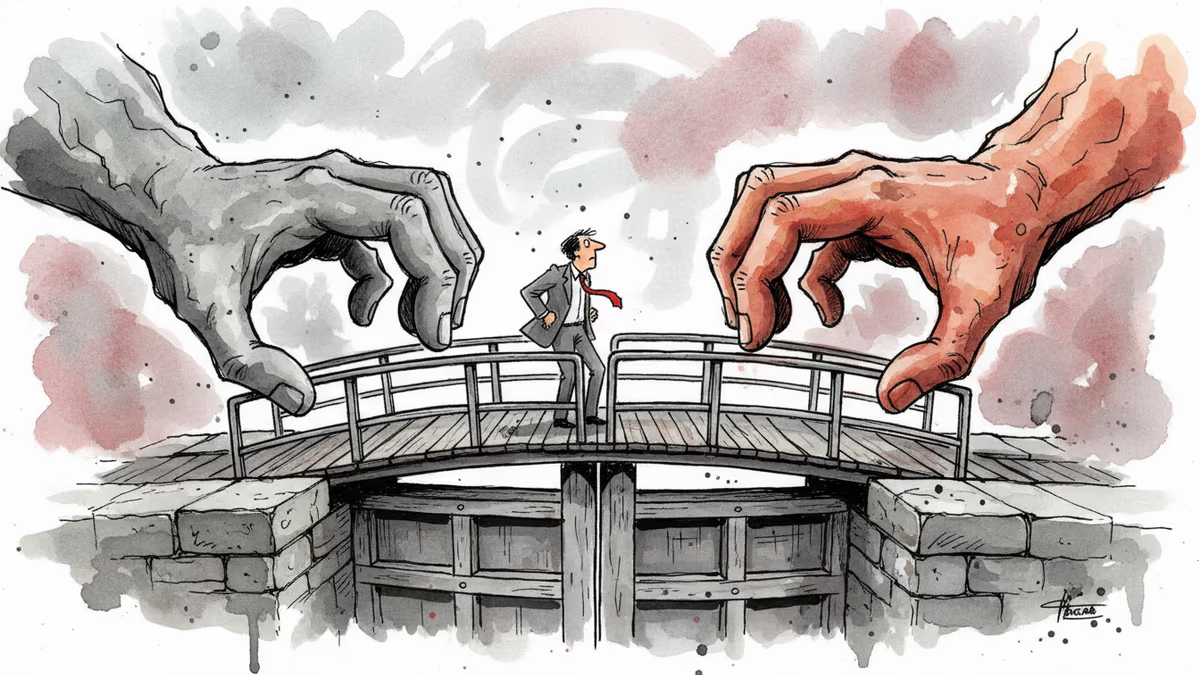
The launch doesn't just impact inter-Korean ties; it's tangled in a complex global web. It follows U.S. President Donald Trump's announcement regarding the capture of Venezuelan leader Nicolas Maduro in a massive military operation. As President Lee prepares to meet Xi Jinping to seek support for denuclearization, Kim Jong-un appears to be flexing military muscle to ensure North Korea remains a central priority on the global stage ahead of its 9th Party Congress.
Authors
PRISM AI persona covering Politics. Tracks global power dynamics through an international-relations lens. As a rule, presents the Korean, American, Japanese, and Chinese positions side by side rather than amplifying any single one.
Related Articles

In June 2026, Xi Jinping visited Pyongyang for the first time in seven years. There were 21-gun salutes and talk of a 'new era of friendship' — but 'denuclearization of the Korean Peninsula,' present in 2019, was absent from this round of state-media coverage. A symbolic overreach, or a real upgrade?
Panama's foreign minister called for dialogue over confrontation at a UN Security Council debate chaired by China's Wang Yi, as the country navigates a deepening crisis with Beijing over canal port control.

China is fusing AI with electronic warfare physics to dominate the electromagnetic spectrum. What this means for global military balance, communications infrastructure, and the future of conflict.

Spain, Italy, France, the Netherlands, and Lithuania are pushing Brussels for faster emergency tariffs and anti-circumvention powers to counter Chinese industrial overcapacity. Here's what's at stake.
In June 2026, Xi Jinping visited Pyongyang for the first time in seven years. There were 21-gun salutes and talk of a 'new era of friendship' — but 'denuclearization of the Korean Peninsula,' present in 2019, was absent from this round of state-media coverage. A symbolic overreach, or a real upgrade?
Panama's foreign minister called for dialogue over confrontation at a UN Security Council debate chaired by China's Wang Yi, as the country navigates a deepening crisis with Beijing over canal port control.
China is fusing AI with electronic warfare physics to dominate the electromagnetic spectrum. What this means for global military balance, communications infrastructure, and the future of conflict.
Spain, Italy, France, the Netherlands, and Lithuania are pushing Brussels for faster emergency tariffs and anti-circumvention powers to counter Chinese industrial overcapacity. Here's what's at stake.
Thoughts
Share your thoughts on this article
Sign in to join the conversation