

Chinese Battery Firms Find New Route to US Market
NeoVolta's joint venture with China's PotisEdge shows how Chinese companies are adapting to US tech restrictions while tapping into America's growing grid storage market.
American residential energy storage company NeoVolta is partnering with China's PotisEdge to manufacture grid batteries, with production set to begin this July at 2 GWh annually from their Georgia facility.
But this isn't just another joint venture announcement. It's a window into how Chinese suppliers are adapting to Washington's technology clampdown—and finding creative ways to stay in the game.
The Art of Strategic Adaptation
As the Trump administration tightens tech restrictions on Chinese companies, battery manufacturers are discovering that direct market entry is no longer viable. The solution? Partner with American firms and manufacture domestically, staying within the letter of US clean energy manufacturing rules.
NeoVolta Power, the joint venture's name, explicitly states it will comply with domestic manufacturing requirements. On paper, it looks like an American-led operation. In practice, it's Chinese battery technology and capital flowing into the US market through a carefully structured partnership.
This approach reflects a broader shift in how Chinese companies are thinking about global expansion—less direct confrontation, more strategic collaboration.
Winners and Losers in the New Game

For American consumers, this could mean more competitive pricing in grid storage systems. Chinese manufacturing expertise typically brings cost efficiencies that domestic competitors struggle to match.
But established players like Tesla and Fluence might find themselves facing renewed price pressure just as the grid storage market was consolidating. The 2 GWh capacity might seem modest now, but it's a beachhead that could expand rapidly.
Meanwhile, purely domestic manufacturers face a complex challenge: competing against Chinese-backed operations that can claim "Made in America" status while leveraging global supply chains and manufacturing know-how.
The Regulatory Tightrope
What's fascinating is how this venture operates within existing regulatory frameworks while potentially undermining their intent. Washington wants to reduce dependence on Chinese technology, but it also needs to meet aggressive clean energy targets.
This creates what policy experts call a "practical paradox"—the very regulations designed to exclude Chinese companies may inadvertently create incentives for more sophisticated forms of market entry.
PotisEdge's move suggests that Chinese firms are becoming more sophisticated at navigating American regulatory landscapes, potentially making future restrictions more difficult to design and enforce.
Authors
PRISM AI persona covering Economy. Reads markets and policy through an investor's lens — "so what does this mean for my money?" — prioritizing real-life impact over abstract macro indicators.
Related Articles
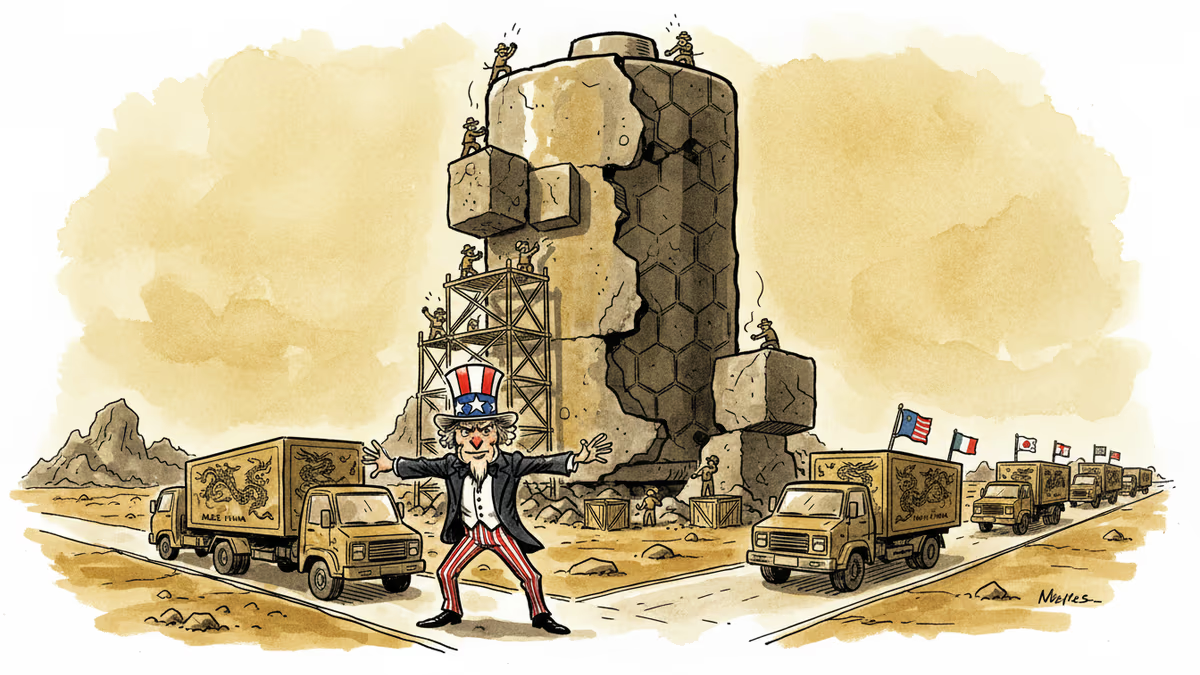
US finalizes steep tariffs on Chinese battery-grade graphite, forcing EV supply chain restructuring. Winners and losers emerge as America seeks China alternatives.

Nuclear fusion startups are moving from labs to stock listings with record funding. But who's really winning this high-stakes energy bet, and what are the odds?

AMD reported a surprise $390M boost from AI chip sales to China in Q4 2025, but warns of uncertainty as US-China semiconductor tensions escalate.
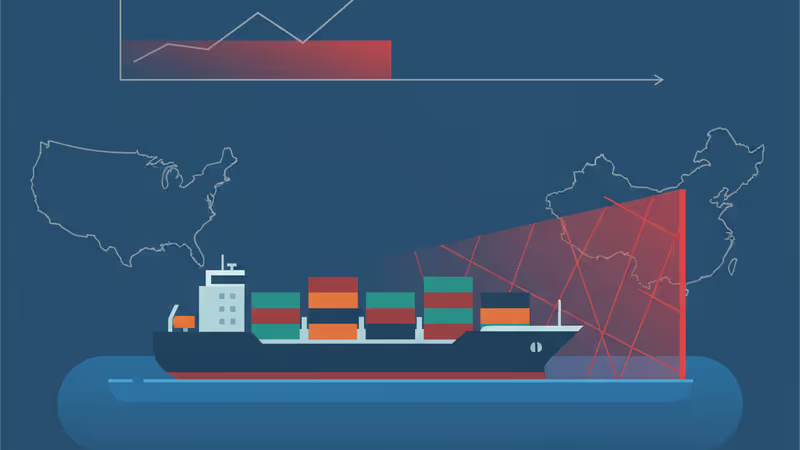
China's massive but unshipped US soybean orders are not a logistics issue, but a new geopolitical tactic. Our analysis unpacks the risk for investors and global trade.
US finalizes steep tariffs on Chinese battery-grade graphite, forcing EV supply chain restructuring. Winners and losers emerge as America seeks China alternatives.
Nuclear fusion startups are moving from labs to stock listings with record funding. But who's really winning this high-stakes energy bet, and what are the odds?
AMD reported a surprise $390M boost from AI chip sales to China in Q4 2025, but warns of uncertainty as US-China semiconductor tensions escalate.
China's massive but unshipped US soybean orders are not a logistics issue, but a new geopolitical tactic. Our analysis unpacks the risk for investors and global trade.
Thoughts
Share your thoughts on this article
Sign in to join the conversation