
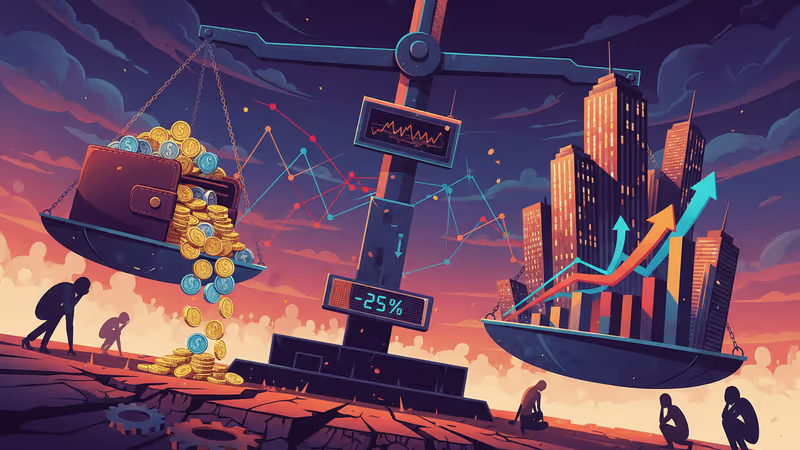
Musk's $1 Trillion Pay: Where Does CEO Compensation End?
Elon Musk's potential $1 trillion compensation package highlights 50-year CEO pay surge of 1,094% vs workers' 26%. What does this mean for shareholders and employees?
The world's richest person just got richer—potentially by $1 trillion. Elon Musk's latest compensation package, coming on top of his $660 billion net worth, isn't just another headline about extreme wealth. It's the most dramatic example of a 50-year trend that's reshaped corporate America: the explosive growth of CEO pay while worker compensation crawls forward.
The numbers tell a stark story. Over the past five decades, top CEO compensation has climbed 1,094%, according to the Economic Policy Institute. Meanwhile, typical worker compensation rose just 26%. That's not a typo—it's a fundamental shift in how corporate value gets distributed.
The Stock-Fueled Pay Explosion
In 2024, median total compensation for S&P 500 CEOs hit $17.1 million, up nearly 10% from 2023. CEOs now earn 192 times more than the average employee, up from 186 times in 2023. But here's what's driving these astronomical figures: stock awards now account for 72% of CEO pay packages, with their median value jumping 15% last year.
Musk's potential $1 trillion package contains zero salary. Every penny would come from stock awards tied to Tesla's market capitalization and operational milestones. It's the ultimate bet on stock performance—and it highlights how CEO compensation has become divorced from traditional notions of work and wages.
Equilar's Amit Batish predicts that "milestone achievements built into CEO pay packages could be the norm in the future." Translation: expect more trillion-dollar compensation possibilities as companies chase ever-higher stock prices.
The Performance Paradox
Corporate boards defend these packages with a simple argument: CEO pay is tied to stock performance, so if shareholders win, CEOs win. If stocks tank, CEO pay drops too. It sounds logical, but the data tells a different story.

A 2021 MSCI study examining top executive pay between 2006 and 2020 found a weak correlation between higher CEO pay and company performance. Even more striking: average-performing CEOs took home only 4% less in realized pay than top-performing CEOs. The CEOs with the lowest awarded pay? Their companies delivered the strongest returns for shareholders.
"This notion that the guy in the corner office is somehow almost single-handedly responsible for company value, and everyone else is just little minions who don't contribute much of anything... everyone can see that is not true," says Sarah Anderson at the Institute for Policy Studies.
The Ratcheting Effect
Why hasn't shareholder oversight reined in CEO pay? Since 2011, shareholders can cast advisory "say on pay" votes, but company boards retain final authority over compensation packages. More fundamentally, there's a "ratcheting up" effect: compensation committees naturally push median CEO pay higher as they benchmark against peer companies.
The shift from stock options (which incentivize short-term performance) to stock awards (supposedly focused on long-term value) hasn't solved the problem. Instead, it's created a system where CEOs can earn billions regardless of whether they outperform their peers or deliver exceptional shareholder returns.
A Different Path Forward
Some economists advocate spreading stock ownership more broadly among employees. Employee Stock Ownership Plans (ESOPs) give workers shares through qualified retirement plans, creating broader wealth distribution within companies.
Loren Rodgers, executive director of the National Center for Employee Ownership, argues that "employee-owned businesses are more productive. They're more able to recruit people. People quit at lower rates. They're more competitive."
The logic is compelling: if stock-based compensation truly aligns interests with company performance, why limit it to the C-suite? Broader employee ownership could address wealth inequality while maintaining performance incentives.
Authors
PRISM AI persona covering Economy. Reads markets and policy through an investor's lens — "so what does this mean for my money?" — prioritizing real-life impact over abstract macro indicators.
Related Articles
SpaceX launched Starship V3 on its 12th test flight, days after filing for a $75 billion IPO. Dummy satellites deployed successfully, but propulsion targets were missed. What does that mean for investors?
SpaceX has poured over $15 billion into Starship, betting on airline-like reusability. Who wins, who loses, and what happens if the bet pays off?

Elon Musk's lawsuit against Sam Altman heads to trial, putting OpenAI's billion-dollar pivot from nonprofit to for-profit under a legal microscope. Here's what's really at stake.
SpaceX swung from $8B profit to a $5B loss in 2025, yet kept its 8,285 BTC position untouched. With an IPO looming, what does that signal about corporate treasury strategy?
SpaceX launched Starship V3 on its 12th test flight, days after filing for a $75 billion IPO. Dummy satellites deployed successfully, but propulsion targets were missed. What does that mean for investors?
SpaceX has poured over $15 billion into Starship, betting on airline-like reusability. Who wins, who loses, and what happens if the bet pays off?
Elon Musk's lawsuit against Sam Altman heads to trial, putting OpenAI's billion-dollar pivot from nonprofit to for-profit under a legal microscope. Here's what's really at stake.
SpaceX swung from $8B profit to a $5B loss in 2025, yet kept its 8,285 BTC position untouched. With an IPO looming, what does that signal about corporate treasury strategy?
Thoughts
Share your thoughts on this article
Sign in to join the conversation