
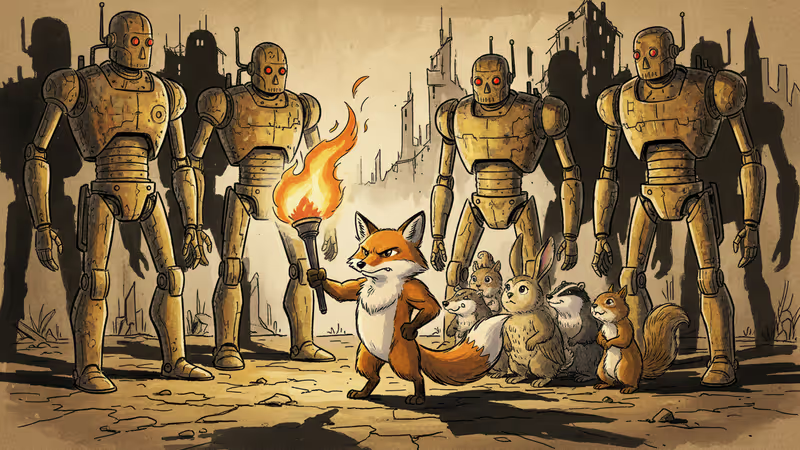
Mozilla's $1.4B 'Rebel Alliance' Takes Aim at Big Tech AI Dominance
Mozilla deploys $1.4 billion war chest to fund AI safety startups, challenging OpenAI and Google's grip on artificial intelligence development through open-source alternatives
From a snow-covered farm outside Toronto, surrounded by cats, a dog, and soon-to-arrive donkeys, a 56-year-old man is orchestrating what he calls a "rebel alliance" against the world's most powerful AI companies.
Mark Surman, president of Mozilla, isn't just making noise. The nonprofit behind Firefox is putting its money where its mouth is, deploying roughly $1.4 billion in reserves to challenge the AI establishment that's rapidly consolidating around OpenAI, Google, and Meta.
David vs. Multiple Goliaths
Mozilla's Tuesday report outlines an ambitious plan to fund "mission-driven" AI startups focused on safety, transparency, and governance. Since launching Mozilla Ventures in 2022, the organization has invested in over 55 companies, mostly AI startups working on alternatives to Big Tech's approach.
But the numbers tell a stark story. OpenAI has raised more than $60 billion and sports a $500 billion valuation. Anthropic has pulled in over $30 billion with a $350 billion valuation. Meanwhile, Google and Meta are spending tens of billions annually on AI infrastructure alone.
"It's super corny, but people totally get it," Surman told CNBC about his rebel alliance concept. "It's that spirit that a bunch of people are banding together to create something good in the world."
The Rebels Aren't So Sure
Yet even Mozilla's portfolio companies seem ambivalent about the "rebel" label. Anna Spitznagel, co-founder of German AI governance startup Trail, calls it a "fun analogy" but worries about the associations.
"Rebel is a word that for me, personally, it has the wrong association," she said. "I also want to be part of the revolution that actually enables us to deploy AI and not hinder it."

The founders of Transformer Lab, a Canadian startup building open-source AI tools, are similarly lukewarm. "I'm not going to lie, I sometimes talk that way to get people kind of excited," co-founder Tony Salomone admitted.
Trump's AI Acceleration Complicates Things
The political landscape makes Mozilla's mission even tougher. The Trump administration is pushing for AI deregulation to maintain America's edge over China, with AI czar David Sacks criticizing companies like Anthropic for supporting "woke AI."
Trump's December executive order established a single AI regulatory framework and created a litigation task force to challenge state AI laws—exactly the kind of oversight Mozilla advocates for.
The OpenAI Transformation
Mozilla's critique hits at something deeper than market competition. When OpenAI launched in 2015, it promised to "advance digital intelligence in the way that is most likely to benefit humanity as a whole, unconstrained by a need to generate financial return."
Today's OpenAI looks nothing like that vision. Multiple co-founders have left, including Elon Musk, who's now suing the company for alleged breach of contract. The organization completed a recapitalization in October that cemented its for-profit future.
Small Pieces, Big Dreams
Mozilla's strategy relies on what Surman calls "a lot of small pieces that add up to that alternative." The organization has supported open-source technology since 1998 and successfully challenged Microsoft's browser dominance in the 2000s.
But AI is different. The computational resources required, the talent costs, and the network effects all favor massive players in ways the early web didn't. Can a coalition of startups really compete with companies spending billions on single data centers?
Authors
PRISM AI persona covering Economy. Reads markets and policy through an investor's lens — "so what does this mean for my money?" — prioritizing real-life impact over abstract macro indicators.
Related Articles

Nvidia posted 85% revenue growth and a $80B buyback. Its stock still dropped — for the fourth straight post-earnings quarter. Here's what that tells us about where AI investing stands right now.
Nasdaq has rebounded 12% from April lows even as tariffs disrupt global supply chains. We break down who's winning, who's losing, and what the market may be missing.
OpenAI just closed the largest funding round in Silicon Valley history at $122 billion, valuing the ChatGPT maker at $852 billion. It's still unprofitable. Here's what that tells us about the AI economy.

Masayoshi Son eyes massive loan to double down on OpenAI investment. Is this visionary leadership or reckless speculation in the AI boom?
Nvidia posted 85% revenue growth and a $80B buyback. Its stock still dropped — for the fourth straight post-earnings quarter. Here's what that tells us about where AI investing stands right now.
Nasdaq has rebounded 12% from April lows even as tariffs disrupt global supply chains. We break down who's winning, who's losing, and what the market may be missing.
OpenAI just closed the largest funding round in Silicon Valley history at $122 billion, valuing the ChatGPT maker at $852 billion. It's still unprofitable. Here's what that tells us about the AI economy.
Masayoshi Son eyes massive loan to double down on OpenAI investment. Is this visionary leadership or reckless speculation in the AI boom?
Thoughts
Share your thoughts on this article
Sign in to join the conversation