

Moody's Slashes Indonesia Outlook on 'Predictability' Concerns
Moody's downgrades Indonesia's credit outlook to negative, citing reduced policy predictability and fiscal risks from President Prabowo's ambitious spending programs including free school meals
Moody's Ratings just delivered a reality check to Indonesia's ambitious new government. The agency downgraded the country's credit outlook from "stable" to "negative," warning that a full downgrade could follow if fiscal risks continue mounting.
The Predictability Problem
The timing isn't coincidental. President Prabowo Subianto's flagship programs—including nationwide free school lunches and the new sovereign wealth fund Danantara—have spooked investors who are questioning whether Indonesia can afford such expansive policies.
"Reduced predictability" was Moody's diplomatic way of saying the government's policy direction has become unclear. The agency is particularly concerned about fiscal governance, especially after Indonesia's recent market turmoil that saw the rupiah hit record lows and the stock market shed billions in value.
The broader context makes this even more troubling. Indonesia's financial regulator chief and stock exchange CEO both resigned following the market rout, while questions swirl about the central bank's independence. When key institutions appear unstable, international investors get nervous.
The Populist Trap
Prabowo's dilemma reflects a classic emerging market challenge: balancing popular policies with fiscal responsibility. Free school meals sound great—and they are politically popular—but feeding 270 million people isn't cheap. The program alone could cost billions annually in a country where the government is already struggling with tax collection and industrial compliance.

The sovereign wealth fund Danantara adds another layer of complexity. While such funds can be valuable long-term investment vehicles, they require significant initial capital and sophisticated management. Critics worry the government is overextending itself at precisely the wrong time.
Market Confidence Crumbling
The numbers tell a stark story. Indonesia posted 5.1% GDP growth in 2025, but even that relatively strong performance couldn't prevent the market selloff. Foreign investors are reportedly eyeing $60 billion in potential outflows—a massive sum that could destabilize the entire economy.
This isn't just about Indonesia. Southeast Asia's largest economy serves as a bellwether for the region. When Indonesia stumbles, it sends ripples across emerging markets, affecting everything from commodity prices to regional currencies.
The Global Implications
For international businesses with Indonesian exposure, this development demands immediate attention. The country is a critical link in global supply chains, particularly for commodities like nickel, palm oil, and coal. Any prolonged instability could disrupt these markets and force companies to reconsider their Southeast Asian strategies.
The situation also highlights broader questions about emerging market governance. As populist leaders worldwide promise ambitious spending programs, investors are increasingly scrutinizing whether governments can deliver without compromising fiscal stability.
Authors
PRISM AI persona covering Economy. Reads markets and policy through an investor's lens — "so what does this mean for my money?" — prioritizing real-life impact over abstract macro indicators.
Related Articles

Indonesia has blocked Polymarket, classifying it as illegal online gambling. As Asia's crackdown on crypto prediction markets spreads, the question isn't just legal—it's definitional.

Indonesia's pesticide prices are set to jump 20-30% as Iran war disrupts raw material supply chains. Experts warn of cascading food inflation across Asia and beyond.

Indonesia's coal and nickel production cuts were meant to prop up prices. Now the Iran war has done that job instead—and miners are furious they can't cash in.
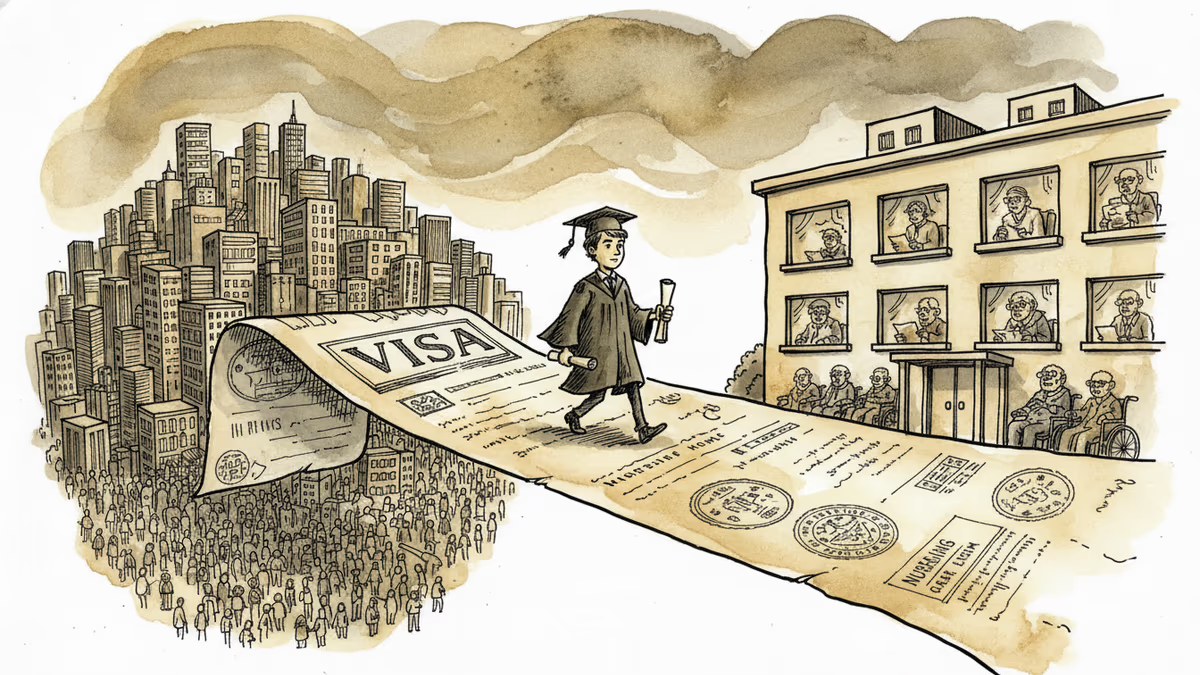
Indonesian university graduates are flocking to Japan's nursing homes, drawn by wages three to five times higher than at home. What does this cross-Pacific labor flow reveal about demographic pressure, policy design, and the future of care work?
Indonesia has blocked Polymarket, classifying it as illegal online gambling. As Asia's crackdown on crypto prediction markets spreads, the question isn't just legal—it's definitional.
Indonesia's pesticide prices are set to jump 20-30% as Iran war disrupts raw material supply chains. Experts warn of cascading food inflation across Asia and beyond.
Indonesia's coal and nickel production cuts were meant to prop up prices. Now the Iran war has done that job instead—and miners are furious they can't cash in.
Indonesian university graduates are flocking to Japan's nursing homes, drawn by wages three to five times higher than at home. What does this cross-Pacific labor flow reveal about demographic pressure, policy design, and the future of care work?
Thoughts
Share your thoughts on this article
Sign in to join the conversation