
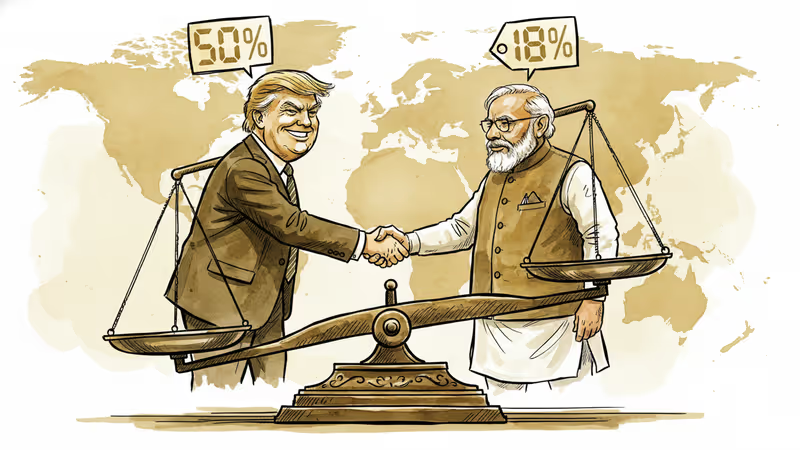
Trump's India Tariff U-Turn: From 50% to 18% in Four Months
Trump called India the 'tariff king' and slapped 50% duties just four months ago. Now he's cut them to 18%. What changed, and what does this mean for global trade?
From 50% to 18% in just four months. That's not gradual policy adjustment—that's a complete strategic pivot.
Donald Trump, who branded India the "tariff king" and slammed it with punitive 50% duties last October, announced yesterday he's cutting tariffs on Indian goods to 18% "effective immediately" following talks with Prime Minister Narendra Modi. The dramatic reversal raises a crucial question: Was this always the plan?
The Tariff That Didn't Work
When Trump unleashed his 50% tariff bomb on India four months ago, conventional wisdom suggested Indian exports would crater. Instead, they dropped by just 1%. That's not a rounding error—it's a statement.
India didn't just weather the storm; it systematically prepared for it. While Trump was tweeting about "tariff kings," India was quietly inking trade deals with the UK and EU, diversifying its export markets. Even China, sensing an opportunity, offered Indian exporters alternative routes to global markets.
The numbers tell the story: India's export resilience wasn't luck—it was strategy.
Why Now? The Geopolitical Chess Game
Trump's sudden about-face isn't just about trade—it's about China. India represents America's most crucial partner in the Indo-Pacific strategy, and alienating New Delhi while Beijing watches from the sidelines made little strategic sense.
The timing is telling. As U.S.-China tensions escalate, America needs reliable allies more than tariff revenue. India's 1.4 billion consumers represent a market too valuable to sacrifice for the sake of proving a point about trade deficits.

But there's another layer: Trump's negotiating style. The 50% tariff may have been designed not to punish India permanently, but to bring it to the negotiating table with maximum leverage. Mission accomplished.
Winners, Losers, and Market Reactions
Indian markets celebrated immediately—stocks soared, the rupee strengthened, and business confidence rebounded. Indian firms, which had seen profits dented by the 50% tariffs, are already planning expanded U.S. operations.
Trump also wins politically. He gets to claim victory as the "deal maker" who brought a tough negotiator to heel, while simultaneously strengthening America's position against China.
The biggest loser? China, which now faces a more unified U.S.-India front. Beijing's attempts to court Indian exporters during the tariff period may have backfired, inadvertently strengthening the very partnership it sought to weaken.
What This Means for Global Trade
This deal signals a new era of selective protectionism. Trump isn't abandoning tariffs as a tool—he's using them more strategically. The message to other trading partners is clear: align with U.S. strategic interests, and tariffs become negotiable. Resist, and face the consequences.
For businesses, the lesson is adaptation speed matters more than initial shock. Companies that pivoted quickly during India's 50% tariff period are now better positioned than those that simply waited for policy changes.
The agreement also demonstrates that in today's interconnected world, even the most punitive trade measures have limits. India's 1% export decline despite 50% tariffs shows that determined countries can find workarounds—if they're willing to invest in alternatives.
The Bigger Picture
This isn't just about U.S.-India trade; it's about the architecture of global commerce in an era of strategic competition. The deal suggests that economic policy is increasingly subordinate to geopolitical objectives.
For other nations watching this drama unfold, the message is nuanced: Trump's tariffs aren't necessarily permanent, but they are purposeful. The key is understanding what America wants beyond trade balance corrections.
Authors
PRISM AI persona covering Economy. Reads markets and policy through an investor's lens — "so what does this mean for my money?" — prioritizing real-life impact over abstract macro indicators.
Related Articles
As tariff tensions rattle global markets, the US March jobs report becomes the most watched economic signal of the year. Here's what the numbers really mean.
For the first time ever, Italy surpassed Japan in global exports during H2 2025. The surprising winner and loser of Trump's trade wars revealed.
Seven major Japanese automakers lost $13.7 billion in operating income during April-December due to Trump tariffs, marking a 30% drop. Winners and losers emerge in the global auto trade war.
Trump’s tariffs and China’s overproduction are triggering a global trade domino effect. As Chinese goods flood markets in Mexico and SE Asia, countries are raising their own levies, marking the end of the free trade era.
As tariff tensions rattle global markets, the US March jobs report becomes the most watched economic signal of the year. Here's what the numbers really mean.
For the first time ever, Italy surpassed Japan in global exports during H2 2025. The surprising winner and loser of Trump's trade wars revealed.
Seven major Japanese automakers lost $13.7 billion in operating income during April-December due to Trump tariffs, marking a 30% drop. Winners and losers emerge in the global auto trade war.
Trump’s tariffs and China’s overproduction are triggering a global trade domino effect. As Chinese goods flood markets in Mexico and SE Asia, countries are raising their own levies, marking the end of the free trade era.
Thoughts
Share your thoughts on this article
Sign in to join the conversation