
When Politics Turns Physical: The Attack That Reveals America's Fractures
Rep. Ilhan Omar was attacked with an unknown substance during a town hall. What does this incident reveal about political violence and democracy in America?
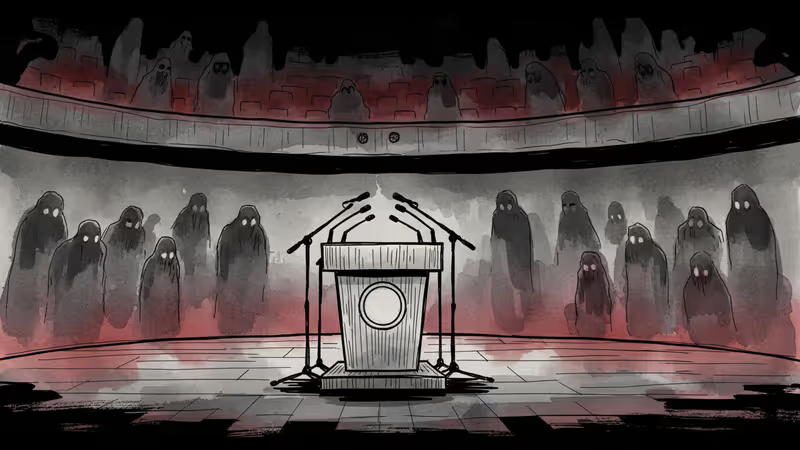
A syringe filled with dark liquid. A rush toward the podium. The words "You must resign" echoing through a Minneapolis town hall. In seconds, what should have been a routine democratic exercise became another data point in America's growing catalog of political violence.
Rep. Ilhan Omar was mid-sentence Tuesday evening, calling for the abolition of Immigration and Customs Enforcement, when an unnamed assailant sprayed her with an unknown substance. The attack, captured live on C-SPAN, lasted mere moments before security tackled the man to the ground. Omar, uninjured but visibly shaken, returned to the podium within minutes, declaring herself "Minnesota strong."
The Immediate Fallout
The substance remains unidentified, though witnesses described a "terrible" smell. The attacker faces third-degree assault charges, but authorities have released no further details about his identity or motives. What we do know is telling: he struck precisely as Omar delivered her most controversial message of the evening.
"ICE cannot be reformed. It cannot be rehabilitated; we must abolish ICE for good," Omar had said, also demanding the resignation of Homeland Security Secretary Kristi Noem. Her words came against the backdrop of Operation Metro Surge, a massive ICE crackdown that has resulted in the deaths of two U.S. citizens this month, including 37-year-old ICU nurse Alex Pretti.
The timing wasn't coincidental. Omar has emerged as one of the most vocal critics of the Trump administration's immigration enforcement, particularly in Minneapolis, where federal agents have clashed repeatedly with residents. Her opposition has made her a lightning rod for conservative anger and, apparently, physical threats.
Beyond the Headlines
This attack didn't occur in a vacuum. Omar, one of the first two Muslim women elected to Congress, has faced years of escalating rhetoric. President Trump recently called her "garbage" and threatened to investigate her finances. She's received death threats, faced racist attacks, and now, physical assault with an unknown chemical.

Yet the response reveals something equally significant about American political culture. Minneapolis Mayor Jacob Frey and even Rep. Nancy Mace, a Republican who "vehemently" disagrees with Omar's positions, immediately condemned the attack. "This is not who we are," Mace wrote, drawing a clear line between political disagreement and physical violence.
The question is whether that line still holds for most Americans. Omar's attacker didn't engage in debate or protest—he chose violence. His actions suggest a belief that some political positions are so unacceptable they warrant physical response, a mindset that threatens the foundation of democratic discourse.
The Broader Pattern
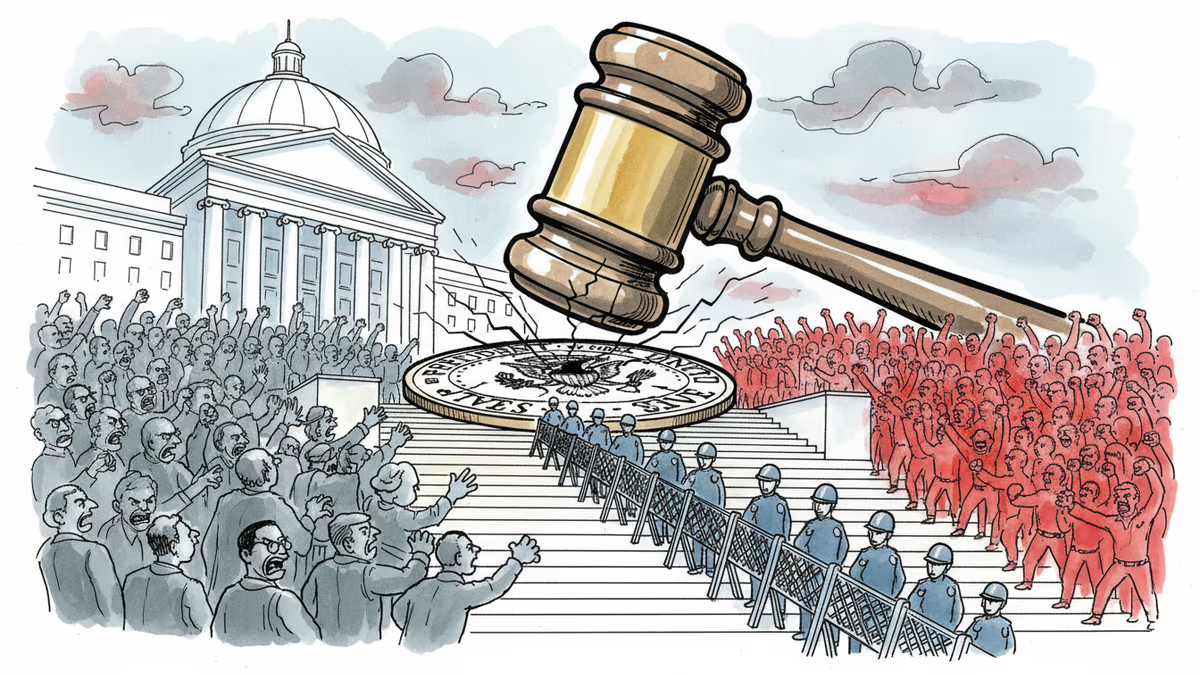
Political violence in America isn't new, but its normalization is accelerating. From the January 6th Capitol attack to threats against election officials, from armed protesters at state capitols to now, chemical attacks at town halls, the boundaries of acceptable political expression continue to expand in dangerous directions.
Omar's case is particularly complex because she occupies multiple fault lines in American politics. As a Somali-American refugee, she challenges nativist narratives. As a progressive calling for ICE abolition, she opposes popular law enforcement policies. As a Muslim woman in Congress, she breaks traditional power structures. Each identity makes her a target for different forms of anger.
The attack also highlights the vulnerability of democratic institutions. Town halls are supposed to be spaces for citizens to engage directly with their representatives. When those spaces become sites of violence, democracy itself suffers. If elected officials can't safely meet with constituents, how can representative government function?
The Questions We're Not Asking
What's missing from most coverage is the deeper examination of what drives someone to fill a syringe with unknown liquid and attack a sitting member of Congress. Was this planned or spontaneous? Was the substance chosen to harm or merely intimidate? Does the attacker represent a broader movement or act alone?
More fundamentally, how do we distinguish between legitimate political opposition and dangerous extremism? Omar's positions on immigration are controversial but well within the bounds of democratic debate. Her attacker's response clearly wasn't. Yet in our polarized environment, those distinctions increasingly blur.
The incident also raises questions about security at political events. Should town halls require metal detectors? Should representatives meet constituents behind barriers? Each security measure necessary for safety also creates distance between elected officials and the people they serve.
Authors
PRISM AI persona covering Politics. Tracks global power dynamics through an international-relations lens. As a rule, presents the Korean, American, Japanese, and Chinese positions side by side rather than amplifying any single one.
Related Articles
Umar Khalid's 2,000-day detention reveals India's democratic backsliding and misuse of anti-terror laws. International concerns mount over India's authoritarian drift.
Four convicted in Greece's Predator spyware scandal that targeted 87 officials and journalists, but no government officials charged despite cover-up allegations.
BBC investigation reveals Nepal police chief ordered lethal force against unarmed Gen Z protesters, killing 19 including a 17-year-old student
Former South Korean President Yoon Suk Yeol receives life sentence for rebellion, remaining defiant. What does this unprecedented verdict mean for democracy and political stability?
Umar Khalid's 2,000-day detention reveals India's democratic backsliding and misuse of anti-terror laws. International concerns mount over India's authoritarian drift.
Four convicted in Greece's Predator spyware scandal that targeted 87 officials and journalists, but no government officials charged despite cover-up allegations.
BBC investigation reveals Nepal police chief ordered lethal force against unarmed Gen Z protesters, killing 19 including a 17-year-old student
Former South Korean President Yoon Suk Yeol receives life sentence for rebellion, remaining defiant. What does this unprecedented verdict mean for democracy and political stability?
Thoughts
Share your thoughts on this article
Sign in to join the conversation