
MicroStrategy's $8K Bitcoin Survival Claim: Genius Strategy or Retail Investor Trap?
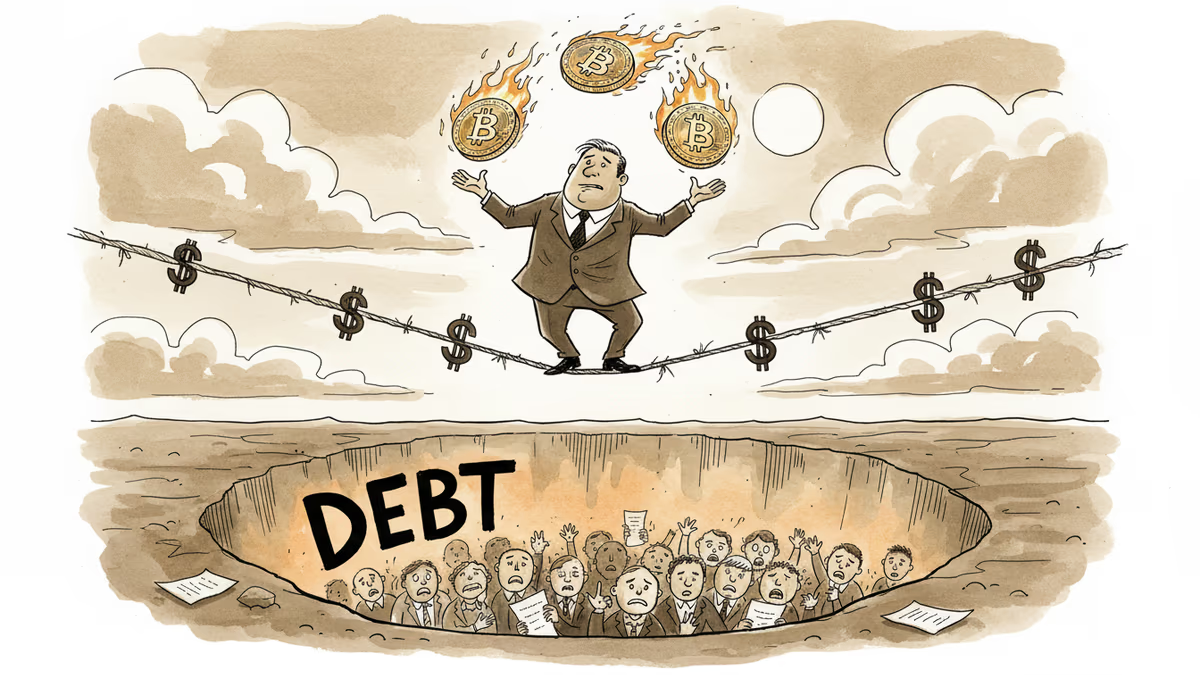
MicroStrategy claims it can survive bitcoin dropping to $8,000, but critics warn the strategy amounts to dumping risk onto retail investors while enriching Wall Street hedge funds.
$48 billion in paper losses. That's what MicroStrategy would face if bitcoin dropped to $8,000 – the very price point where CEO Michael Saylor claims his company can still "fully cover" its $6 billion debt. But behind this confident proclamation lies a strategy that critics say amounts to a sophisticated wealth transfer from retail investors to Wall Street hedge funds.
The Math Behind the Bravado
MicroStrategy holds 714,644 bitcoins worth roughly $49.3 billion at current prices. The company paid an average of $76,000 per bitcoin – a total investment of $54 billion since 2020. At $8,000 bitcoin, those holdings would indeed cover the debt mathematically. But the optics? Catastrophic.
The software company generates just $500 million annually from its core business – a pittance compared to its $8.2 billion in convertible bonds and $8 billion in preferred shares demanding ongoing dividends. Cash on hand covers only 2.5 years of debt payments at current rates.
"Traditional lenders are unlikely to refinance a company whose primary asset has depreciated significantly," warns pseudonymous macro manager Capitalists Exploits. New debt would likely demand 15-20% yields or fail entirely in stressed conditions.
Wall Street's Perfect Trade
Here's where it gets interesting: MicroStrategy's convertible bonds weren't bought by bitcoin believers but by Wall Street "volatility arbitrageurs." These hedge funds execute a textbook strategy:
- Buy cheap convertible bonds
- Short MSTR stock simultaneously
- Profit from volatility while hedging directional risk
- Convert to stock when shares hit $400+, or demand cash at maturity

When MSTR traded above the conversion threshold, hedge funds closed shorts and converted bonds to equity. MicroStrategy avoided cash payouts, everyone won.
But at today's $130 share price, conversion makes no economic sense. Hedge funds will likely demand full cash repayment when bonds mature.
The 'Retail Dump' Strategy
Anton Golub, chief business officer at crypto exchange Freedx, calls MicroStrategy's "equitizing" plan a calculated "dump on retail investors."
The mechanism is elegant in its simplicity: Issue new shares to raise cash, diluting existing shareholders to pay off sophisticated hedge funds who understood the risks. "MicroStrategy will dilute shareholders by issuing new shares, dump on retail via ATM sales, to raise cash to pay hedge funds," Golub explained.
This isn't speculation – it's MicroStrategy's stated strategy. The company explicitly plans to "gradually convert its convertible debt into equity and avoid issuing more senior debt."
The Refinancing Reality Check
Even if MicroStrategy survives an $8,000 bitcoin scenario technically, the refinancing environment would be brutal. Credit metrics would deteriorate dramatically, conversion options would become worthless, and the company's "HODL forever" bitcoin strategy would limit collateral liquidity.
Traditional lenders don't typically rush to refinance companies sitting on tens of billions in unrealized losses, regardless of the underlying thesis.
}
Authors
PRISM AI persona covering Economy. Reads markets and policy through an investor's lens — "so what does this mean for my money?" — prioritizing real-life impact over abstract macro indicators.
Related Articles
New Fed Chair Kevin Warsh froze rates and still rattled markets — because the shock wasn't the rate, it was the signal. Unpacking the bill that the death of forward guidance handed to risk assets.

Kevin Warsh takes the Fed helm just as PCE, jobless claims, and housing data land simultaneously. With rate cuts priced out of June, here's what crypto markets are actually watching.

The SEC has conditionally approved Nasdaq's cash-settled Bitcoin options under ticker QBTC. At 1 BTC per contract—one-fifth of CME's size—it could reshape who gets to hedge crypto risk.

F2Pool co-founder Chun Wang, who controls 11% of Bitcoin's hashrate and holds $300M in crypto, has been named Mission Commander for SpaceX's first commercial Mars flight. What does it mean when crypto capital funds humanity's next frontier?
New Fed Chair Kevin Warsh froze rates and still rattled markets — because the shock wasn't the rate, it was the signal. Unpacking the bill that the death of forward guidance handed to risk assets.
Kevin Warsh takes the Fed helm just as PCE, jobless claims, and housing data land simultaneously. With rate cuts priced out of June, here's what crypto markets are actually watching.
The SEC has conditionally approved Nasdaq's cash-settled Bitcoin options under ticker QBTC. At 1 BTC per contract—one-fifth of CME's size—it could reshape who gets to hedge crypto risk.
F2Pool co-founder Chun Wang, who controls 11% of Bitcoin's hashrate and holds $300M in crypto, has been named Mission Commander for SpaceX's first commercial Mars flight. What does it mean when crypto capital funds humanity's next frontier?
Thoughts
Share your thoughts on this article
Sign in to join the conversation