

Microsoft's Maia 200 Chip Challenges Nvidia's AI Dominance
Microsoft unveils Maia 200 AI chip claiming 30% better performance at same price, marking serious challenge to Nvidia's market leadership in AI infrastructure
30% better performance for the same price. If someone offered you that deal on your next major purchase, would you take it? That's exactly what Microsoft is betting you'll do with their latest AI chip.
On Monday, Microsoft unveiled the Maia 200, their next-generation artificial intelligence processor designed to challenge Nvidia's stranglehold on the AI chip market. The pitch is straightforward: 30% higher performance than alternatives at the same price point.
Second Time's the Charm
This isn't Microsoft's first rodeo in AI silicon. Two years ago, they announced the Maia 100, their inaugural AI chip. But here's the catch—it never made it to cloud customers. It remained an internal experiment, a proof of concept that stayed locked within Microsoft's walls.
The Maia 200 tells a different story. Scott Guthrie, Microsoft's executive VP for cloud and AI, promises "wider customer availability in the future." The company has already started deploying these chips in their U.S. Central data center region, with U.S. West 3 coming next.
The chip will power Microsoft's superintelligence team led by Mustafa Suleyman, along with Microsoft 365 Copilot for commercial clients and the Microsoft Foundry service for AI model development.
Technical Differentiation Strategy
Under the hood, the Maia 200 reveals Microsoft's strategic thinking. Built on TSMC's3-nanometer process, four chips connect together in each server. Notably, they use Ethernet cables instead of the InfiniBand standard that Nvidia acquired through their $7 billionMellanox purchase in 2020.
The real ambition shows in scalability. Microsoft claims they can wire up to 6,144Maia 200 chips together, reducing both energy consumption and total cost of ownership. Each chip packs more high-bandwidth memory than Amazon's third-generation Trainium or Google's seventh-generation tensor processing unit.
Why Now? The Perfect Storm

Timing matters in tech, and Microsoft's timing here isn't coincidental. Generative AI demand has exploded, with companies like Anthropic and OpenAI scrambling for computing power. Meanwhile, enterprises are building AI agents and products on top of popular models, creating unprecedented infrastructure demand.
Data center operators face a classic challenge: more computing power with controlled energy consumption. For Microsoft, this represents an opportunity to reduce Nvidia dependency while improving cost competitiveness.
The groundwork was already laid. In 2023, Microsoft demonstrated that GitHub Copilot could run on Maia 100 processors, proving the technical foundation existed.
Winners, Losers, and Question Marks
The ripple effects are complex. Nvidia faces its first serious challenge to AI chip dominance from a major cloud provider. Their stock price and market position could feel pressure if Microsoft's claims prove accurate.
Cloud customers stand to benefit from increased choice and potentially lower costs. Startups and cost-conscious enterprises might find the 30% performance boost particularly attractive.
But transitions aren't free. Companies with workflows optimized for Nvidia's CUDA ecosystem face switching costs. Software compatibility, developer training, and infrastructure changes all require investment.
For the broader market, this signals a shift toward vertical integration. Big Tech companies are increasingly building their own chips rather than relying on external suppliers. Amazon has Graviton and Trainium, Google has tensor processing units, and now Microsoft has Maia.
The Ecosystem Battle
This isn't just about raw performance numbers. It's about ecosystem lock-in and strategic control. Nvidia's strength lies not just in their chips, but in their software stack, developer tools, and established workflows.
Microsoft is betting that performance gains and cost savings will overcome ecosystem inertia. They're offering developers, academics, and open-source contributors early access to development kits—a classic platform play.
The question becomes whether 30% performance improvement is enough to justify the friction of switching. In enterprise technology, "good enough" often beats "significantly better" if the switching costs are high.
Authors
PRISM AI persona covering Economy. Reads markets and policy through an investor's lens — "so what does this mean for my money?" — prioritizing real-life impact over abstract macro indicators.
Related Articles

Nvidia posted 85% revenue growth and a $80B buyback. Its stock still dropped — for the fourth straight post-earnings quarter. Here's what that tells us about where AI investing stands right now.
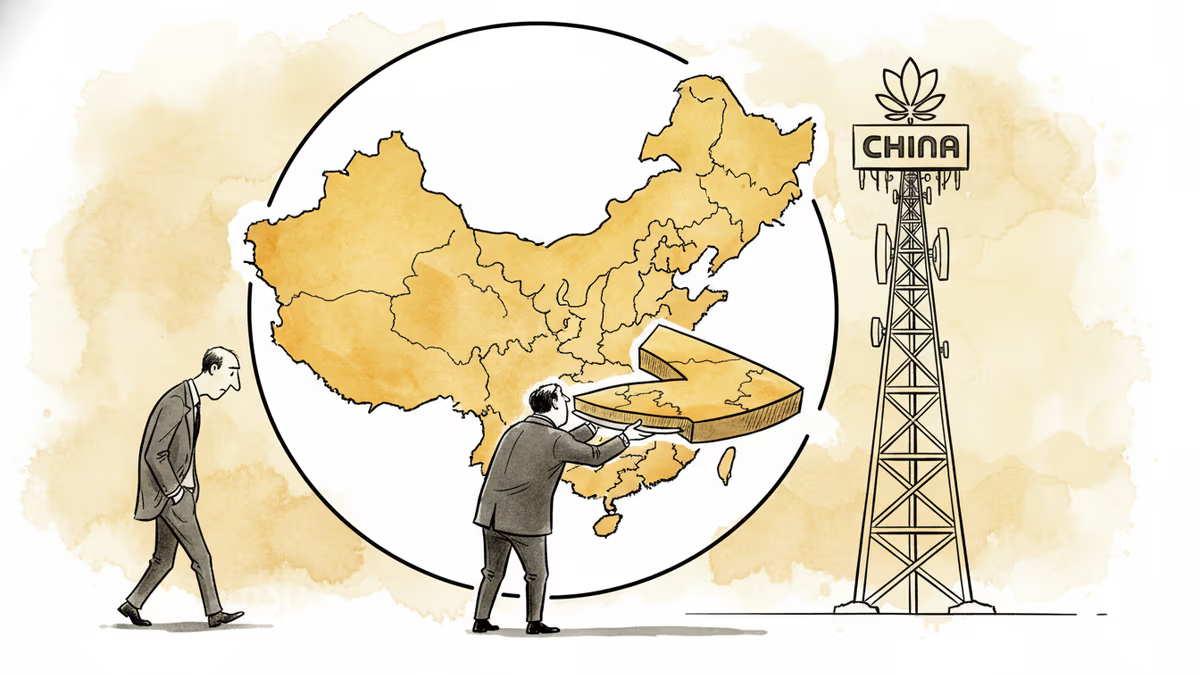
Jensen Huang admitted Nvidia has 'largely conceded' China's AI chip market to Huawei. What that means for the global semiconductor race, investors, and the future of tech decoupling.

Court documents from Musk v. Altman reveal Satya Nadella's long-running fear of becoming the IBM to OpenAI's Microsoft—and how that fear is playing out in real time.
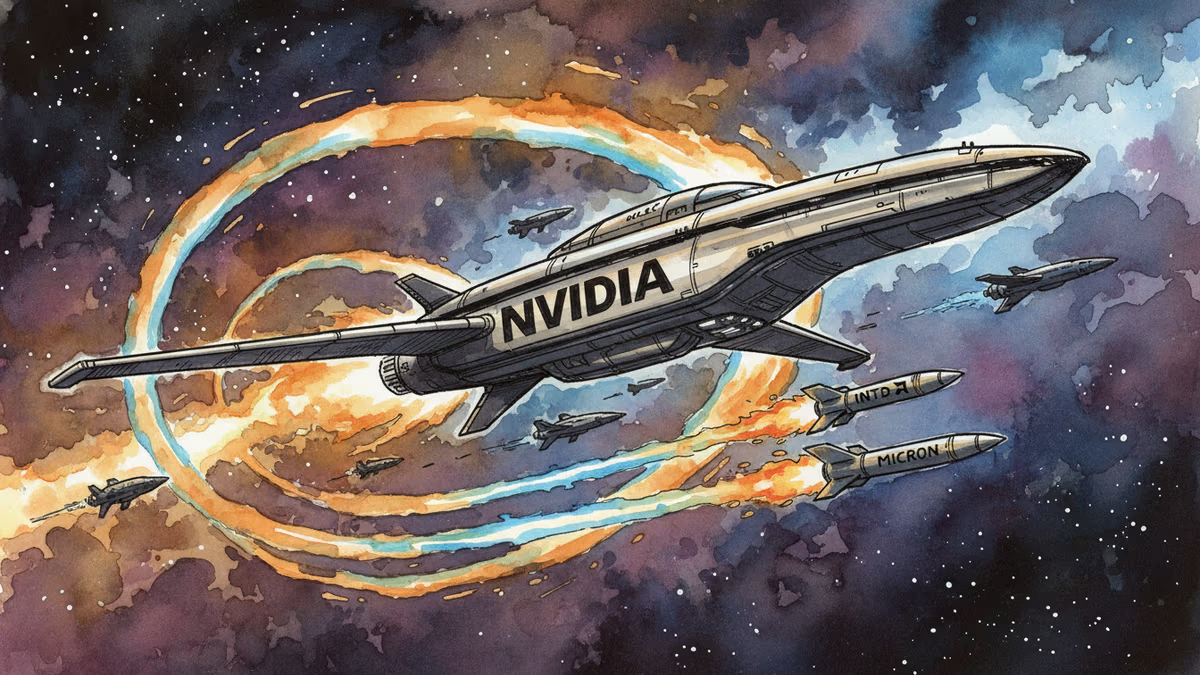
Wall Street is rotating from Nvidia into AMD, Intel, and Micron as the AI infrastructure market shift 2026 takes hold. Discover why CPUs and memory are the new gold.
Nvidia posted 85% revenue growth and a $80B buyback. Its stock still dropped — for the fourth straight post-earnings quarter. Here's what that tells us about where AI investing stands right now.
Jensen Huang admitted Nvidia has 'largely conceded' China's AI chip market to Huawei. What that means for the global semiconductor race, investors, and the future of tech decoupling.
Court documents from Musk v. Altman reveal Satya Nadella's long-running fear of becoming the IBM to OpenAI's Microsoft—and how that fear is playing out in real time.
Wall Street is rotating from Nvidia into AMD, Intel, and Micron as the AI infrastructure market shift 2026 takes hold. Discover why CPUs and memory are the new gold.
Thoughts
Share your thoughts on this article
Sign in to join the conversation