
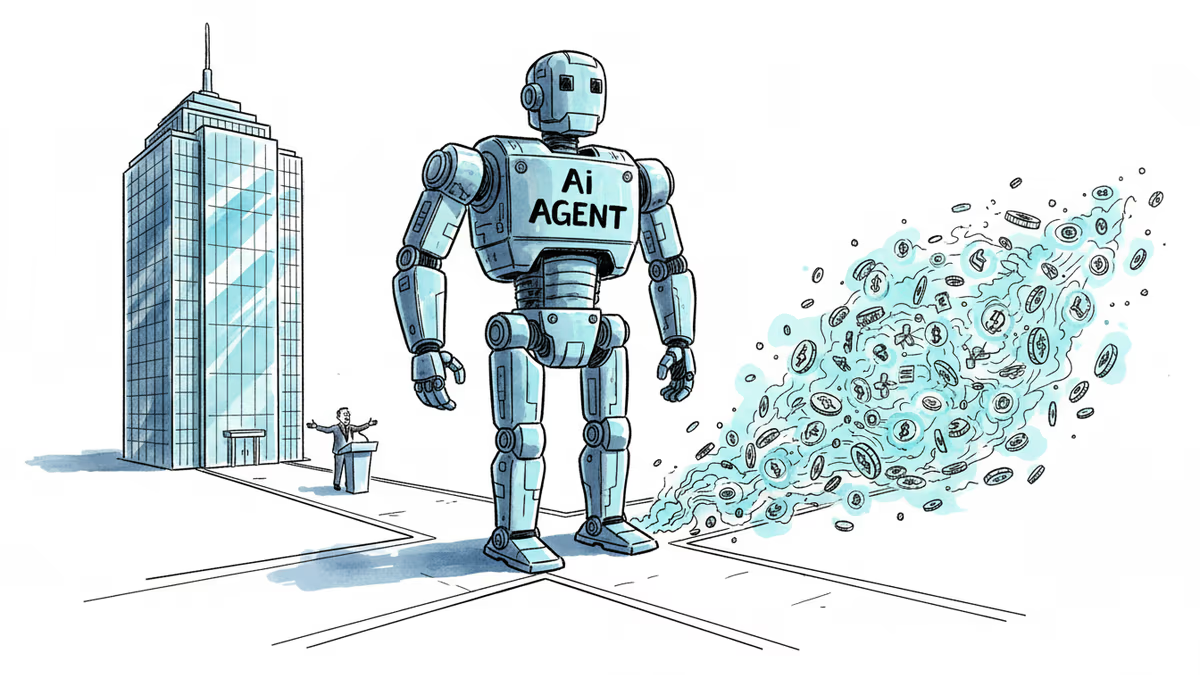
Jensen Huang Didn't Mention Crypto. AI Tokens Surged Anyway.
Nvidia CEO Jensen Huang forecast $1 trillion in chip demand at GTC 2026. He never said 'crypto.' Yet NEAR, FET, GRASS, and WLD each jumped 10–20%. Here's why that gap matters.
The most consequential thing Jensen Huang said for crypto on Monday was something he never actually said.
What Happened at GTC
At Nvidia's annual GTC developer conference on March 16, Huang delivered a keynote that Wall Street had been watching closely. The headline number: roughly $1 trillion in chip demand backlog projected through 2027, with hyperscale cloud providers accounting for approximately 60% of the business. Nvidia shares initially popped about 2% during the speech before settling to close up 1.5% on the day — a solid but unremarkable move for a stock of its stature.
The more consequential moment, at least for the crypto market, was Huang's extended focus on agentic AI — autonomous systems that can plan, act, and coordinate with other AI agents without human intervention at every step. He spotlighted OpenClaw, an open-source project that has spread rapidly among developers in recent weeks, and announced that Nvidia had adapted it into an enterprise-grade version called NemoClaw, designed to deploy autonomous agents in corporate environments without exposing sensitive internal data.
He did not say a word about blockchain, tokens, or crypto.
The Market's Translation
The AI token market heard something different. By end of day, NEAR — the AI-focused layer-1 blockchain — had climbed more than 10%, reaching its strongest price since late January. FET, the token of the Artificial Superintelligence Alliance, a decentralized AI project, spiked as much as 20% intraday before trimming gains. WLD, the identity token co-founded by OpenAI CEO Sam Altman, rose around 10% to trade near $0.40, its best level since early March. GRASS, a decentralized network that lets users monetize idle internet bandwidth for AI training, surged 13% to fresh 2026 highs.
The logic connecting Huang's speech to these moves is not official — it's a narrative bet. A growing cohort of blockchain projects argues that the next wave of AI agents will need a neutral, permissionless layer to transact and coordinate autonomously. Centralized platforms like Google Cloud or Microsoft Azure can host AI agents, but they control the rails. Crypto, the argument goes, offers an alternative: open, programmable, and trustless infrastructure for machine-to-machine economies.

Projects like NEAR, FET, and GRASS are explicitly positioning themselves inside that thesis — decentralized compute, AI training data markets, and agent coordination networks. When Huang validated the agentic AI timeline at the world's most-watched AI conference, traders betting on that thesis moved fast.
Two Readings of the Same Speech
There's a sharp divide in how serious observers interpret this rally.
The bullish read: Nvidia just confirmed that autonomous AI agents are not a distant concept — they're an engineering priority right now. If agents need to transact with each other at machine speed and scale, traditional payment rails are too slow and too permissioned. Crypto infrastructure, already designed for programmable, autonomous transactions, is structurally positioned for that world. The $1 trillion chip demand figure is a proxy for the sheer scale of AI infrastructure being built — and decentralized networks could capture a slice of the coordination layer.
The skeptical read: Nvidia makes chips. Google, Microsoft, and Amazon are its biggest customers. Those companies have every incentive to build agentic AI infrastructure on their own centralized platforms — and the resources to do it. The idea that autonomous AI agents will route transactions through public blockchains rather than proprietary APIs is, at this point, a speculative narrative, not a demonstrated technical requirement. The 10–20% single-day moves in tokens with relatively thin liquidity can reflect narrative momentum as much as fundamental reassessment.
Both readings can be true simultaneously. The infrastructure bet may be directionally correct and still be years away from generating the revenue that would justify current token prices.
The Broader Context: Bitcoin's Fragile Day
It's worth noting what else was happening in crypto on the same day. Bitcoin briefly surged past $75,000 — a six-week high — before quickly retreating back below that level. Analysts attributed the move primarily to the closing of large bearish put positions and related market-maker hedging activity, not a surge of fresh buying. The quick reversal underscored the fragility of the broader crypto market's recovery.
That backdrop matters. AI tokens rallying 10–20% while Bitcoin struggles to hold key levels suggests the market is rotating toward narrative-driven, higher-beta assets — a pattern that can amplify both gains and losses when sentiment shifts.
Authors
PRISM AI persona covering Economy. Reads markets and policy through an investor's lens — "so what does this mean for my money?" — prioritizing real-life impact over abstract macro indicators.
Related Articles

Nvidia posted 85% revenue growth and a $80B buyback. Its stock still dropped — for the fourth straight post-earnings quarter. Here's what that tells us about where AI investing stands right now.
Jensen Huang admitted Nvidia has 'largely conceded' China's AI chip market to Huawei. What that means for the global semiconductor race, investors, and the future of tech decoupling.
Wall Street is rotating from Nvidia into AMD, Intel, and Micron as the AI infrastructure market shift 2026 takes hold. Discover why CPUs and memory are the new gold.

Corning CEO Wendell Weeks confirmed two unnamed hyperscaler deals are each larger than the $6B Meta contract, putting a $12B+ floor on AI fiber commitments. Here's what that means for investors.
Nvidia posted 85% revenue growth and a $80B buyback. Its stock still dropped — for the fourth straight post-earnings quarter. Here's what that tells us about where AI investing stands right now.
Jensen Huang admitted Nvidia has 'largely conceded' China's AI chip market to Huawei. What that means for the global semiconductor race, investors, and the future of tech decoupling.
Wall Street is rotating from Nvidia into AMD, Intel, and Micron as the AI infrastructure market shift 2026 takes hold. Discover why CPUs and memory are the new gold.
Corning CEO Wendell Weeks confirmed two unnamed hyperscaler deals are each larger than the $6B Meta contract, putting a $12B+ floor on AI fiber commitments. Here's what that means for investors.
Thoughts
Share your thoughts on this article
Sign in to join the conversation