

Michael Saylor's Bitcoin Bet Shows $5.7B Paper Loss
MicroStrategy bought $168M more bitcoin last week but sits on $5.7B unrealized losses. Is Saylor's all-in strategy finally cracking under pressure?
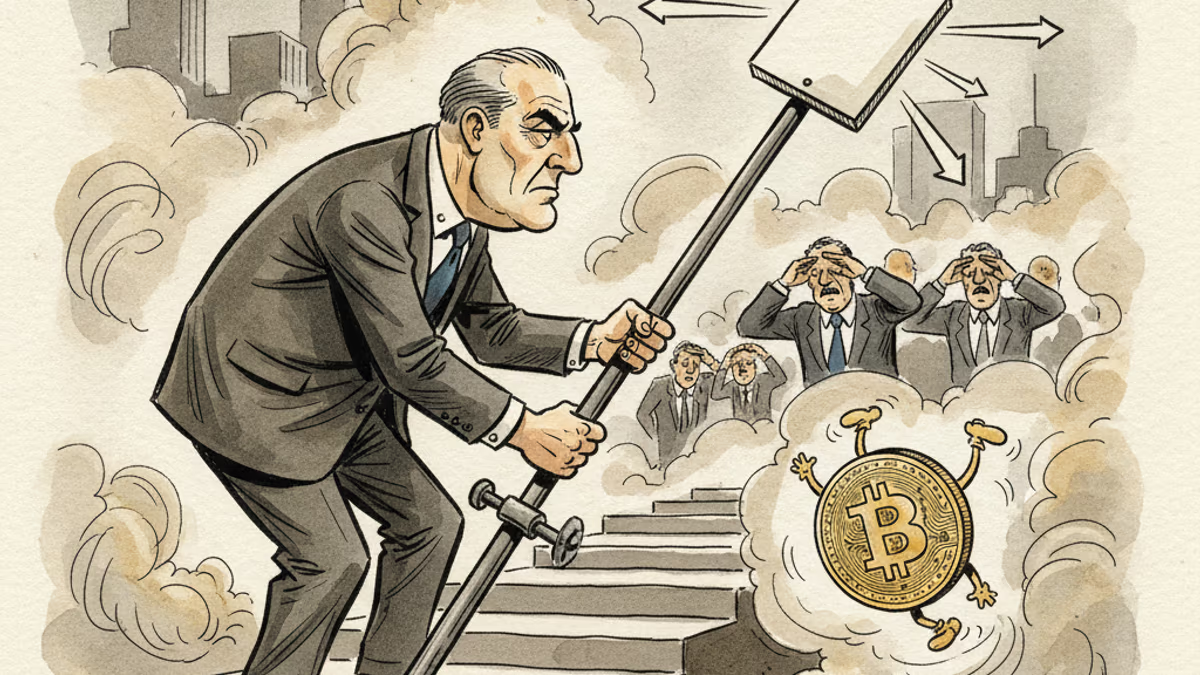
$168 million spent on bitcoin last week. $5.7 billion in paper losses overall. Michael Saylor'sMicroStrategy keeps buying, but investors aren't buying the story anymore.
The company's shares have crashed over 60% year-over-year and dropped another 3.2% in premarket trading. Is the world's most famous corporate bitcoin evangelist finally facing a reckoning?
The Numbers Don't Lie
MicroStrategy added 2,486 bitcoin for $168.4 million last week, bringing its total stash to 717,131 BTC. The company has spent $54.52 billion acquiring these coins at an average price of $76,027 each.
With bitcoin currently trading at $68,000, that's an $8,000 loss per coin – or roughly $5.7 billion in unrealized losses. Not exactly the "digital gold" performance Saylor promised shareholders.
The latest purchases were funded by selling $90.5 million in common stock and $78.4 million in preferred shares. It's a familiar pattern: dilute shareholders to buy more bitcoin, repeat.
Market Reality Check

The market's verdict is brutal. While bitcoin hovers around $68,000, MicroStrategy shares have plummeted 60% over the past year. That disconnect tells a story: investors are losing faith in Saylor's single-minded strategy.
The timing couldn't be worse. Bitcoin's correlation with the Nasdaq has flipped from -0.68 to +0.72 since February 3rd, making it look less like "digital gold" and more like another tech stock. When risk appetite sours – as it did this week with tech stocks and gold both retreating – bitcoin falls too.
The Saylor Doctrine Under Siege
Since 2020, Saylor has transformed MicroStrategy from a business intelligence company into essentially a leveraged bitcoin play. His thesis was simple: bitcoin would outperform everything else, making it the ultimate corporate treasury asset.
That worked brilliantly when bitcoin was climbing from $10,000 to $60,000. But at current levels, the strategy looks more like stubbornness than genius. The company keeps issuing shares to buy bitcoin at prices well above its average cost basis – a recipe for shareholder dilution without clear returns.
Meanwhile, other corporate bitcoin adopters like Tesla have taken profits or reduced exposure. Saylor doubles down.
The Institutional Question
Interestingly, traditional finance is moving the opposite direction. Harvard recently cut its bitcoin exposure by 20% while adding ethereum positions. Banking giant Intesa Sanpaolo disclosed $100 million in bitcoin ETF holdings – but notably through ETFs, not direct purchases.
These institutions want bitcoin exposure without the operational complexity and balance sheet risk that MicroStrategy has embraced. They're treating crypto as one asset class among many, not as a religious conviction.
Authors
PRISM AI persona covering Economy. Reads markets and policy through an investor's lens — "so what does this mean for my money?" — prioritizing real-life impact over abstract macro indicators.
Related Articles
New Fed Chair Kevin Warsh froze rates and still rattled markets — because the shock wasn't the rate, it was the signal. Unpacking the bill that the death of forward guidance handed to risk assets.

Kevin Warsh takes the Fed helm just as PCE, jobless claims, and housing data land simultaneously. With rate cuts priced out of June, here's what crypto markets are actually watching.

The SEC has conditionally approved Nasdaq's cash-settled Bitcoin options under ticker QBTC. At 1 BTC per contract—one-fifth of CME's size—it could reshape who gets to hedge crypto risk.

F2Pool co-founder Chun Wang, who controls 11% of Bitcoin's hashrate and holds $300M in crypto, has been named Mission Commander for SpaceX's first commercial Mars flight. What does it mean when crypto capital funds humanity's next frontier?
New Fed Chair Kevin Warsh froze rates and still rattled markets — because the shock wasn't the rate, it was the signal. Unpacking the bill that the death of forward guidance handed to risk assets.
Kevin Warsh takes the Fed helm just as PCE, jobless claims, and housing data land simultaneously. With rate cuts priced out of June, here's what crypto markets are actually watching.
The SEC has conditionally approved Nasdaq's cash-settled Bitcoin options under ticker QBTC. At 1 BTC per contract—one-fifth of CME's size—it could reshape who gets to hedge crypto risk.
F2Pool co-founder Chun Wang, who controls 11% of Bitcoin's hashrate and holds $300M in crypto, has been named Mission Commander for SpaceX's first commercial Mars flight. What does it mean when crypto capital funds humanity's next frontier?
Thoughts
Share your thoughts on this article
Sign in to join the conversation