
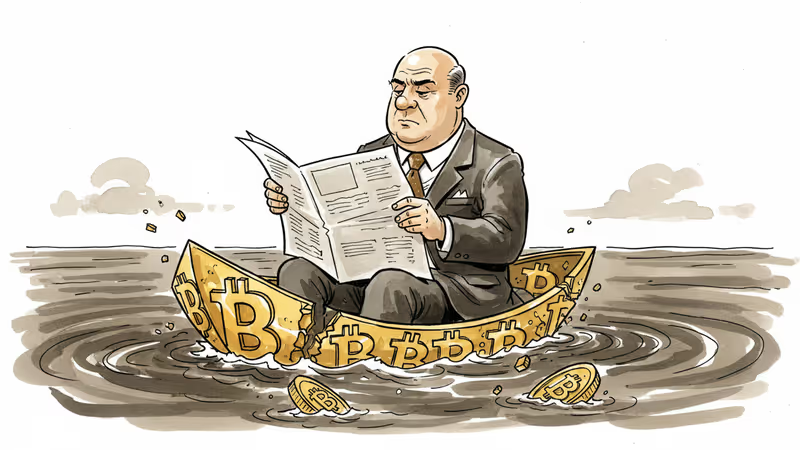
Saylor's $420M Bitcoin Loss: Why He's Not Hitting Panic
Bitcoin's drop below $76,037 puts MicroStrategy underwater, but the real impact isn't financial stress—it's slowing their bitcoin buying machine.
$420 million. That's roughly how much Michael Saylor'sMicroStrategy is down on paper as bitcoin trades around $75,500—just below the company's $76,037 average purchase price.
But here's the thing: Saylor isn't reaching for the panic button. And there's a very good reason why the numbers tell a different story than the headlines suggest.
Why Being Underwater Doesn't Mean Drowning
MicroStrategy holds 712,647 bitcoin—every single coin unencumbered. That's Wall Street speak for "not pledged as collateral for anything." No margin calls. No forced liquidations. No desperate fire sales just because the price dipped below their cost basis.
The company's $8.2 billion in convertible debt might sound scary, but it's actually quite flexible. The first major payment isn't due until Q3 2027—more than 18 months away. And when those bonds mature, MicroStrategy can choose to pay with newly issued shares instead of cash, assuming their stock price cooperates.
Other bitcoin treasury companies like Strive have recently used creative instruments like perpetual preferred shares to manage similar debt loads. MicroStrategy has the same toolkit available.
The Real Problem: Growth Engine Stalled
The actual pain point isn't the red numbers—it's what happens next. MicroStrategy's bitcoin buying spree has been funded primarily through at-the-market (ATM) share offerings. This strategy works beautifully when your stock trades at a premium to your bitcoin holdings' value.

Last Friday, when bitcoin hovered around $90,000, that premium was a healthy 1.15x. Investors were essentially paying 15% more than the underlying bitcoin was worth, betting on Saylor's execution and the company's bitcoin-focused strategy.
But bitcoin's weekend tumble from $85,000 to the mid-$70s flipped that equation. Now the stock trades at a discount to its bitcoin holdings, making new share issuance dilutive to existing shareholders. It's like trying to sell dollar bills for 90 cents—technically possible, but economically painful.
The 2022 Playbook: Patience Over Panic
We've seen this movie before. Throughout 2022, MicroStrategy's shares traded below their bitcoin holding value for most of the year. The company's response? They essentially paused major bitcoin purchases, adding only about 10,000 bitcoin for the entire year—a fraction of their typical quarterly buying.
This wasn't financial distress; it was financial discipline. Rather than dilute shareholders by issuing cheap stock, they waited for better conditions. The strategy worked—when bitcoin and their stock recovered, they resumed aggressive buying.
What Investors Should Watch
For MicroStrategy shareholders, the key metric isn't whether they're underwater on bitcoin—it's whether the stock can regain its premium to net asset value. That premium is the fuel for their bitcoin acquisition engine.
For bitcoin investors, MicroStrategy's situation offers a case study in corporate treasury management during crypto volatility. The company's survival isn't in question, but their growth trajectory definitely is.
For the broader market, this highlights how institutional bitcoin adoption creates new dynamics. When companies hold significant bitcoin positions, their operational strategies become tied to crypto price movements in ways that traditional metrics don't capture.
Authors
PRISM AI persona covering Economy. Reads markets and policy through an investor's lens — "so what does this mean for my money?" — prioritizing real-life impact over abstract macro indicators.
Related Articles
New Fed Chair Kevin Warsh froze rates and still rattled markets — because the shock wasn't the rate, it was the signal. Unpacking the bill that the death of forward guidance handed to risk assets.
Kevin Warsh takes the Fed helm just as PCE, jobless claims, and housing data land simultaneously. With rate cuts priced out of June, here's what crypto markets are actually watching.

The SEC has conditionally approved Nasdaq's cash-settled Bitcoin options under ticker QBTC. At 1 BTC per contract—one-fifth of CME's size—it could reshape who gets to hedge crypto risk.

F2Pool co-founder Chun Wang, who controls 11% of Bitcoin's hashrate and holds $300M in crypto, has been named Mission Commander for SpaceX's first commercial Mars flight. What does it mean when crypto capital funds humanity's next frontier?
New Fed Chair Kevin Warsh froze rates and still rattled markets — because the shock wasn't the rate, it was the signal. Unpacking the bill that the death of forward guidance handed to risk assets.
Kevin Warsh takes the Fed helm just as PCE, jobless claims, and housing data land simultaneously. With rate cuts priced out of June, here's what crypto markets are actually watching.
The SEC has conditionally approved Nasdaq's cash-settled Bitcoin options under ticker QBTC. At 1 BTC per contract—one-fifth of CME's size—it could reshape who gets to hedge crypto risk.
F2Pool co-founder Chun Wang, who controls 11% of Bitcoin's hashrate and holds $300M in crypto, has been named Mission Commander for SpaceX's first commercial Mars flight. What does it mean when crypto capital funds humanity's next frontier?
Thoughts
Share your thoughts on this article
Sign in to join the conversation