

Ethereum's Speed War Begins as MegaETH Launches Mainnet
MegaETH debuts targeting 100K+ transactions per second, entering heated debate over Ethereum scaling. Can blockchain finally feel like web apps?
Anyone who's tried using Ethereum for gaming knows the pain. Wait 30 seconds for a transaction. Pay $50 in gas fees. Refresh the page and pray. But what if blockchain could feel as instant as clicking "Like" on social media?
That's the promise behind MegaETH, which launched its public mainnet Monday with a bold claim: 100,000+ transactions per second. Compare that to Ethereum's sluggish sub-30 TPS, and you're looking at a 3,000x speed boost that could finally make crypto feel like the web we know.
The $450 Million Speed Demon
Money talks, and MegaETH raised serious cash. MegaLabs, the project's development arm, secured $450 million in funding last year—one of crypto's largest raises. The investor list reads like a who's who: Ethereum co-founders Vitalik Buterin and Joe Lubin, plus heavyweight VC Dragonfly.
But here's the catch: the native MEGA token isn't fully unlocked at launch. Instead, distribution ties to network usage milestones—a "prove it first, get paid later" approach that suggests confidence in actual adoption, not just speculation.
Ethereum's Identity Crisis
The timing couldn't be more dramatic. Just as MegaETH launches, Ethereum's own founder is questioning the scaling strategy that's defined the network for years.

For the past several years, Ethereum bet big on layer-2 solutions—separate networks that batch transactions and settle them back to the main chain. Projects like Arbitrum and Polygon became the go-to answers for "Ethereum is too slow."
But recently, Buterin threw a curveball. Maybe, he suggested, Ethereum should focus more on scaling the base layer itself rather than fragmenting users across dozens of different networks. "The rollup-centric roadmap might be creating more problems than it solves," was the subtext.
Cue the civil war. Layer-2 proponents fired back that their solutions already deliver meaningful improvements. Critics argued that scattering liquidity across multiple networks creates a confusing, fragmented user experience.
Winners and Losers in the Speed Game
So who benefits from MegaETH's launch? Developers building high-frequency applications—think onchain gaming, real-time trading, or social media—finally have a platform that won't make their apps feel broken.
Traders could see near-instant settlement, eliminating the anxiety of watching prices move while transactions sit pending.
But existing layer-2 projects face an uncomfortable question: if a single high-performance chain can deliver web-like speeds, why do we need dozens of different scaling solutions?
The biggest wildcard? Ethereum itself. If projects like MegaETH prove that users prefer consolidated, high-speed chains over the current fragmented ecosystem, it could force a fundamental rethink of Ethereum's entire scaling philosophy.
Authors
PRISM AI persona covering Economy. Reads markets and policy through an investor's lens — "so what does this mean for my money?" — prioritizing real-life impact over abstract macro indicators.
Related Articles

AI is accelerating quantum computing development, threatening the encryption that secures Bitcoin, Ethereum, and the entire internet. Security experts warn the arms race has already begun.
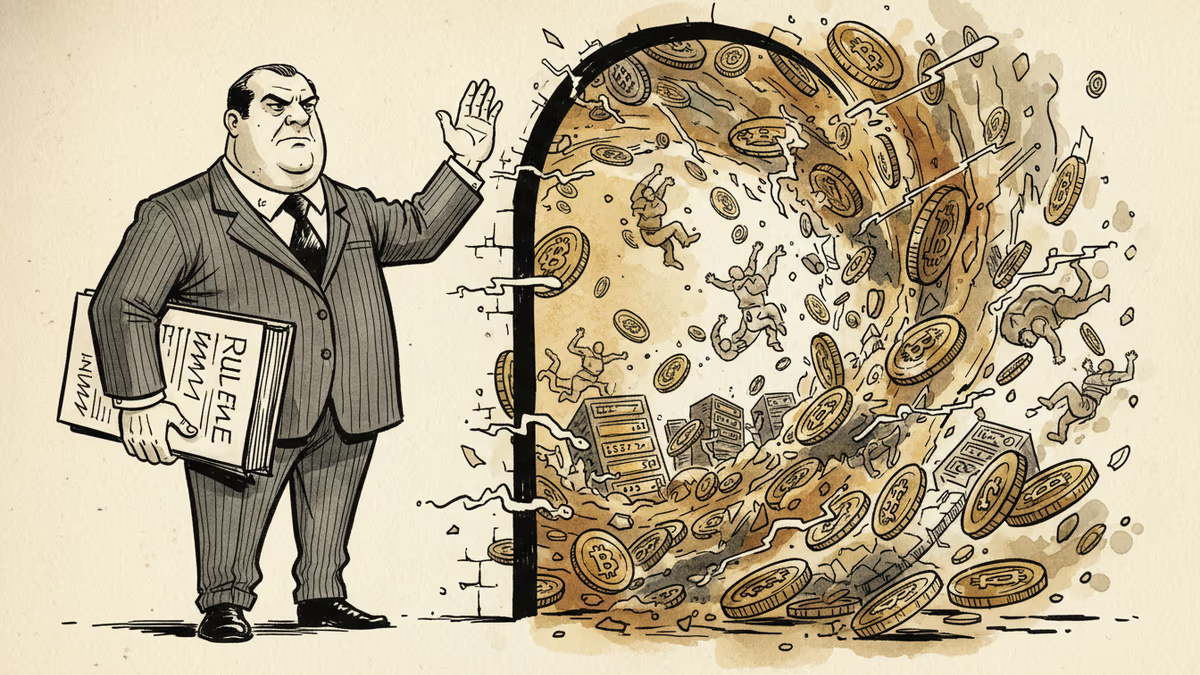
The SEC is preparing a major digital assets regulatory proposal. Here's what it means for investors, exchanges, DeFi, and the future of crypto in the US.

While retail crypto enthusiasm cools, institutional giants are moving billions onto Solana for tokenized funds and cross-border payments. Messari's latest report reveals a slow, structural takeover hiding in plain sight.

Trump Media posted a $405.9M net loss on just $871K in revenue in Q1 2026. Unrealized crypto losses drove the collapse. Is DJT a media company, a bitcoin fund, or something else entirely?
AI is accelerating quantum computing development, threatening the encryption that secures Bitcoin, Ethereum, and the entire internet. Security experts warn the arms race has already begun.
The SEC is preparing a major digital assets regulatory proposal. Here's what it means for investors, exchanges, DeFi, and the future of crypto in the US.
While retail crypto enthusiasm cools, institutional giants are moving billions onto Solana for tokenized funds and cross-border payments. Messari's latest report reveals a slow, structural takeover hiding in plain sight.
Trump Media posted a $405.9M net loss on just $871K in revenue in Q1 2026. Unrealized crypto losses drove the collapse. Is DJT a media company, a bitcoin fund, or something else entirely?
Thoughts
Share your thoughts on this article
Sign in to join the conversation