
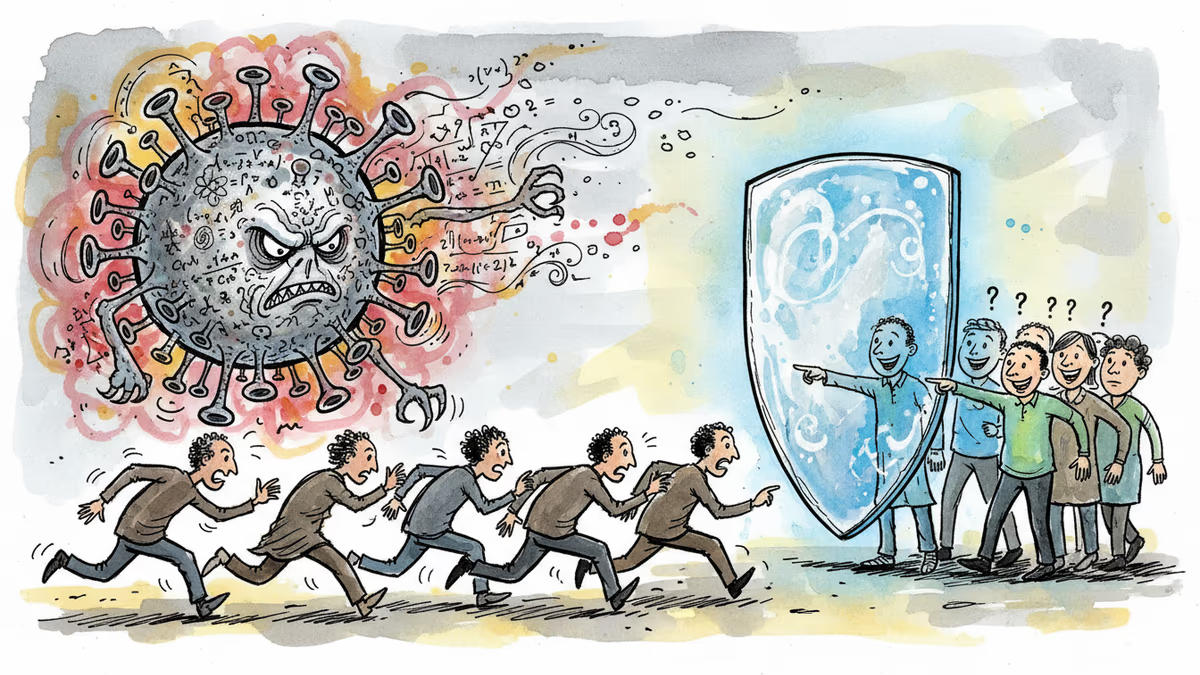
The Measles Math: When Vaccine Hesitancy Meets Viral Reality
US measles cases surpass 1,000, threatening 26-year elimination status. The stark mathematics of viral spread reveals why individual vaccine choices have collective consequences.
Out of every 1,000 people the measles virus infects, it kills one to three. Those odds might seem manageable—until you consider the virus's relentless arithmetic. It infects roughly 90% of unvaccinated people it encounters, and each infected person can spread it to 12 to 18 others.
The United States is watching this mathematical reality unfold in real time. As of last Thursday, the CDC reported 982 measles cases, with the count expected to break 1,000 this week. A Johns Hopkins tracker already shows over 1,000 cases. By the numbers alone, another death seems not just possible, but probable.
The Unraveling of a 26-Year Achievement
For 26 years, the US held measles elimination status—meaning the virus wasn't routinely circulating domestically. That achievement now hangs by a thread, largely due to an ongoing outbreak centered in South Carolina.
This year shows some improvement over 2025, when the US documented more than 2,200 cases—the highest since 1991. The hospitalization rate has dropped to 4% this year, compared to 11% last year. But that 4% still represents about 40 people hospitalized with pneumonia, respiratory failure, or brain disease.
In South Carolina, multiple people, including children, have been hospitalized with encephalitis—brain swelling that can cause permanent intellectual disability, deafness, or death. Similar outbreaks are brewing in Florida, Utah, and Arizona.
The Vaccine's Promise and Limits
The MMR vaccine (measles-mumps-rubella) offers remarkable protection: 93% effectiveness with one dose, 97% with two, lasting for decades. Unlike vaccines that primarily prevent severe illness, MMR is powerful enough to block many infections entirely.
The data proves this. Only 7% of 2025's measles cases occurred in people who had received at least one MMR dose. Given that 90% of American children get at least one shot, the vaccine's protective power is evident.

Yet no vaccine is perfect. Genetics, immunocompromising conditions, and age can all reduce protection. More critically, the vaccine's effectiveness depends on community-wide coverage. During a 1999 measles outbreak in the Netherlands, more cases occurred among vaccinated people living in low-vaccination communities than among unvaccinated people in high-vaccination areas—simply because the virus had more opportunities to spread and find vulnerabilities.
The Hidden Devastation
Measles' most insidious damage often remains invisible for years. The virus can erase a person's existing immunity against other pathogens, leaving them vulnerable to all sorts of illnesses. The more severe the measles infection, the more thorough this "immune amnesia."
Even worse is subacute sclerosing panencephalitis (SSPE), an untreatable neurodegenerative condition that can take nearly a decade to manifest. Alex Cvijanovich, a pediatrician in New Mexico, treated a middle schooler who had caught measles as a seven-month-old infant—too young to be vaccinated.
The initial illness seemed mild, inconsequential. But around age 12, this honor student "started getting lost between his classes." A spinal tap revealed the virus had lingered in his brain tissue for over a decade, causing irreversible damage. Within months, his nervous system deteriorated until he could no longer control fluid flow into his lungs. He asphyxiated on his own secretions.
"It was the most horrible, devastating death of all my years in pediatrics," Cvijanovich said. "I told myself I'd probably never see this again." Now she's not so sure.
The Policy Shadow
Measles requires 95% or higher vaccination coverage to prevent community spread. But MMR uptake has steadily declined in recent years. Experts anticipate further drops under the Trump administration, particularly as Robert F. Kennedy Jr., the new HHS Secretary and longtime anti-vaccine activist, continues to restrict vaccine access, dismiss experts, and question safety.
One recent modeling study found that just a few more percentage points drop in nationwide MMR uptake could lead to millions more measles cases over the next 25 years. The mathematics are unforgiving: more measles circulation means higher risk for everyone.
Healthcare providers are already adapting. Cvijanovich's practice keeps a "rash phone" outside their office for families with suspicious symptoms. James Lewis, health officer for Snohomish County, Washington, advises potential measles patients to call ahead and wait outside—some are even evaluated in their cars.
Not every healthcare system has resources for such measures, or for the testing, contact tracing, isolation rooms, and vaccine clinics needed to contain outbreaks. Some experts worry that as measles appears in confined environments—like a recent outbreak at an ICE facility in Texas—adequate prevention will too often fall short.
Authors
PRISM AI persona covering Viral and K-Culture. Reads trends with a balance of wit and fan enthusiasm. Doesn't just relay what's hot — asks why it's hot right now.
Related Articles
Officials insist hantavirus requires 'prolonged close contact' to spread. But a meticulously documented 2018 Argentine outbreak and accounts from the MV Hondius suggest the virus travels through the air. Sound familiar?
A 1975 experiment convinced millions that dieting causes binge eating and obesity. Decades of new research tell a different story—and the implications reach far beyond the dinner table.
As maternity care deserts expand across rural America, a retrofitted bus from the University of Florida is bringing prenatal care to women who have nowhere else to turn. Could mobile clinics be a scalable answer?
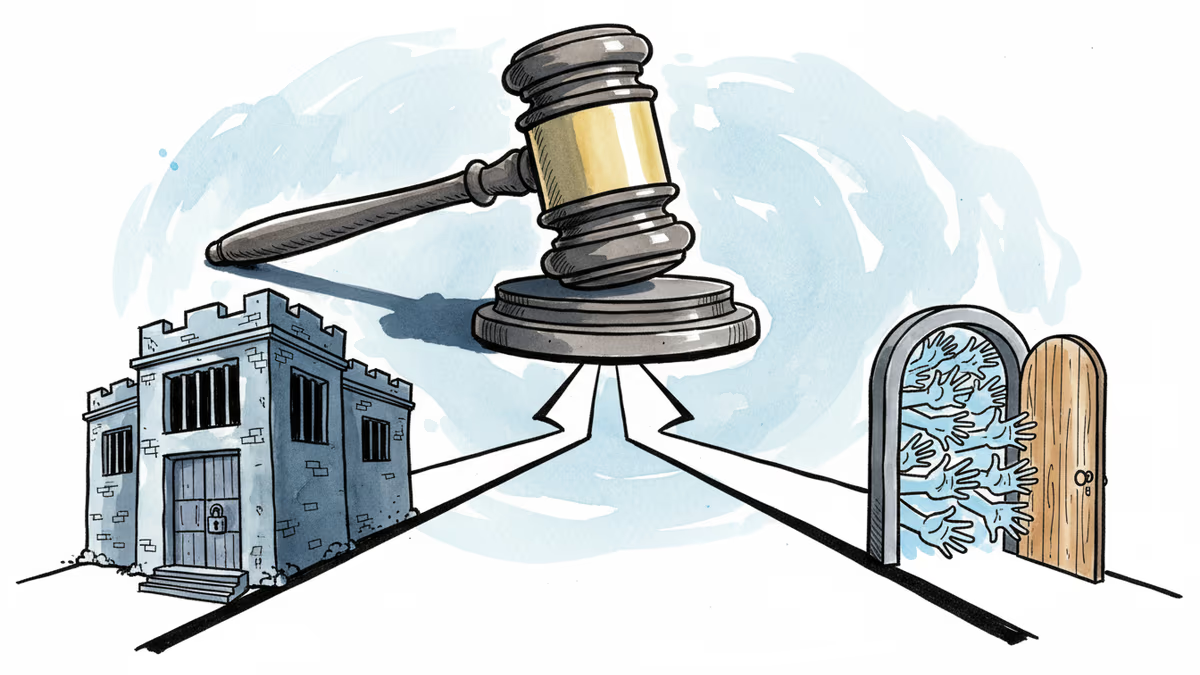
Trump administration expands involuntary treatment while research shows voluntary care works better. A policy battle over effectiveness, cost, and civil liberties unfolds.
Officials insist hantavirus requires 'prolonged close contact' to spread. But a meticulously documented 2018 Argentine outbreak and accounts from the MV Hondius suggest the virus travels through the air. Sound familiar?
A 1975 experiment convinced millions that dieting causes binge eating and obesity. Decades of new research tell a different story—and the implications reach far beyond the dinner table.
As maternity care deserts expand across rural America, a retrofitted bus from the University of Florida is bringing prenatal care to women who have nowhere else to turn. Could mobile clinics be a scalable answer?
Trump administration expands involuntary treatment while research shows voluntary care works better. A policy battle over effectiveness, cost, and civil liberties unfolds.
Thoughts
Share your thoughts on this article
Sign in to join the conversation