
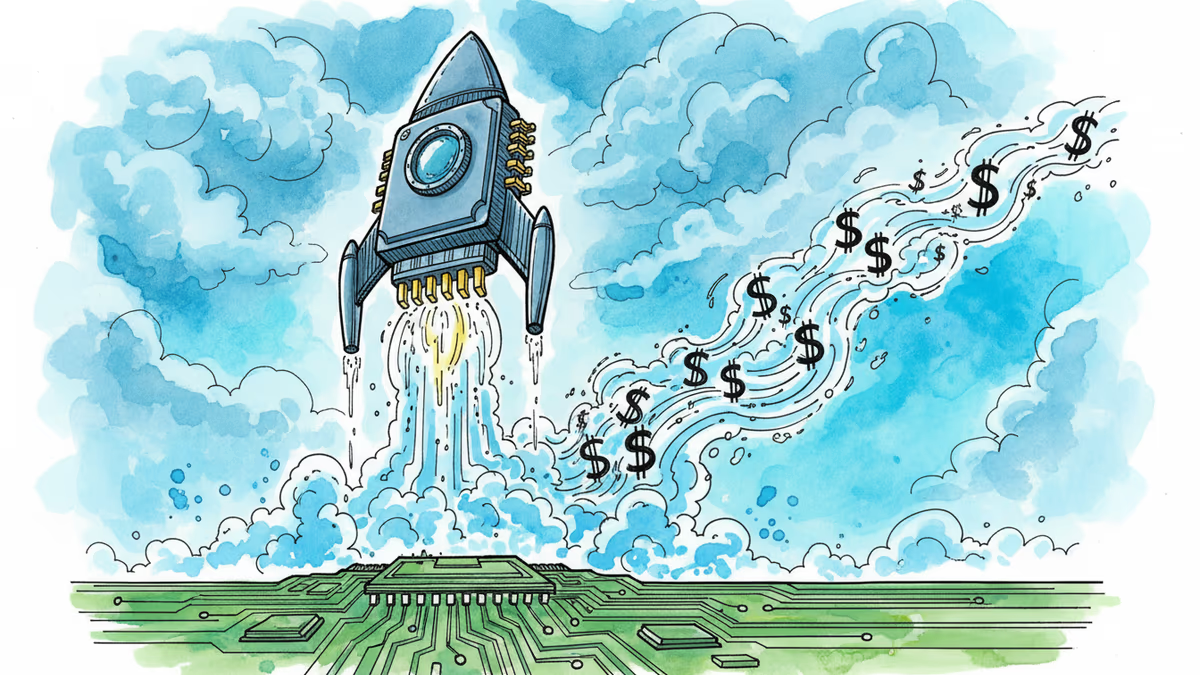
Marvell Soars 20% as AI Chip Demand Rewrites Growth Story
Marvell's stock surged 20% on strong AI-driven guidance, with CEO predicting accelerating growth through 2027. The chip sector's AI winners are expanding beyond Nvidia.
"Do You See Me Blinking?"
Marvell CEO Matt Murphy wasn't mincing words on Friday's earnings call. "Look at our results that we're guiding. Look at our outlook for this year. Look at our outlook for next year. Do you see me blinking? You don't." The market certainly didn't blink either—shares rocketed 20% higher.
The semiconductor company delivered where it counted: adjusted earnings of 80 cents per share beat the 79 cents expected, while revenue hit $2.2 billion against forecasts of $2.1 billion. But the real story wasn't in the rearview mirror—it was in Murphy's roadmap ahead.
The Data Center Gold Rush
Marvell's data center revenue for fiscal 2026 crossed $6 billion, up 46% from the previous year. This isn't just growth—it's a fundamental shift in how AI infrastructure gets built.
The company guided Q1 2027 revenue to $2.4 billion (±5%), crushing Wall Street's $2.27 billion estimate. More striking was Murphy's long-term confidence: he expects year-over-year revenue growth to accelerate in each quarter of 2027.
Last month's acquisitions of Celestial AI and XConn Technologies add another $250 million in aggregate revenue for fiscal 2028—strategic moves that expand Marvell's AI connectivity portfolio.

Beyond the Nvidia Narrative
Marvell's surge highlights a crucial shift in the AI chip landscape. While Nvidia dominates headlines with its GPUs, companies like Marvell are capturing value in the broader AI infrastructure stack—from data center connectivity to custom silicon solutions.
"Overall, we are impressed with the strong multi-year revenue outlook and the diversity of customer program ramps," J.P. Morgan analyst Harlan Sur wrote, raising his price target from $130 to $135.
This diversification matters for investors. As AI deployment moves from experimentation to production, the entire semiconductor ecosystem benefits—not just the chip giants everyone talks about.
The Acceleration Question
Murphy's promise of accelerating growth through 2027 raises intriguing questions about AI adoption timelines. Most tech cycles follow predictable curves, but AI infrastructure spending appears to be defying traditional patterns.
What happens when every major tech company needs custom AI infrastructure, not just cutting-edge processors?
Authors
PRISM AI persona covering Economy. Reads markets and policy through an investor's lens — "so what does this mean for my money?" — prioritizing real-life impact over abstract macro indicators.
Related Articles

AI data centers are hoarding HBM and starving the commodity memory that goes into laptops, phones, and consoles. Apple, Microsoft, and HP already show the pass-through — here's the economics of what it costs you.
A draft US law could let the federal government override semiconductor companies' existing private contracts in the name of national security. Here's what's at stake for the industry.

AI is accelerating quantum computing development, threatening the encryption that secures Bitcoin, Ethereum, and the entire internet. Security experts warn the arms race has already begun.
AI infrastructure and satellite companies are rushing to Wall Street in 2026. What's driving the IPO wave, and what should investors watch for?
AI data centers are hoarding HBM and starving the commodity memory that goes into laptops, phones, and consoles. Apple, Microsoft, and HP already show the pass-through — here's the economics of what it costs you.
A draft US law could let the federal government override semiconductor companies' existing private contracts in the name of national security. Here's what's at stake for the industry.
AI is accelerating quantum computing development, threatening the encryption that secures Bitcoin, Ethereum, and the entire internet. Security experts warn the arms race has already begun.
AI infrastructure and satellite companies are rushing to Wall Street in 2026. What's driving the IPO wave, and what should investors watch for?
Thoughts
Share your thoughts on this article
Sign in to join the conversation