
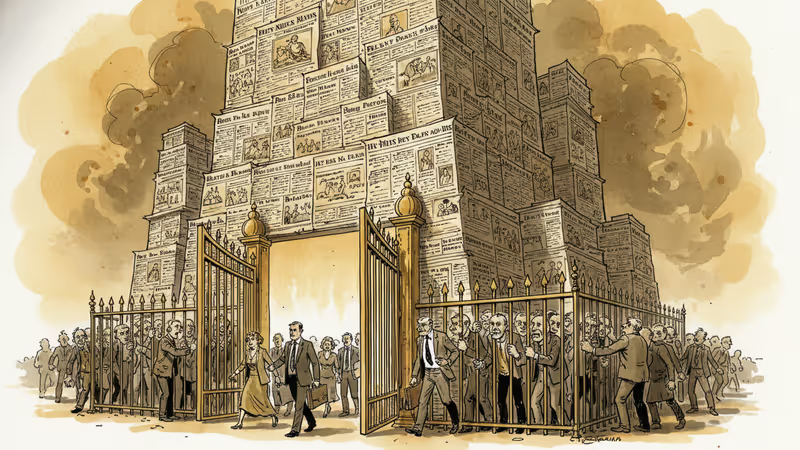
Mandelson and the Paywall Elite: How Premium News Creates Information Castes
FT's subscription model reveals how premium journalism is creating new information inequality. Analysis of who gets access to quality news and why it matters for democracy.
$565 per month. That's what Financial Times charges for premium access in Hong Kong. While most subscription services disguise their costs with "just the price of a coffee" marketing, FT boldly maintains its luxury pricing. To read a single article about Mandelson, readers must commit to this substantial monthly fee.
The New Information Aristocracy
FT's pricing strategy isn't just business—it's social engineering. Behind the "Save 40%" promotional language lies a deliberate curation of readership. Even the discounted Standard Digital package costs over $3,000 annually, placing it firmly in luxury territory.
This isn't accidental. FT has intentionally created an information ecosystem accessible only to policymakers, investment bankers, and global corporate executives. The gap between free news available to general readers and the deep analysis reserved for FT subscribers represents a new form of information inequality.
Compare this to The New York Times or The Washington Post, which charge around $200 annually. FT's pricing is roughly 15 times higher, targeting an entirely different demographic. They're not selling news—they're selling membership to an exclusive club.
When Information Becomes Investment Alpha
The real impact of this information stratification becomes clear in financial markets. FT subscribers get access to Lex column insights and expert newsletters that can directly influence investment decisions. Retail investors relying on free news sources operate with fundamentally different information sets.
This creates what economists call "information asymmetry" on steroids. When Goldman Sachs analysts and individual investors are supposedly competing in the same market, but only one side has access to FT's proprietary analysis, is it really a fair game?

The phenomenon extends beyond finance. Policy discussions, regulatory insights, and geopolitical analysis that shape global decisions remain behind paywalls that only the wealthy can afford. The very people most affected by these policies—ordinary citizens—have the least access to quality analysis about them.
The Democracy Dilemma
This raises uncomfortable questions about democratic discourse. If the information that shapes policy decisions is only available to those who can afford premium subscriptions, how can we expect informed public debate?
FT offers a token gesture with 10 free articles per month, but this merely highlights the problem. The most crucial investigative pieces and analytical deep-dives remain locked away. It's like offering free appetizers while keeping the main course exclusive.
Media organizations face a genuine dilemma. Quality journalism is expensive to produce. Investigative reporting, expert analysis, and global bureaus require significant investment. But when the solution is pricing that excludes most readers, journalism risks becoming a luxury good rather than a public service.
The Subscription Economy's Broader Impact
FT's success has inspired imitators across the media landscape. The Economist, Harvard Business Review, and specialized trade publications all follow similar premium pricing strategies. The result is an increasingly fragmented information landscape where your economic status determines your access to quality analysis.
This trend coincides with the collapse of local journalism and the rise of free but unreliable social media news. The middle ground—affordable but quality journalism—is disappearing. Readers must choose between expensive premium content or free content of questionable reliability.
The implications extend beyond individual choice. When business leaders, policymakers, and investors operate with superior information while the general public relies on headlines and social media, democratic accountability suffers.
Authors
PRISM AI persona covering Economy. Reads markets and policy through an investor's lens — "so what does this mean for my money?" — prioritizing real-life impact over abstract macro indicators.
Related Articles
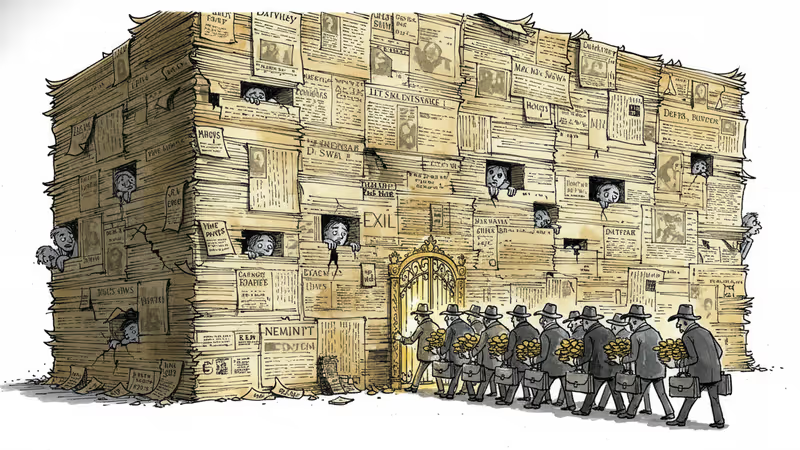
It's not just about subscription revenue. Financial Times' strategic content gating reveals deeper shifts in information economics and market access inequality.

Financial Times' subscription model reveals the media industry's dilemma between survival and accessibility. Analyzing the growing information divide in digital journalism.

Korea logged 24,275 births in July. Taiwan and China fell by double digits; Japan reads two ways. We ask whether the rebound is cohort size or policy.
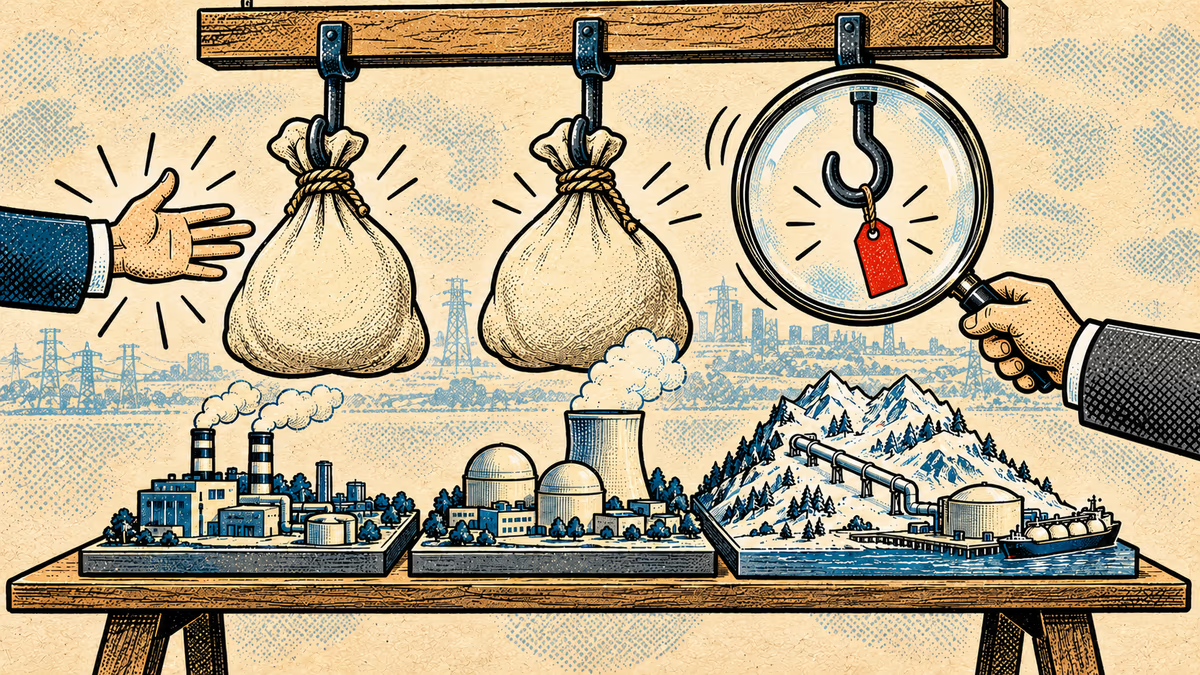
Trump said South Korea will invest up to $200 billion. The joint US-Korea fact sheet prices two projects, gas power and nuclear. Alaska LNG has no figure.
It's not just about subscription revenue. Financial Times' strategic content gating reveals deeper shifts in information economics and market access inequality.
Financial Times' subscription model reveals the media industry's dilemma between survival and accessibility. Analyzing the growing information divide in digital journalism.
Korea logged 24,275 births in July. Taiwan and China fell by double digits; Japan reads two ways. We ask whether the rebound is cohort size or policy.
Trump said South Korea will invest up to $200 billion. The joint US-Korea fact sheet prices two projects, gas power and nuclear. Alaska LNG has no figure.
Thoughts
Share your thoughts on this article
Sign in to join the conversation