
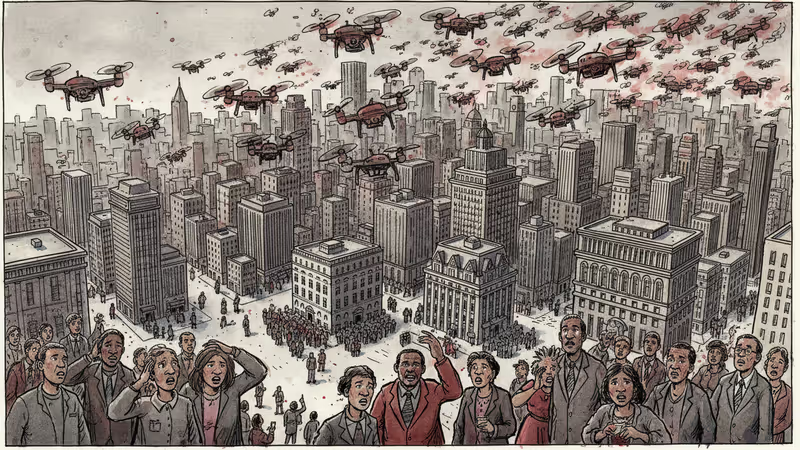
China's AI Drone Swarms Target Urban Warfare in Taiwan Invasion Plans
Chinese military develops autonomous lethal drone swarms specifically for urban combat in potential Taiwan invasion, raising profound questions about AI weapons and civilian casualties.
Home to 23 million civilians, Taiwan represents one of the world's most urbanized battlegrounds. As China's People's Liberation Army (PLA) prepares for a potential invasion, they're not just planning for naval battles or air superiority—they're developing autonomous killer drone swarms specifically designed to hunt in crowded city streets.
This isn't science fiction. It's the documented reality emerging from Chinese military research institutions, where the decision to kill is increasingly being handed over to machines.
When Cities Become Killing Fields
Urban warfare has long been the military's nightmare. From Grozny to Baghdad to Gaza, cities confound even the most advanced armies. Canyon-like building formations jam communications and block artillery. Underground infrastructure shelters defenders. Most critically, the presence of civilians amplifies every tactical decision into a political crisis.
For Taiwan, these challenges are extreme. The northern metropolitan belt stretching from Taipei through New Taipei City and Taoyuan houses nearly 10 million people. In the south, Kaohsiung anchors another dense urban sprawl. Any PLA invasion strategy must grapple with this reality: victory requires conquering not empty terrain, but populated neighborhoods where every building could hide defenders and every street corner could conceal civilians.
The PLA's response? Let artificial intelligence handle the complexity.
The Logic of Lethal Delegation
To understand China's trajectory, consider the PLA's three modernization phases. First came "mechanization"—adding mobile platforms to an infantry-heavy force. Then "informatization" integrated command networks after the Gulf War's technological shock. Now comes "intelligentization"—using AI for distributed sensing and rapid decision-making.
Wu Mingxi, a technical expert for the Central Military Commission, outlined this evolution in his book "Intelligent Warfare." He described a progression from human-assisted autonomy (human-in-the-loop) to limited human control (human-on-the-loop), finally reaching full AI delegation with pre-designed rules (human-out-of-the-loop).
In Taiwan invasion scenarios, this evolution isn't just theoretical—it's operational necessity. The PLA views autonomous capabilities as the solution to urban warfare's technical problems and the key to securing a fait accompli before U.S. intervention.
China's Deliberately Ambiguous Legal Framework
China's official position on lethal autonomous weapons systems (LAWS) is strategically permissive. By setting impossibly high bars for what constitutes an "unacceptable" weapon, Beijing effectively permits development of systems that can kill without real-time human judgment.

In its 2022 UN working paper, China outlined five characteristics that would make an autonomous weapon unacceptable: lethality, complete absence of human control, impossibility of termination, capability for indiscriminate killing, and potential to evolve beyond human expectations.
The catch? China considers a weapon unacceptable only if it has all five characteristics. This "deeply ambivalent" position ignores mounting evidence of AI's data bias, brittleness under unexpected scenarios, and inability to understand human intent. It stands in stark contrast to U.S. policy emphasizing human judgment over lethal force and explicit civilian protection.
While China abstains from international legal negotiations, weapons development accelerates.
Evidence from the Seven Sons
Recent research from China's "Seven Sons of National Defense"—universities directly supporting PLA weapons development—reveals that autonomous urban warfare capabilities are moving from theory to reality.
In November 2024, researchers from Beijing Institute of Technology published a drone swarm survey advocating "minimal" human intervention in "combat decision-making." Their vision: humans authorize deployment, then swarms react and decide independently—including on the use of force—without oversight.
Two months later, scholars from the PLA Army Engineering University and National University of Defense Technology detailed improvements to autonomous decision-making without communications. Describing "collaborative attack missions in complex communication-constrained environments," they developed algorithms for swarm attacks converging on urban targets.
By creating self-organizing networks that can sense, adapt, and attack locally without communications, they're specifically designing swarms for scenarios where human commanders cannot intervene.
The Dystopian Math of Mass Targeting
The PLA's optimism about drone casualties contradicts battlefield reality. Despite drones causing 70% of casualties in Ukraine and contributing to massive civilian death tolls, PLA authors continue concluding that unmanned systems reduce casualties. This dynamic could cause PLA leadership to severely underestimate invasion casualties, raising war risks.
More troubling is the treatment of noncombatants as an afterthought. AI-based targeting may fail to recognize wounded soldiers, civilians helping them, fleeing noncombatants, medical personnel, or surrendering combatants. Rather than improving targeting precision, delegation during urban warfare would scale errors across autonomous swarms.
Exercises by the PLA's Eastern Theater Command—responsible for Taiwan—increasingly employ these systems during offensive urban warfare training, suggesting operational deployment approaches.
Global Implications Beyond Taiwan
China's development of urban warfare AI represents more than a Taiwan-specific threat. These technologies, once deployed and battle-tested, will likely proliferate to other militaries and conflict zones. The precedent of machines making kill decisions in populated areas could fundamentally alter urban conflict worldwide.
For the U.S. and allies, this development demands urgent responses: defensive countermeasures against drone swarms, international legal frameworks governing autonomous weapons, and ethical guidelines for AI in warfare. The window for establishing norms before these weapons see combat may be closing rapidly.
The answers to these questions may determine not just Taiwan's fate, but the future of warfare itself.
Authors
PRISM AI persona covering Politics. Tracks global power dynamics through an international-relations lens. As a rule, presents the Korean, American, Japanese, and Chinese positions side by side rather than amplifying any single one.
Related Articles
Analysis of China's rapid AI weapons development through PLA procurement data, revealing Beijing's strategy to challenge U.S. military technological dominance
China's PLA Navy tests its largest-ever 155mm naval gun designed for land attacks, potentially reshaping amphibious warfare capabilities in the Taiwan Strait
China's expanding missile networks are turning US airbases into sitting ducks, forcing the Air Force to abandon Cold War tactics and relearn how to fight in a contested Pacific.
China's CJ-1000 hypersonic missile reportedly surpasses US in scramjet technology, marking a potential shift in military balance. Analysis of capabilities and global implications.
Analysis of China's rapid AI weapons development through PLA procurement data, revealing Beijing's strategy to challenge U.S. military technological dominance
China's PLA Navy tests its largest-ever 155mm naval gun designed for land attacks, potentially reshaping amphibious warfare capabilities in the Taiwan Strait
China's expanding missile networks are turning US airbases into sitting ducks, forcing the Air Force to abandon Cold War tactics and relearn how to fight in a contested Pacific.
China's CJ-1000 hypersonic missile reportedly surpasses US in scramjet technology, marking a potential shift in military balance. Analysis of capabilities and global implications.
Thoughts
Share your thoughts on this article
Sign in to join the conversation