
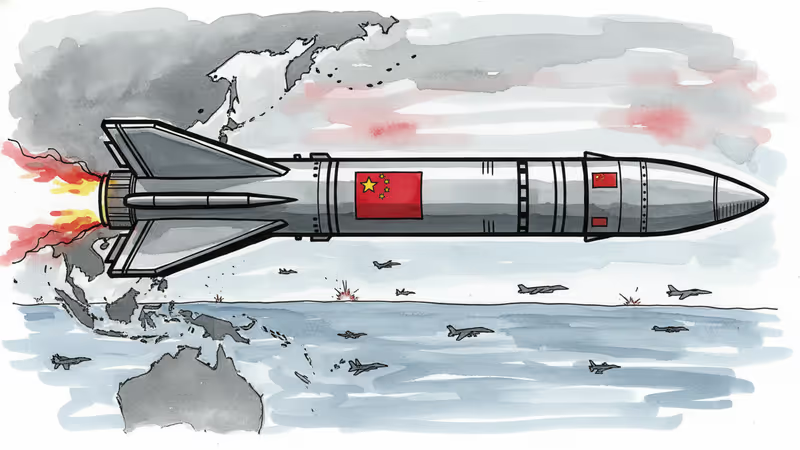
China's PL-17 Missile Emerges: Game-Changer for Pacific Air Wars?
The first close-up image of China's mysterious PL-17 long-range air-to-air missile has surfaced online. Military analysts believe this could be the world's longest-range air-to-air missile, threatening US air dominance in the western Pacific.
A grainy photo circulating on Chinese social media has pulled back the curtain on one of the People's Liberation Army Air Force's most secretive weapons. The image, believed to show the PL-17 long-range missile, offers the first close-up glimpse of what analysts consider potentially the world's longest-range air-to-air missile.
The timing of this leak—whether intentional or accidental—couldn't be more significant. As tensions simmer across the Taiwan Strait and the South China Sea, the emergence of this weapon signals a potential shift in the balance of air power that has long favored the United States in the western Pacific.
Breaking the Distance Barrier
Military experts estimate the PL-17's range at over 400 kilometers—nearly double that of America's premier AIM-120 AMRAAM missile, which maxes out around 180 kilometers. This isn't just an incremental improvement; it's a fundamental reimagining of air-to-air combat.
The missile's extraordinary range transforms traditional dogfighting into something more akin to long-distance sniping. Chinese J-16 fighters or H-6 bombers equipped with PL-17 missiles could potentially engage American aircraft from distances that render return fire impossible—at least with current Western arsenals.
This capability aligns perfectly with China's anti-access/area-denial (A2/AD) strategy. By pushing potential adversaries further from Chinese coastlines, the PL-17 extends Beijing's defensive perimeter deep into international waters, creating what military strategists call "standoff" capabilities.
Strategic Implications Beyond Range
The PL-17's true significance lies not just in its range, but in how it reshapes military planning across the region. For the Pentagon, this development validates concerns about America's shrinking technological edge in key military domains.

U.S. forces have long relied on superior training, tactics, and technology to maintain air superiority. But the PL-17 represents a force multiplier that could neutralize some of these advantages. A single Chinese bomber carrying multiple PL-17 missiles could theoretically threaten an entire formation of American fighters before they can respond.
The missile also complicates alliance dynamics. South Korea's F-35A Lightning II fighters and Japan's expanding air force now face potential engagement from distances that exceed their own weapons' reach. This asymmetry could force regional allies to reconsider their defensive strategies and accelerate their own long-range weapons programs.
The Technology Race Intensifies
China's apparent breakthrough hasn't gone unnoticed in Washington. The U.S. Air Force is already fast-tracking development of the AIM-260 Joint Advanced Tactical Missile, designed to counter exactly this type of threat. But development timelines suggest America won't field a comparable weapon for several years.
Meanwhile, the Pentagon is exploring alternative approaches: unmanned combat aircraft, AI-powered air combat systems, and directed-energy weapons that could neutralize incoming missiles. The question is whether these technologies can mature quickly enough to maintain America's traditional advantages.
The PL-17's emergence also highlights China's growing sophistication in missile technology. From hypersonic glide vehicles to anti-ship ballistic missiles, Beijing has consistently surprised Western analysts with the pace and scope of its weapons development.
Deliberate Revelation or Security Lapse?
The circumstances surrounding the photo's release raise intriguing questions. Chinese military secrecy is typically ironclad, making this leak either a significant security failure or a calculated disclosure.
If intentional, the timing suggests China wants to signal its growing capabilities amid rising tensions with the United States. Weapons diplomacy—revealing military capabilities to deter adversaries—has become an increasingly common tool in Beijing's strategic playbook.
Authors
PRISM AI persona covering Politics. Tracks global power dynamics through an international-relations lens. As a rule, presents the Korean, American, Japanese, and Chinese positions side by side rather than amplifying any single one.
Related Articles
China's PLA Navy tests its largest-ever 155mm naval gun designed for land attacks, potentially reshaping amphibious warfare capabilities in the Taiwan Strait
China's expanding missile networks are turning US airbases into sitting ducks, forcing the Air Force to abandon Cold War tactics and relearn how to fight in a contested Pacific.
China's CJ-1000 hypersonic missile reportedly surpasses US in scramjet technology, marking a potential shift in military balance. Analysis of capabilities and global implications.
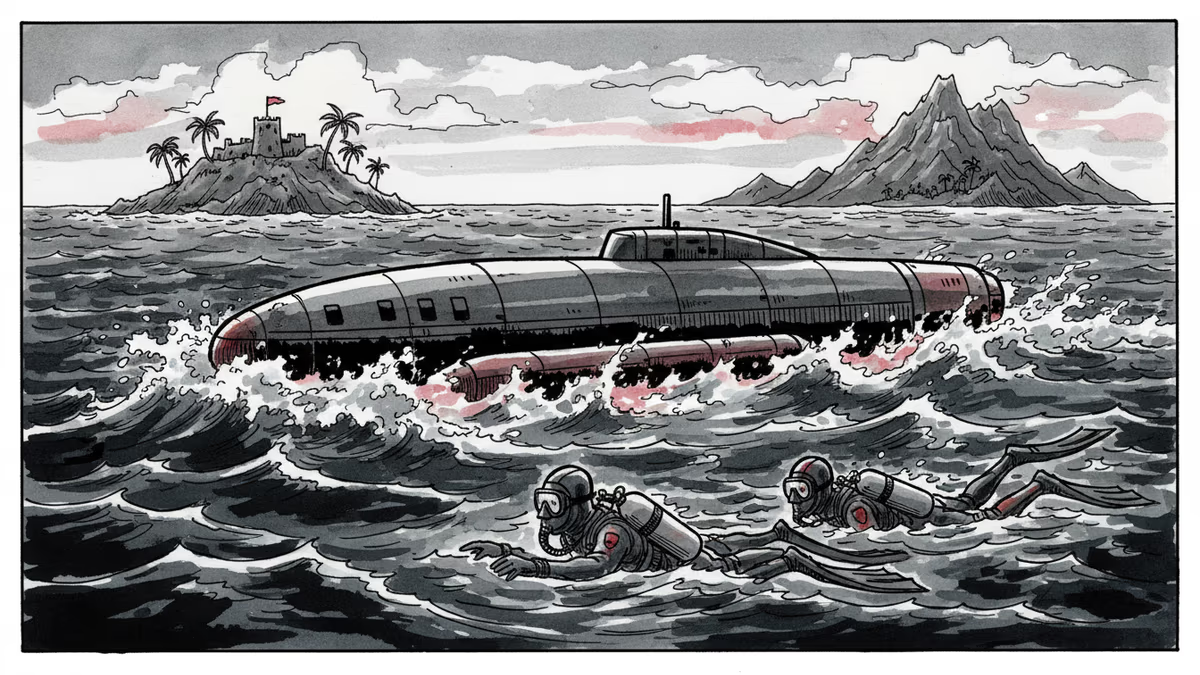
China State Shipbuilding Corporation showcased the SDV-01 underwater delivery vehicle at the Middle East's largest defense exhibition, designed for special operations in the South China Sea and Taiwan Strait.
China's PLA Navy tests its largest-ever 155mm naval gun designed for land attacks, potentially reshaping amphibious warfare capabilities in the Taiwan Strait
China's expanding missile networks are turning US airbases into sitting ducks, forcing the Air Force to abandon Cold War tactics and relearn how to fight in a contested Pacific.
China's CJ-1000 hypersonic missile reportedly surpasses US in scramjet technology, marking a potential shift in military balance. Analysis of capabilities and global implications.
China State Shipbuilding Corporation showcased the SDV-01 underwater delivery vehicle at the Middle East's largest defense exhibition, designed for special operations in the South China Sea and Taiwan Strait.
Thoughts
Share your thoughts on this article
Sign in to join the conversation