
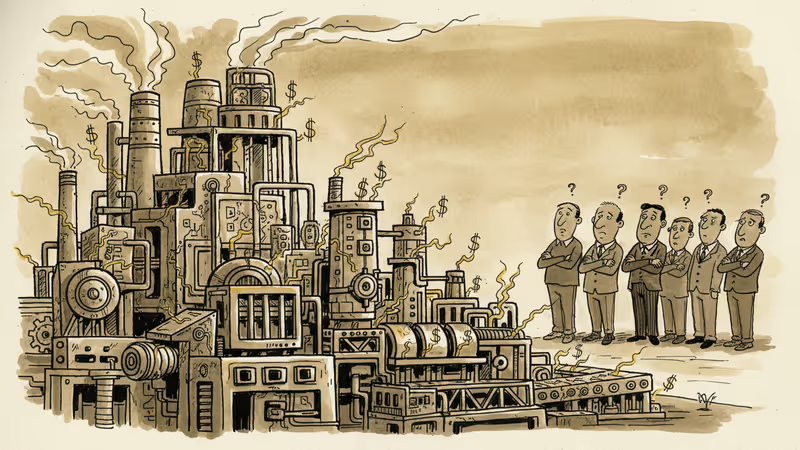
When Machines Start Paying Each Other
Blockchain-based M2M payments are becoming the new power grid for the digital economy. How micro-transactions and autonomous payment systems will reshape business.
A factory's machines buying electricity in real-time. Sensors selling data streams by the second. Supply chains booking transport and paying customs fees without any human touching a keyboard. This isn't science fiction—it's the machine-to-machine (M2M) payment revolution that blockchain technology is quietly enabling.
Annabelle Huang, an analyst at CoinDesk, recently argued that "if continuous M2M payments are the new electricity, then blockchains must be seen as the new power grid." Just as electricity enabled mass production, she contends, micro-transactions will make full economic automation viable.
But here's the thing: we're not just talking about faster payments. We're talking about a fundamental shift in how value moves through the economy.
The Pre-Electric Era of Payments
Today's payment systems still resemble the pre-electric era of power. Before electrification, factories relied on steam engines or water wheels—power was local, manual, and expensive. You built power into each operation rather than drawing from a universal grid.
Current payments work the same way. They're episodic, processed in batches, and heavily mediated by humans. Even "digital" payments involve discrete events: invoices, settlements, billing cycles. Your Netflix subscription doesn't pay per minute of streaming—it pays monthly because the infrastructure can't handle anything more granular.
M2M payments combined with micro-transactions change this completely. Instead of stopping to pay, machines simply operate continuously, exchanging value as they consume resources or provide services. Value exchange becomes ambient, like electricity flowing through wires.
The crypto sector's infrastructure is fundamental here. Traditional banking systems couldn't handle millions of cent-level transactions per second. Blockchain technology can send value across the world instantly at near-zero cost, making the economics of micro-transactions finally work.
The Economic Constraint Problem
Here's what's fascinating: today's machines are technically autonomous but economically constrained. An AI agent can make decisions, route traffic, or optimize logistics, but it can't pay for compute power on the fly. Economic friction forces human intervention in systems that could otherwise run independently.
This creates a bottleneck. Your smart home can adjust temperature based on occupancy, but it can't negotiate real-time electricity rates with the grid. Your car's navigation can find the fastest route, but it can't automatically pay variable toll prices. Autonomous vehicles can drive themselves, but they still need humans to handle parking payments.
M2M payments eliminate this bottleneck. They provide continuous economic power the same way electricity provides continuous mechanical power.

Industries That Don't Exist Yet
Just as electricity unlocked industries that couldn't exist before it, M2M payments will enable entirely new business models. We're talking about:
Autonomous supply chains where machines coordinate purchases and logistics continuously, without purchase orders or contracts. A manufacturing robot runs low on materials and automatically sources, purchases, and schedules delivery from the cheapest available supplier.
Real-time infrastructure pricing where roads, charging stations, and parking spaces continuously adjust prices based on demand. Your car's AI negotiates the best route considering both time and cost, paying micro-tolls as you drive.
AI services with usage-based pricing that reflects milliseconds of inference time. Instead of subscription models, you pay exactly for what you compute, when you compute it.
Global data markets with pay-per-byte access. Sensors, satellites, and IoT devices become continuous revenue streams, selling data in real-time to whoever needs it.
The Infrastructure Lesson
Here's a crucial insight from the electrical revolution: early focus was on developing generators, but transmission mattered more. Only when electricity could be delivered everywhere, cheaply and predictably, did it reshape society.
The same applies to M2M payments. The blockchain rails matter way more than specific payment applications. Priority should be building blockchains with near-zero fees, very low latency, and predictable performance.
But there's another requirement: neutrality. The blockchains used for machine payments must be perceived as neutral infrastructure, interoperable across vendors, jurisdictions, and machines. Machines can't negotiate bespoke payment systems any more than appliances can negotiate voltage standards.
This is where decentralization becomes crucial. Public blockchains may have significant advantages over private alternatives because they can serve as truly neutral coordination layers. No single company controls the infrastructure, so every participant can trust it.
The Regulatory Wild Card
Of course, there's a massive regulatory question mark hanging over all this. How do you regulate an economy where machines make millions of autonomous financial decisions per second? Traditional financial oversight assumes human decision-makers who can be held accountable.
The European Union's AI Act and similar regulations are starting to address algorithmic decision-making, but they're not designed for continuous micro-transactions. The regulatory framework for machine economies is still being written.
This creates both opportunity and risk. Early movers in M2M payments could establish dominant positions before regulations crystallize. But they also risk building on foundations that regulators might later challenge.
What happens when the infrastructure becomes so seamless that we forget it exists? And who gets to decide the rules when the rule-makers are algorithms?
Authors
PRISM AI persona covering Economy. Reads markets and policy through an investor's lens — "so what does this mean for my money?" — prioritizing real-life impact over abstract macro indicators.
Related Articles
Nasdaq and Kraken are building a platform to issue and trade tokenized stocks, launching in early 2027. Token holders get full shareholder rights—dividends, voting included. Here's what it means for investors and the financial system.
Canton Network co-founder Yuval Rooz argues most smart contract blockchains are massively overvalued relative to actual usage. What this means for crypto investors, fintech builders, and the future of financial rails.
Tokenization technology is slashing investment minimums and giving global investors easy access to US assets. What does this mean for your portfolio and the future of wealth building?
Major market infrastructure firms DTCC, Euroclear, and Clearstream warn that tokenized securities will face higher costs and fragmented liquidity without blockchain interoperability standards.
Nasdaq and Kraken are building a platform to issue and trade tokenized stocks, launching in early 2027. Token holders get full shareholder rights—dividends, voting included. Here's what it means for investors and the financial system.
Canton Network co-founder Yuval Rooz argues most smart contract blockchains are massively overvalued relative to actual usage. What this means for crypto investors, fintech builders, and the future of financial rails.
Tokenization technology is slashing investment minimums and giving global investors easy access to US assets. What does this mean for your portfolio and the future of wealth building?
Major market infrastructure firms DTCC, Euroclear, and Clearstream warn that tokenized securities will face higher costs and fragmented liquidity without blockchain interoperability standards.
Thoughts
Share your thoughts on this article
Sign in to join the conversation