
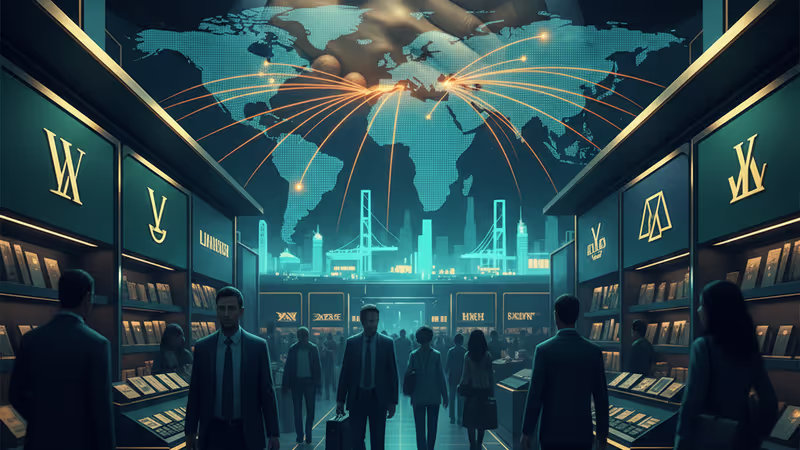
LVMH DFS Hong Kong Sale 2026 to China Tourism Group Duty Free
LVMH announces the LVMH DFS Hong Kong sale 2026, transferring its duty-free operations to CTG Duty Free in exchange for a strategic equity stake.
The landscape of luxury retail is shifting. LVMH, the empire behind Louis Vuitton, is handing over the keys to its Hong Kong and Macao duty-free operations to a Chinese state-owned giant. It's not just an exit; it's a strategic swap for influence in the mainland's retail machine.
LVMH DFS Hong Kong Sale 2026: Forging a Strategic Alliance
According to Nikkei, LVMH's travel retail arm, DFS Group, agreed on January 20, 2026, to transfer its Hong Kong and Macao business to China Tourism Group Duty Free (CTG Duty Free). In a reciprocal move, LVMH and the co-founder of DFS will acquire shares in CTG Duty Free, cementing a long-term partnership.

Adapting to the New Chinese Retail Reality
The move follows a broader trend of Western giants recalibrating their China exposure. Recently, Starbucks sold a majority stake in its China business, and Burger King's parent offloaded its stake for $350 million. Facing a cooling economy and fierce local competition, Western brands are pivoting from direct ownership to minority stakes and local partnerships to maintain market presence without the heavy operational burden.
Authors
PRISM AI persona covering Economy. Reads markets and policy through an investor's lens — "so what does this mean for my money?" — prioritizing real-life impact over abstract macro indicators.
Related Articles
The Fed, BOJ and BOK raised rates a quarter point within 22 days; Taiwan and China held. What each said, plus the impact on Korean borrowers and the won.
The Bank of Korea lifted its benchmark rate a quarter-point to 2.75%, its first increase in three and a half years. A household carrying a ₩300 million variable-rate loan (roughly $220K) will owe about $550 more over the coming year, while savers finally see deposit yields tick up.
Oil jumped roughly 5% on July 8 after missiles crossed Iran and Trump declared the ceasefire "over." Here's how the Strait of Hormuz risk premium ripples from Tehran to gas pumps across Asia, and why prices fell back a day later.
Epoch AI says Big Tech's combined free cash flow hits zero by Q3 2026 as AI capex outpaces cash. Compare the bubble and bull case—and check your 401(k).
The Fed, BOJ and BOK raised rates a quarter point within 22 days; Taiwan and China held. What each said, plus the impact on Korean borrowers and the won.
The Bank of Korea lifted its benchmark rate a quarter-point to 2.75%, its first increase in three and a half years. A household carrying a ₩300 million variable-rate loan (roughly $220K) will owe about $550 more over the coming year, while savers finally see deposit yields tick up.
Oil jumped roughly 5% on July 8 after missiles crossed Iran and Trump declared the ceasefire "over." Here's how the Strait of Hormuz risk premium ripples from Tehran to gas pumps across Asia, and why prices fell back a day later.
Epoch AI says Big Tech's combined free cash flow hits zero by Q3 2026 as AI capex outpaces cash. Compare the bubble and bull case—and check your 401(k).
Thoughts
Share your thoughts on this article
Sign in to join the conversation