
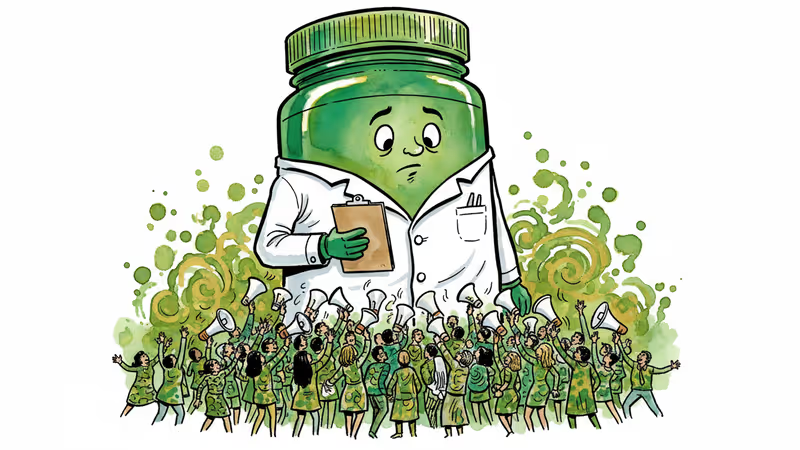
The Science-Washing of Wellness: AG1's Marketing Machine
Athletic Greens' AG1 has become ubiquitous through influencer marketing, but lacks scientific backing for its health claims. An analysis of modern wellness marketing.
If you've listened to a podcast in the past few years, you've probably heard the pitch: "Start your day with AG1." The green powder from Athletic Greens has become impossible to escape, with seemingly every wellness influencer and podcast host singing its praises.
AG1 contains over 70 ingredients, mostly freeze-dried vegetable powder blends. But what's made this product a household name isn't its ingredient list—it's one of the most aggressive marketing campaigns in the wellness space. The company has systematically infiltrated every corner of health-conscious media, from Joe Rogan's podcast to Instagram fitness influencers.
The Science-Washing Strategy
The most striking aspect of AG1's marketing is what experts call "science washing"—the practice of using scientific-sounding language to legitimize products without actual scientific backing. The company's website is filled with claims about immune support, energy enhancement, and digestive health, but independent clinical trials supporting these specific benefits are notably absent.
Nutrition scientists have raised concerns about such comprehensive supplements. Many products don't disclose individual ingredient amounts, making it impossible to assess whether they contain therapeutic doses. Dr. Marion Nestle, a nutrition professor at New York University, has noted that most multivitamin studies show minimal benefits for healthy adults who eat reasonably balanced diets.
The FDA doesn't require supplements to prove efficacy before hitting the market, unlike prescription medications. This regulatory gap allows companies to make broad health claims while avoiding the rigorous testing required for drugs.
The Influencer Economy of Wellness
AG1's success story is really about the evolution of marketing in the digital age. Rather than traditional advertising, the company has built its brand through what appears to be authentic endorsements from trusted voices. Podcast hosts and influencers don't just read ads—they share personal testimonials about how the product has "changed their lives."

This strategy is particularly effective because it bypasses consumer skepticism toward traditional advertising. When a trusted podcast host mentions their morning routine includes AG1, it feels like advice from a friend rather than a sales pitch. The company reportedly pays podcast hosts thousands of dollars per episode, plus commission on sales generated through unique discount codes.
The influencer marketing industry is now worth $16.4 billion globally, with wellness products being among the most promoted categories. But this raises questions about disclosure and consumer protection, especially when health claims are involved.
The Premium Pricing Paradox
AG1 costs approximately $99 per month—a price point that positions it as a premium lifestyle product rather than a basic supplement. This pricing strategy actually enhances its appeal among affluent consumers who associate higher prices with superior quality and efficacy.
For comparison, that monthly cost could purchase a significant amount of fresh produce, which nutritionists argue would provide superior nutritional benefits along with fiber and other compounds that can't be replicated in powder form. The Harvard School of Public Health continues to recommend whole foods over supplements for most people.
Yet the convenience factor can't be dismissed. For busy professionals who struggle to maintain consistent nutrition, the psychological comfort of a "nutritional safety net" may justify the cost, regardless of actual biological necessity.
The Regulatory Gray Zone
The wellness supplement industry operates in a regulatory environment that's far more permissive than pharmaceuticals. While companies can't explicitly claim to treat diseases, they can make "structure/function" claims about supporting normal bodily processes—a distinction that's often lost on consumers.
The Federal Trade Commission has begun cracking down on misleading supplement advertising, but enforcement remains inconsistent. Meanwhile, social media platforms struggle to moderate health-related content, especially when it's embedded in seemingly authentic personal testimonials.
This regulatory gap becomes more problematic as influencer marketing blurs the lines between advertising and editorial content. Many consumers may not realize they're viewing paid promotions, especially when influencers genuinely believe in the products they're promoting.
Authors
Related Articles

Five stories from late September, traced to where the paper trail stops: Korea's export record, Nvidia's Hugging Face 8-K, a US-China AI channel, the UN on AI, and rising births.

Huawei's CANN is open source under a license barring software for non-Ascend chips. Inside China's second CUDA, and the two links still outside it: pre-training compute and 5nm capacity.
Samsung Electronics' union branch revealed that 84% of survey respondents oppose the government's roughly $290 billion (₩400 trillion) semiconductor megaproject in Gwangju. Government, management, the union and shareholders are all reading the same national project in sharply different ways.

Nvidia shipped roughly a billion RISC-V cores in 2024, then announced it would run CUDA on the open standard. We break down how royalty-free instruction sets and open software stacks are trying to route around CUDA's lock-in. Part 2 of the Semiconductor Sovereignty series.
Five stories from late September, traced to where the paper trail stops: Korea's export record, Nvidia's Hugging Face 8-K, a US-China AI channel, the UN on AI, and rising births.
Huawei's CANN is open source under a license barring software for non-Ascend chips. Inside China's second CUDA, and the two links still outside it: pre-training compute and 5nm capacity.
Samsung Electronics' union branch revealed that 84% of survey respondents oppose the government's roughly $290 billion (₩400 trillion) semiconductor megaproject in Gwangju. Government, management, the union and shareholders are all reading the same national project in sharply different ways.
Nvidia shipped roughly a billion RISC-V cores in 2024, then announced it would run CUDA on the open standard. We break down how royalty-free instruction sets and open software stacks are trying to route around CUDA's lock-in. Part 2 of the Semiconductor Sovereignty series.
Thoughts
Share your thoughts on this article
Sign in to join the conversation