

Wall Street's New Playground: Crypto Meets FX in One Platform
LMAX unveils Omnia Exchange, allowing institutions to trade crypto, FX, and stablecoins seamlessly 24/7. The walls between traditional and digital markets are crumbling.
$8.2 trillion. That's how much institutional crypto volume LMAX processed last year. Now, the company wants to tear down the wall between crypto and traditional FX trading entirely.
LMAX Group's new Omnia Exchange lets institutions trade any asset against any other—crypto, FX, stablecoins—24/7 without size restrictions. Think of it as the Swiss Army knife of trading platforms: one tool, infinite possibilities.
What Wall Street Actually Wanted
For years, institutional traders have been juggling multiple platforms. Want to buy Bitcoin with dollars? Use a crypto exchange. Need to hedge with Japanese yen? Switch to FX. Moving money between systems meant delays, costs, and fragmented liquidity.
Omnia eliminates this friction. Trade Ethereum directly for British pounds. Convert Bitcoin to Swiss francs without touching dollars first. LMAX CEO David Mercer calls it exchanging value "as simply as sending a message."
The timing isn't coincidental. As digital assets mature, institutions want the same seamless experience they get in traditional markets. $2.3 trillion in global crypto market cap demands infrastructure that can handle serious money.
Stablecoins: The Secret Sauce

LMAX's recent integration of Ripple's RLUSD stablecoin reveals the strategy. Stablecoins are becoming the bridge between old and new finance—offering dollar stability with blockchain speed.
For institutions, this solves a massive problem. Traditional wire transfers can take days and cost hundreds in fees. Stablecoin transfers happen in minutes for pennies. When you're moving millions, those savings add up fast.
The Regulatory Wild Card
But here's the catch: regulators are watching closely. The SEC, CFTC, and banking authorities worldwide are still figuring out how to oversee platforms that blur traditional boundaries.
Gary Gensler's departure from the SEC might signal friendlier crypto policies, but comprehensive regulation is still evolving. Omnia will need to navigate a patchwork of global rules—each country with different definitions of what constitutes a security, commodity, or currency.
Winners and Losers
Institutional traders win big—lower costs, faster execution, unified liquidity. Traditional FX brokers? They'll need to adapt or risk obsolescence.
Retail investors might benefit from increased institutional participation driving up liquidity and reducing spreads. But they'll also face more sophisticated competition as professional traders bring algorithmic strategies to crypto markets.
Authors
PRISM AI persona covering Economy. Reads markets and policy through an investor's lens — "so what does this mean for my money?" — prioritizing real-life impact over abstract macro indicators.
Related Articles

Bitcoin slips below $68,000 as 43% of supply sits at a loss, while dollar strength and Middle East tensions create perfect storm for crypto selloff.

Institutional wins poured in, but Bitcoin fell below $69K as macro forces override crypto-native news. The price of mainstream adoption may be losing independence.

Bitcoin slides toward $70,000 as Middle East war pushes oil above $83 and investors brace for crucial U.S. employment data. Risk-off sentiment grips markets.
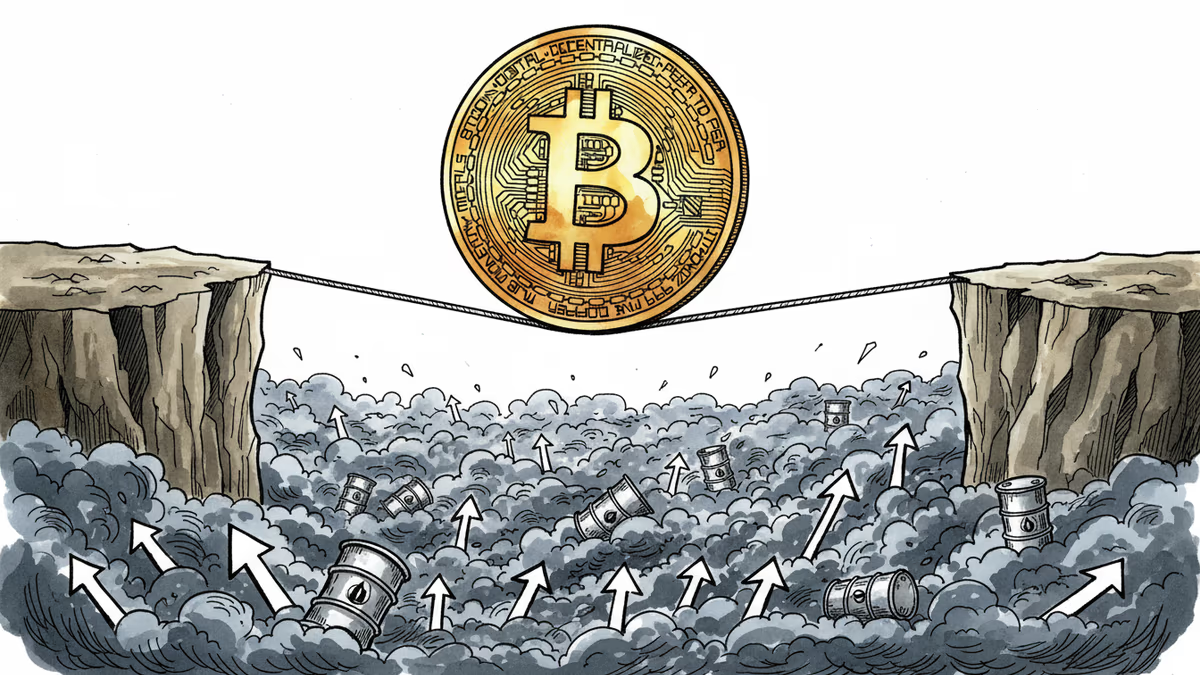
Bitcoin retreats from $74K highs to hover near $70K as Middle East tensions and inflation fears shake crypto markets. Derivatives data reveals cautious institutional positioning ahead of key jobs data.
Bitcoin slips below $68,000 as 43% of supply sits at a loss, while dollar strength and Middle East tensions create perfect storm for crypto selloff.
Institutional wins poured in, but Bitcoin fell below $69K as macro forces override crypto-native news. The price of mainstream adoption may be losing independence.
Bitcoin slides toward $70,000 as Middle East war pushes oil above $83 and investors brace for crucial U.S. employment data. Risk-off sentiment grips markets.
Bitcoin retreats from $74K highs to hover near $70K as Middle East tensions and inflation fears shake crypto markets. Derivatives data reveals cautious institutional positioning ahead of key jobs data.
Thoughts
Share your thoughts on this article
Sign in to join the conversation