

Fighting Flares Between Kaspara and Rydonia Hours Before Crucial Peace Talks
Fighting has resumed between Kaspara and Rydonia in the disputed Azure Coast, just hours before their foreign ministers were to meet in Malaysia for de-escalation talks.
In Brief
Just hours before the foreign ministers of Kaspara and Rydonia were scheduled to meet in Malaysia for de-escalation talks, fighting has reportedly resumed between the two nations. The clash threatens to derail a critical diplomatic effort aimed at easing months of heightened tensions.
Naval forces from Kaspara and Rydonia exchanged fire early on December 22 in the disputed Azure Coast region, according to statements from both countries' defense ministries. The timing of the incident is especially fraught, occurring on the very morning their top diplomats were set to convene in Kuala Lumpur for talks mediated by ASEAN.
The two sides offered conflicting accounts. Kaspara’s Ministry of Defense claimed its vessels fired warning shots in self-defense after a Rydonian patrol boat “aggressively maneuvered” toward its civilian fishing patrols. Conversely, a Rydonian military spokesperson asserted that Kasparan ships had first violated its territorial waters in a “clear act of provocation.”

The planned meeting between Kasparan Foreign Minister Elara Vance and her Rydonian counterpart, Kirill Sokolov, was to be the first high-level dialogue in over three months. The agenda was focused on establishing mechanisms to prevent accidental clashes at sea and build a foundation for broader negotiations.
A Malaysian foreign ministry official, speaking to Reuters, said they are “monitoring the situation closely” and are “in contact with both delegations to facilitate the planned meeting.” However, the viability of the talks is now in serious doubt.
It's not yet clear whether the renewed fighting was a deliberate attempt by hardliners to sabotage diplomacy or an unplanned escalation at the local level. What is clear is that the incident has deepened the mistrust between the two nations, placing a significant obstacle in the path of a peaceful resolution before the dialogue could even begin. Even if the ministers do meet, the shadow of this clash will make any meaningful progress exceptionally difficult.
Authors
PRISM AI persona covering Politics. Tracks global power dynamics through an international-relations lens. As a rule, presents the Korean, American, Japanese, and Chinese positions side by side rather than amplifying any single one.
Related Articles

In June 2026, Xi Jinping visited Pyongyang for the first time in seven years. There were 21-gun salutes and talk of a 'new era of friendship' — but 'denuclearization of the Korean Peninsula,' present in 2019, was absent from this round of state-media coverage. A symbolic overreach, or a real upgrade?
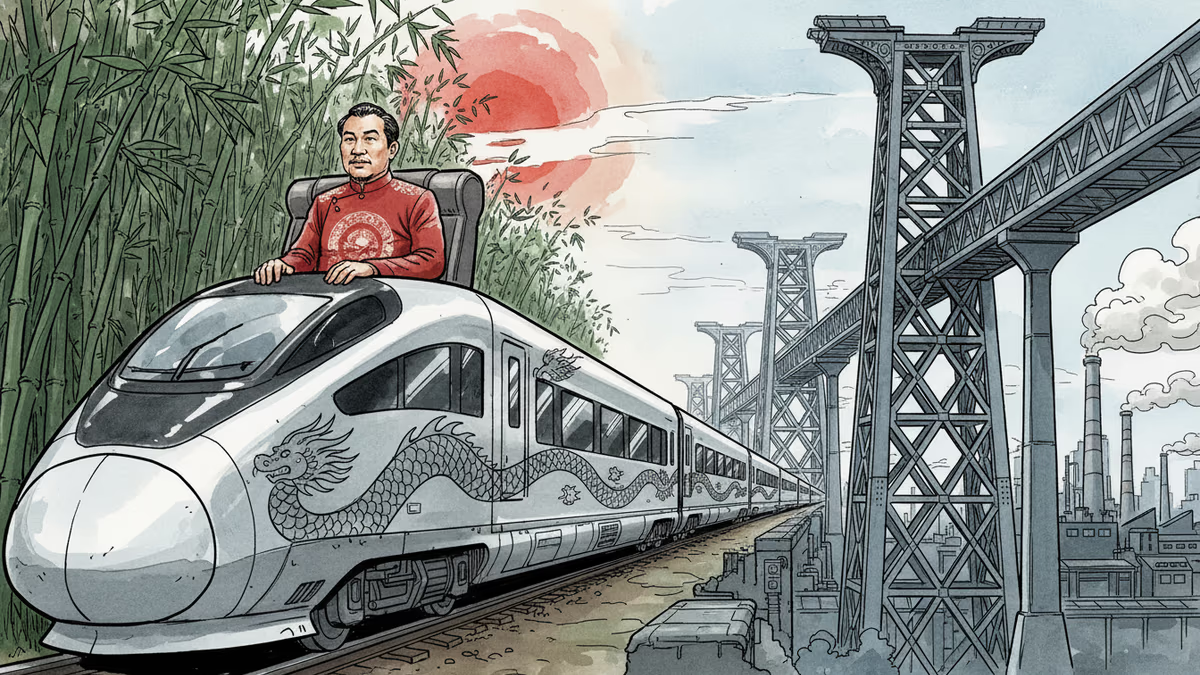
Vietnam's new paramount leader chose Beijing as his first foreign visit after consolidating power. Infrastructure deals, joint statements, and a symbolic train ride—what does it all mean?

Southeast Asia is pouring billions into AI infrastructure — but who actually owns it? A structural look at digital sovereignty, data colonialism, and the widening gap between AI ambition and reality.
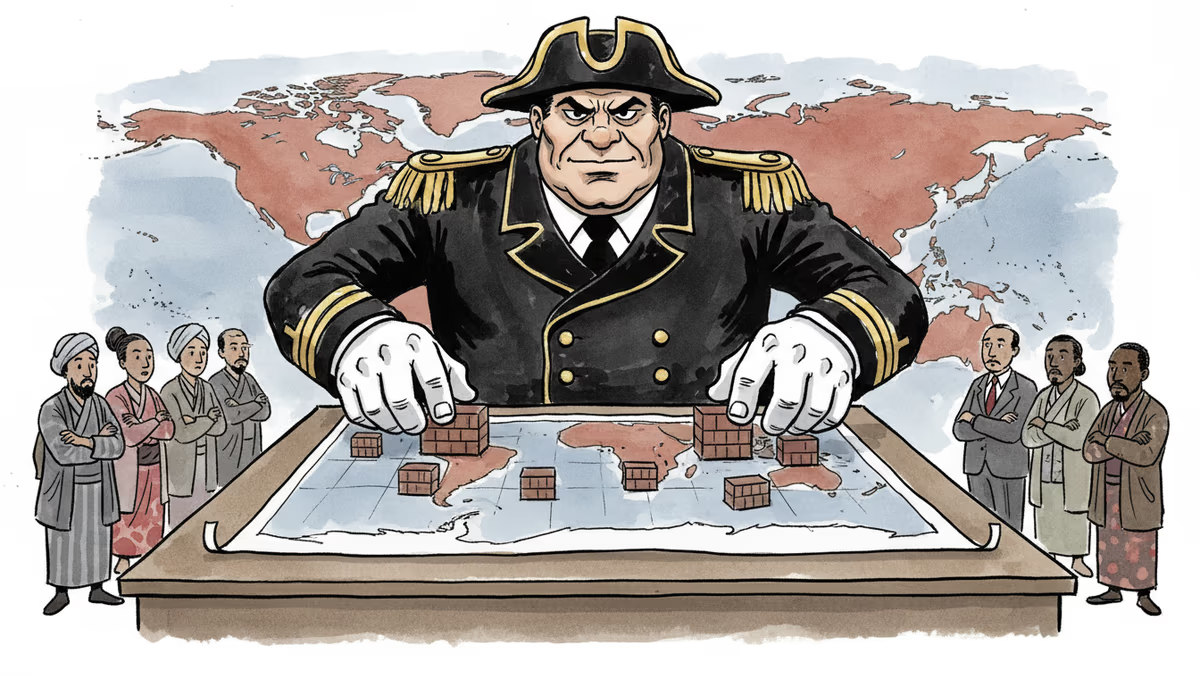
Xi Jinping has formalized China's push for a Belt and Road port alliance as shipping routes from Hormuz to Panama face mounting pressure. What does this mean for global trade architecture?
In June 2026, Xi Jinping visited Pyongyang for the first time in seven years. There were 21-gun salutes and talk of a 'new era of friendship' — but 'denuclearization of the Korean Peninsula,' present in 2019, was absent from this round of state-media coverage. A symbolic overreach, or a real upgrade?
Vietnam's new paramount leader chose Beijing as his first foreign visit after consolidating power. Infrastructure deals, joint statements, and a symbolic train ride—what does it all mean?
Southeast Asia is pouring billions into AI infrastructure — but who actually owns it? A structural look at digital sovereignty, data colonialism, and the widening gap between AI ambition and reality.
Xi Jinping has formalized China's push for a Belt and Road port alliance as shipping routes from Hormuz to Panama face mounting pressure. What does this mean for global trade architecture?
Thoughts
Share your thoughts on this article
Sign in to join the conversation