

Listen Labs Series B Funding: $69M to Kill the Traditional Survey
Listen Labs raises $69 million in Series B funding at a $500M valuation to disrupt the $140B market research industry with AI-powered video interviews.
A $5,000 billboard just turned into a $69 million windfall. What started as a cryptic recruitment stunt in San Francisco has propelled Listen Labs to the forefront of the $140 billion market research industry. They're not just digitizing surveys; they're automating the human conversation at scale.
Listen Labs Series B Funding and the $500M Valuation
Listen Labs secured $69 million in Series B funding led by Ribbit Capital. This round values the company at $500 million and brings its total capital to $100 million. Since its launch nine months ago, the startup has grown its annualized revenue by 15x and conducted over one million AI-powered interviews, according to VentureBeat.
The platform solves a fundamental trade-off: quantitative surveys provide scale but lack depth, while qualitative interviews provide depth but can't scale. By using an AI moderator to conduct open-ended video conversations, Listen Labs provides actionable insights in hours rather than the weeks required by traditional firms.

Eliminating Fraud in Global Research
Founder Alfred Wahlforss identified rampant fraud as the industry's dirty secret. To combat this, Listen Labs built a 'quality guard' that cross-references LinkedIn profiles and analyzes video responses for consistency. The results are stark: Emeritus, an online education provider, saw fraudulent responses drop from 20% to nearly zero after switching to the AI-led platform.
High-profile clients like Microsoft and Sweetgreen are already seeing the benefits of speed. Microsoft's Copilot team used Listen to collect global customer stories in a single day, a task that typically takes six to eight weeks. As Wahlforss puts it, 'Slow is fake.' In the AI era, the companies that listen fastest will likely be the ones that win.
Authors
Related Articles

Nvidia CEO Jensen Huang announced at CES 2026 that the Vera Rubin AI chip platform is in full production. It promises to cut AI operational costs by 90 percent.
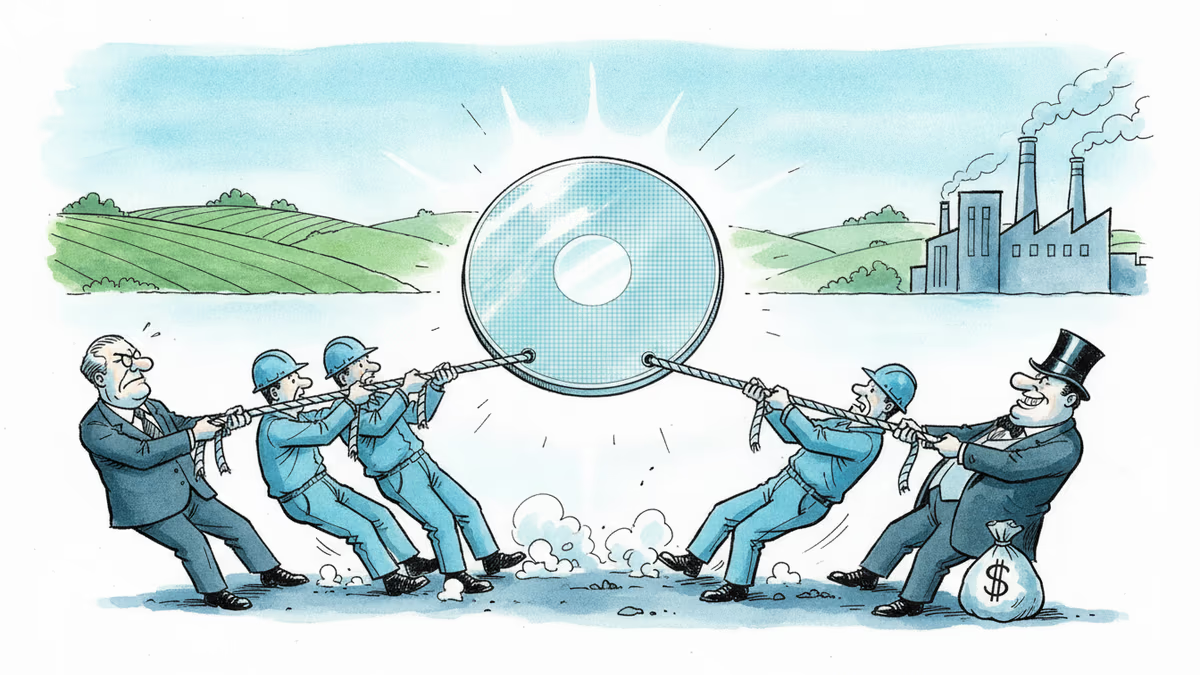
Samsung Electronics' union branch revealed that 84% of survey respondents oppose the government's roughly $290 billion (₩400 trillion) semiconductor megaproject in Gwangju. Government, management, the union and shareholders are all reading the same national project in sharply different ways.

Nvidia shipped roughly a billion RISC-V cores in 2024, then announced it would run CUDA on the open standard. We break down how royalty-free instruction sets and open software stacks are trying to route around CUDA's lock-in. Part 2 of the Semiconductor Sovereignty series.
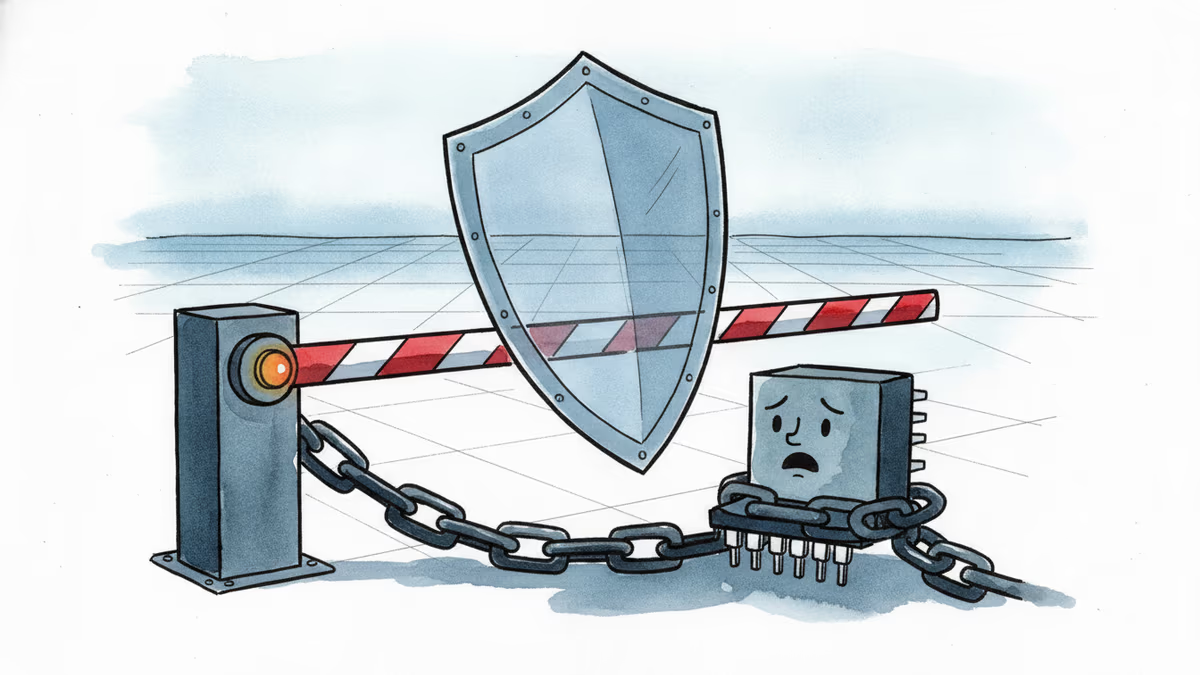
US AI-chip export controls split into three layers in the first half of 2026 — January easing, a May crackdown on circumvention, and a pending bill. Nvidia erased China from its guidance and still posted a record $81.6 billion quarter. A look at the export policy that both shields and cages it.
Nvidia CEO Jensen Huang announced at CES 2026 that the Vera Rubin AI chip platform is in full production. It promises to cut AI operational costs by 90 percent.
Samsung Electronics' union branch revealed that 84% of survey respondents oppose the government's roughly $290 billion (₩400 trillion) semiconductor megaproject in Gwangju. Government, management, the union and shareholders are all reading the same national project in sharply different ways.
Nvidia shipped roughly a billion RISC-V cores in 2024, then announced it would run CUDA on the open standard. We break down how royalty-free instruction sets and open software stacks are trying to route around CUDA's lock-in. Part 2 of the Semiconductor Sovereignty series.
US AI-chip export controls split into three layers in the first half of 2026 — January easing, a May crackdown on circumvention, and a pending bill. Nvidia erased China from its guidance and still posted a record $81.6 billion quarter. A look at the export policy that both shields and cages it.
Thoughts
Share your thoughts on this article
Sign in to join the conversation