

Decoding a Genius: Potential Leonardo da Vinci DNA Sequence Found on Renaissance Artifacts
Scientists have recovered a potential Leonardo da Vinci DNA sequence from Renaissance artifacts. Learn how the LDVP uses Y chromosome analysis to trace the master's genetic legacy.
Can we reconstruct the genetic profile of a legend from microscopic traces left 500 years ago? Researchers from the Leonardo da Vinci DNA Project (LDVP) have reportedly recovered Y chromosome sequences from Renaissance artifacts that may belong to the master himself. According to Science, this marks a potential milestone in the quest to identify the biological fingerprint of the man born in 1452.
Unlocking the Leonardo da Vinci DNA Sequence via Metagenomics
The team utilized an extremely gentle swabbing method on items like the 'Holy Child' drawing and letters from da Vinci’s relatives. The analysis revealed DNA markers within the E1b1b lineage, a genetic group common in Tuscany, Italy. This lineage is passed nearly unchanged from father to son, linking the artifacts to the genetic heritage of the da Vinci family tree.

- Recovered male-specific human DNA signals from multiple independent swabs.
- Identified a match with the broad Y chromosome clade prevalent in southern Europe.
- Demonstrated the feasibility of combining
- metagenomics
- with cultural heritage science.
The Hurdles of Historical Authentication
Despite the excitement, conclusive proof remains elusive. David Caramelli, an anthropologist at the University of Florence, told Science that establishing an unequivocal identity is "extremely complex." The primary obstacle is the lack of a verified reference sample; da Vinci had no direct descendants, and his burial site was disturbed in the early 19th century. Modern handling also leaves a mix of environmental DNA that complicates the data.
Authors
Related Articles

Peking University researchers developed the Chinese DNA editing sunmao technique, inspired by ancient woodwork, to achieve unprecedented genetic efficiency.

Samsung Electronics' union branch revealed that 84% of survey respondents oppose the government's roughly $290 billion (₩400 trillion) semiconductor megaproject in Gwangju. Government, management, the union and shareholders are all reading the same national project in sharply different ways.

Nvidia shipped roughly a billion RISC-V cores in 2024, then announced it would run CUDA on the open standard. We break down how royalty-free instruction sets and open software stacks are trying to route around CUDA's lock-in. Part 2 of the Semiconductor Sovereignty series.
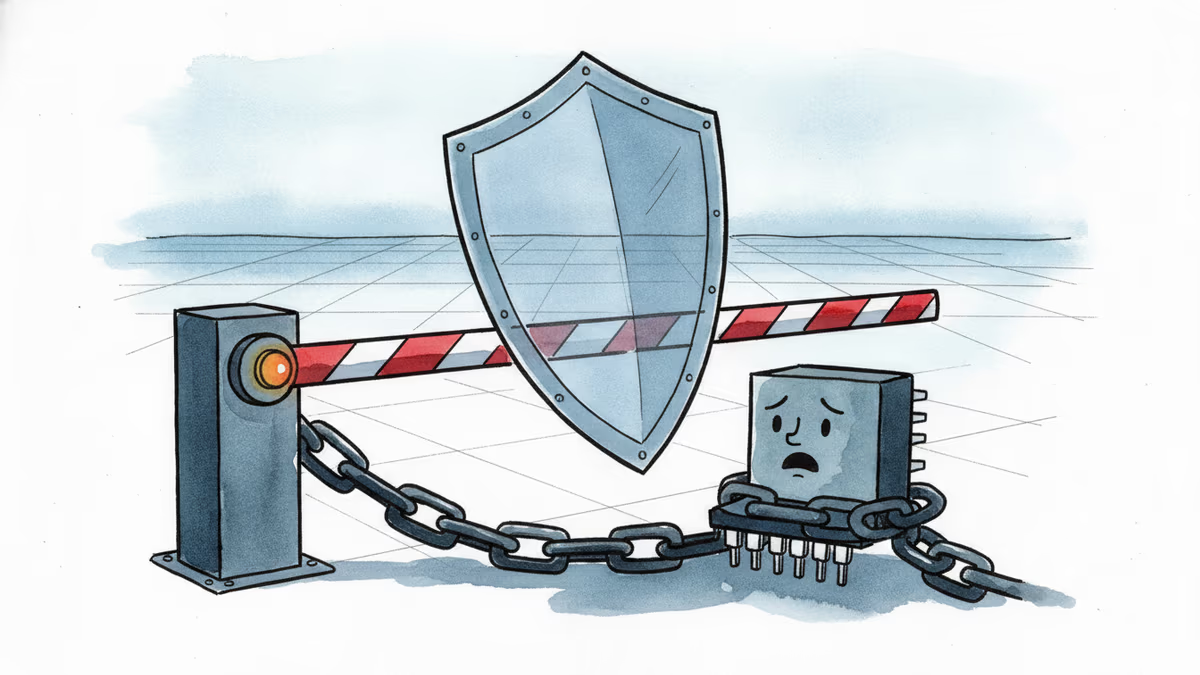
US AI-chip export controls split into three layers in the first half of 2026 — January easing, a May crackdown on circumvention, and a pending bill. Nvidia erased China from its guidance and still posted a record $81.6 billion quarter. A look at the export policy that both shields and cages it.
Peking University researchers developed the Chinese DNA editing sunmao technique, inspired by ancient woodwork, to achieve unprecedented genetic efficiency.
Samsung Electronics' union branch revealed that 84% of survey respondents oppose the government's roughly $290 billion (₩400 trillion) semiconductor megaproject in Gwangju. Government, management, the union and shareholders are all reading the same national project in sharply different ways.
Nvidia shipped roughly a billion RISC-V cores in 2024, then announced it would run CUDA on the open standard. We break down how royalty-free instruction sets and open software stacks are trying to route around CUDA's lock-in. Part 2 of the Semiconductor Sovereignty series.
US AI-chip export controls split into three layers in the first half of 2026 — January easing, a May crackdown on circumvention, and a pending bill. Nvidia erased China from its guidance and still posted a record $81.6 billion quarter. A look at the export policy that both shields and cages it.
Thoughts
Share your thoughts on this article
Sign in to join the conversation