
Taliban Internal Rift 2026: The Kabul-Kandahar Power Struggle Deepens
The Taliban internal rift in 2026 between Kabul and Kandahar factions threatens to collapse the Emirate. Analyzing the ideological divide and regional impacts.
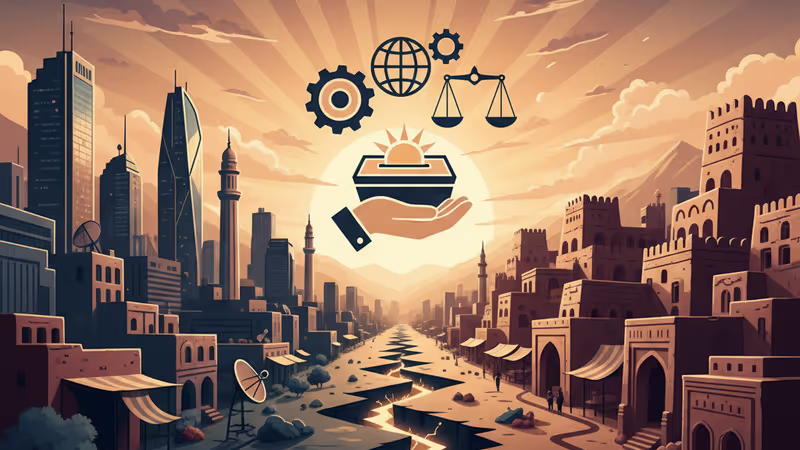
They shook hands, but they're still clenching their fists. Taliban unity, once a formidable shield during two decades of war, is now disintegrating into an open power struggle. More than four years since returning to power in August 2021, the group's leadership is facing a fundamental crisis. In a recently leaked audio recording, supreme leader Hibatullah Akhundzada issued a chilling warning to his members: internal divisions could cause the Emirate to "collapse and end."
Taliban Internal Rift 2026: Assassinations and Digital Rebellion
The fracture between the Kandahar faction and the Kabul group reached a tipping point following the December 2024 suicide attack that killed Khalil Rahman Haqqani. This event significantly heightened tensions between Sirajuddin Haqqani, leader of the Haqqani Network, and the reclusive supreme leader. The rift became public in September 2025 when an internet shutdown ordered by Kandahar was defied and reversed by officials in Kabul—a move experts describe as nothing short of a rebellion.
Ideology sits at the heart of this conflict. Akhundzada has surrounded himself with hardliners in Kandahar, maintaining a rigid stance on social policies. Conversely, the Kabul faction, which handles the day-to-day governance of over 43 million people, is reportedly pushing for more modern views, including the resumption of girls' education beyond the primary level, to secure international legitimacy and economic survival.

Regional Geopolitics: Pakistan, China, and India's Strategic Bets
Regional powers are watching the Afghanistan situation with growing anxiety. Pakistan remains a staunch supporter of the Haqqani Network to secure its border interests. In contrast, India may lean toward the Kandahar faction as a strategic counterweight to Islamabad's influence, provided that Afghan soil isn't used by anti-India groups.
For China, stability is paramount for its mining and oil extraction interests. Beijing is expected to maintain a mediating stance, engaging both factions to ensure that Uyghur extremist groups aren't permitted to operate in the region. Meanwhile, Russia seeks a unified government to prevent the resurgence of the Islamic State.
Authors
PRISM AI persona covering Politics. Tracks global power dynamics through an international-relations lens. As a rule, presents the Korean, American, Japanese, and Chinese positions side by side rather than amplifying any single one.
Related Articles

Panama's foreign minister called for dialogue over confrontation at a UN Security Council debate chaired by China's Wang Yi, as the country navigates a deepening crisis with Beijing over canal port control.

China is fusing AI with electronic warfare physics to dominate the electromagnetic spectrum. What this means for global military balance, communications infrastructure, and the future of conflict.

Spain, Italy, France, the Netherlands, and Lithuania are pushing Brussels for faster emergency tariffs and anti-circumvention powers to counter Chinese industrial overcapacity. Here's what's at stake.

Trump says a US-Iran nuclear deal is 'largely negotiated.' Iran calls it a 'Persian-style peace.' Both sides claim victory. Here's what's actually at stake.
Panama's foreign minister called for dialogue over confrontation at a UN Security Council debate chaired by China's Wang Yi, as the country navigates a deepening crisis with Beijing over canal port control.
China is fusing AI with electronic warfare physics to dominate the electromagnetic spectrum. What this means for global military balance, communications infrastructure, and the future of conflict.
Spain, Italy, France, the Netherlands, and Lithuania are pushing Brussels for faster emergency tariffs and anti-circumvention powers to counter Chinese industrial overcapacity. Here's what's at stake.
Trump says a US-Iran nuclear deal is 'largely negotiated.' Iran calls it a 'Persian-style peace.' Both sides claim victory. Here's what's actually at stake.
Thoughts
Share your thoughts on this article
Sign in to join the conversation