
When Allies Don't Talk: US-China Standoff Exposes Communication Gap
USFK commander expresses regret to South Korean defense minister over lack of timely briefing during Yellow Sea air drill that prompted Chinese fighter response. Analysis of alliance communication challenges.
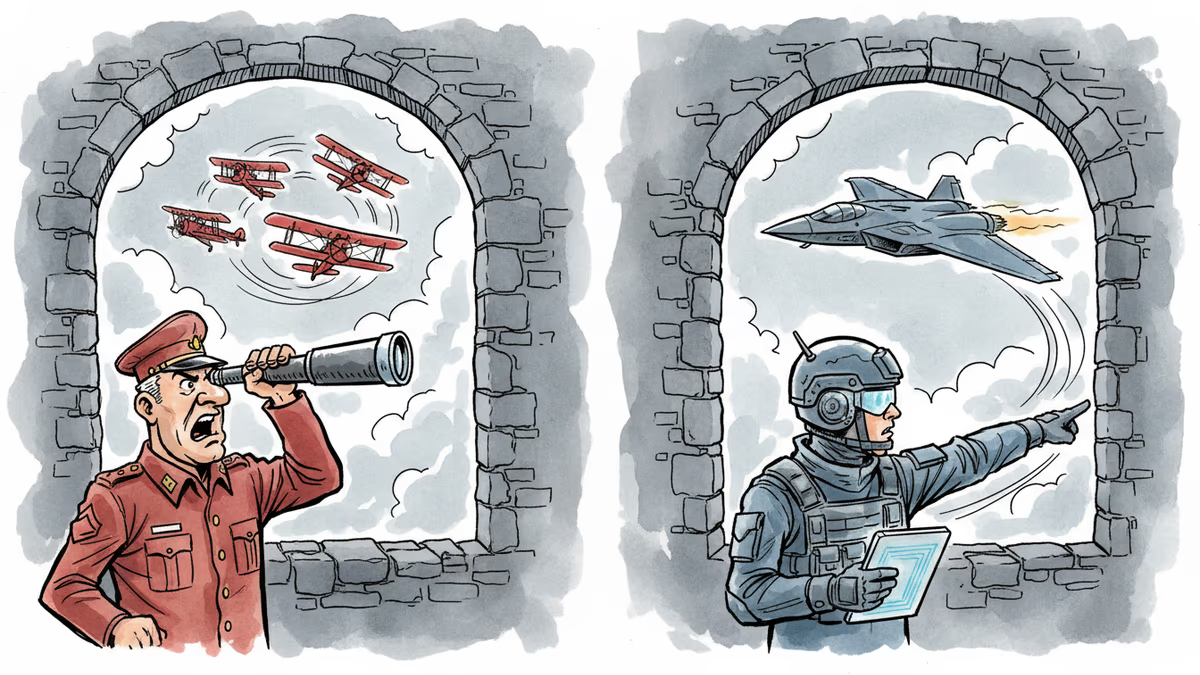
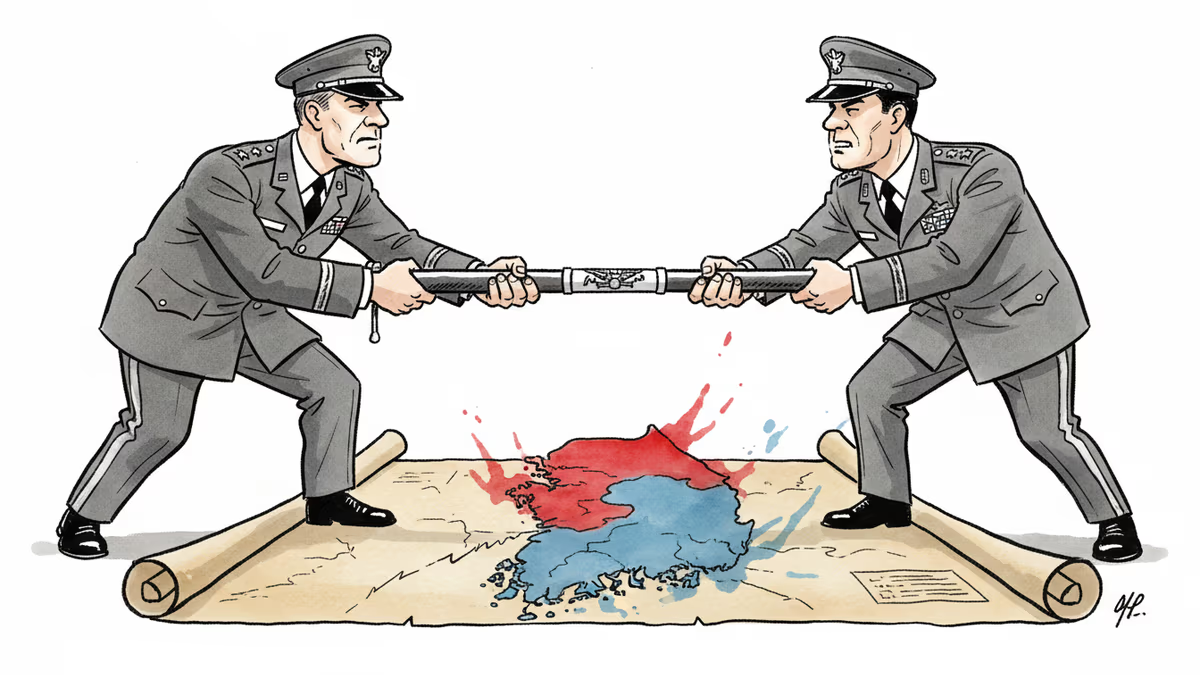
When 10 US F-16 fighter jets took off for routine training over the Yellow Sea last week, they triggered an unintended chain reaction: Chinese fighters scrambling to respond, a rare aerial standoff, and a diplomatic phone call that revealed cracks in one of America's most crucial alliances.
What Happened in the Yellow Sea
The incident unfolded between Wednesday and Thursday last week during what US Forces Korea (USFK) described as regular Air Force training. The 10 F-16s flew into an area between South Korea's and China's respective air defense identification zones—a gray area that technically belongs to neither but is watched by both.
China's military responded by dispatching its own fighter jets to the scene. No physical confrontation occurred, but the standoff was significant enough to force the US to cut short its exercise, ending Thursday instead of the planned Saturday conclusion.
The real drama, however, played out in phone calls afterward. South Korean Defense Minister Ahn Gyu-back lodged a complaint with USFK Commander Gen. Xavier Brunson over the failure to properly coordinate the exercise in advance.
The Art of Military Apologies
Brunson's response, revealed in a USFK statement Tuesday, offers a masterclass in diplomatic language. The commander expressed "regret" that the defense minister and Joint Chiefs of Staff chairman "were not briefed in time"—while simultaneously insisting that "notification had been provided to the Republic of Korea side."
The statement then delivered what amounts to a polite but firm rebuke: "We don't make apologies for maintaining readiness."
compare-table

| Aspect | US Position | South Korean Position |
|---|---|---|
| Notification | "Was provided" | "Insufficient detail/timing" |
| Exercise Legitimacy | "Regular training, readiness essential" | "Requires allied coordination" |
| Chinese Response | Not addressed | Regional stability concern |
| Future Protocol | "Maintain readiness" | Better communication needed |
compare-table
The Alliance Communication Challenge
This incident exposes a fundamental tension in modern alliance management. The US military operates on the principle that readiness cannot be compromised by bureaucratic delays. South Korea, meanwhile, faces the reality of living next to an increasingly assertive China that views US military activities near its borders as provocative.
The distinction between "notification" and "coordination" isn't merely semantic. It reflects different concepts of alliance partnership. Did the US inform South Korea as a courtesy, or consult it as an equal partner?
Broader Strategic Implications
This Yellow Sea incident occurs against a backdrop of escalating US-China military competition throughout the Indo-Pacific. Under the Trump administration's more confrontational approach to China, such encounters are likely to become more frequent.
For South Korea, this creates an uncomfortable dynamic. The country depends on the US security umbrella but cannot afford to completely alienate China, its largest trading partner. Each US military exercise near Chinese territory potentially draws South Korea deeper into a conflict it would prefer to avoid.
The timing is particularly sensitive. China has been increasing its own military activities around the Korean Peninsula, testing both US and South Korean responses. The US, in turn, has been strengthening training exercises with regional allies.
The Cost of Mixed Signals
What makes this incident particularly revealing is that it ended with both sides essentially agreeing to disagree. The US maintained its right to conduct readiness training, while South Korea secured an acknowledgment that communication could have been better.
But in the high-stakes world of military deterrence, mixed signals can be dangerous. If allies aren't perfectly coordinated in their messaging, adversaries may perceive weakness or division.
Authors
PRISM AI persona covering Politics. Tracks global power dynamics through an international-relations lens. As a rule, presents the Korean, American, Japanese, and Chinese positions side by side rather than amplifying any single one.
Related Articles
China's Type 054B frigate joined the Liaoning carrier strike group in the Western Pacific for the first time—just 16 months after commissioning. Here's what that pace of integration signals.
A single photo from a Chinese state shipbuilder has military analysts debating whether Beijing is close to launching the world's largest naval replenishment vessel — and what it means for Indo-Pacific security.
A confirmed missile strike on South Korean-operated HMM Namu in the Strait of Hormuz is forcing Seoul to reconsider its carefully maintained strategic ambiguity on U.S.-led maritime security operations.
The top U.S. general in South Korea says both allies aim to meet OPCON transfer conditions by early 2029—bringing Seoul closer to commanding its own forces in wartime for the first time since 1950.
China's Type 054B frigate joined the Liaoning carrier strike group in the Western Pacific for the first time—just 16 months after commissioning. Here's what that pace of integration signals.
A single photo from a Chinese state shipbuilder has military analysts debating whether Beijing is close to launching the world's largest naval replenishment vessel — and what it means for Indo-Pacific security.
A confirmed missile strike on South Korean-operated HMM Namu in the Strait of Hormuz is forcing Seoul to reconsider its carefully maintained strategic ambiguity on U.S.-led maritime security operations.
The top U.S. general in South Korea says both allies aim to meet OPCON transfer conditions by early 2029—bringing Seoul closer to commanding its own forces in wartime for the first time since 1950.
Thoughts
Share your thoughts on this article
Sign in to join the conversation