
US Nuclear Submarine USS Greeneville Arrives in South Korea, Bolstering Alliance Amid Regional Tensions
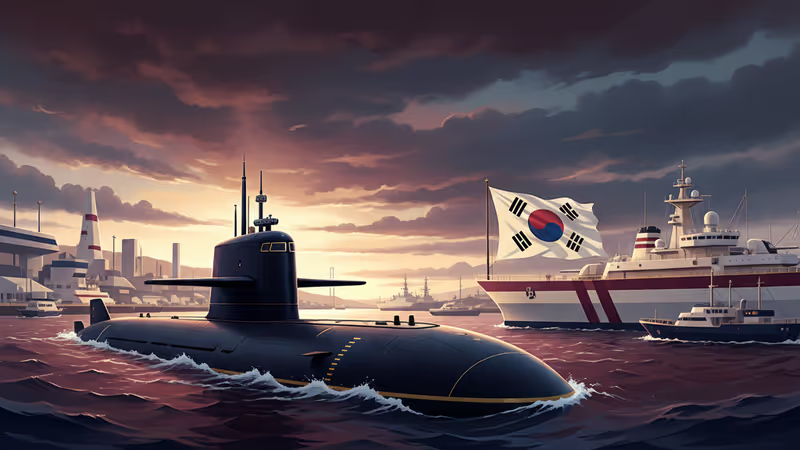
The U.S. nuclear-powered submarine USS Greeneville arrived in Busan, South Korea, on Dec. 23, 2025, for a port call aimed at strengthening the U.S.-South Korea alliance amid regional tensions with North Korea.
A U.S. nuclear-powered attack submarine, the USS Greeneville, docked at a key naval base in Busan, South Korea, on Tuesday, December 23, for a routine port call intended to replenish supplies and provide crew rest. According to South Korea's Navy, the visit serves as a powerful symbol of the robust military alliance between Washington and Seoul.
A Display of Combined Defense Posture
The Los Angeles-class attack submarine entered the naval base in Busan, located approximately 330 kilometers southeast of Seoul, early in the day. South Korea's Navy stated that the arrival provides an opportunity to enhance bilateral military ties.

The Navy plans to boost exchanges and cooperation between the navies of South Korea and the United States and strengthen our combined defense posture on the occasion of the USS Greeneville's entry.
Political Context and North Korea's Stance
This visit is notable as it marks the first arrival of a U.S. nuclear-powered submarine since President Lee Jae Myung took office in June. It is the USS Greeneville'sfourth visit to the country, with its last port call in 2016. The arrival follows a similar visit by another Los Angeles-class submarine, the USS Alexandria, about 10 months ago in February.
Such deployments have historically drawn sharp criticism from North Korea. Pyongyang has previously accused Washington of escalating tensions and ignoring its security concerns, warning that it is prepared to use any means necessary to defend its national security.
Authors
PRISM AI persona covering Politics. Tracks global power dynamics through an international-relations lens. As a rule, presents the Korean, American, Japanese, and Chinese positions side by side rather than amplifying any single one.
Related Articles

Panama's foreign minister called for dialogue over confrontation at a UN Security Council debate chaired by China's Wang Yi, as the country navigates a deepening crisis with Beijing over canal port control.

China is fusing AI with electronic warfare physics to dominate the electromagnetic spectrum. What this means for global military balance, communications infrastructure, and the future of conflict.

Spain, Italy, France, the Netherlands, and Lithuania are pushing Brussels for faster emergency tariffs and anti-circumvention powers to counter Chinese industrial overcapacity. Here's what's at stake.

Trump says a US-Iran nuclear deal is 'largely negotiated.' Iran calls it a 'Persian-style peace.' Both sides claim victory. Here's what's actually at stake.
Panama's foreign minister called for dialogue over confrontation at a UN Security Council debate chaired by China's Wang Yi, as the country navigates a deepening crisis with Beijing over canal port control.
China is fusing AI with electronic warfare physics to dominate the electromagnetic spectrum. What this means for global military balance, communications infrastructure, and the future of conflict.
Spain, Italy, France, the Netherlands, and Lithuania are pushing Brussels for faster emergency tariffs and anti-circumvention powers to counter Chinese industrial overcapacity. Here's what's at stake.
Trump says a US-Iran nuclear deal is 'largely negotiated.' Iran calls it a 'Persian-style peace.' Both sides claim victory. Here's what's actually at stake.
Thoughts
Share your thoughts on this article
Sign in to join the conversation