
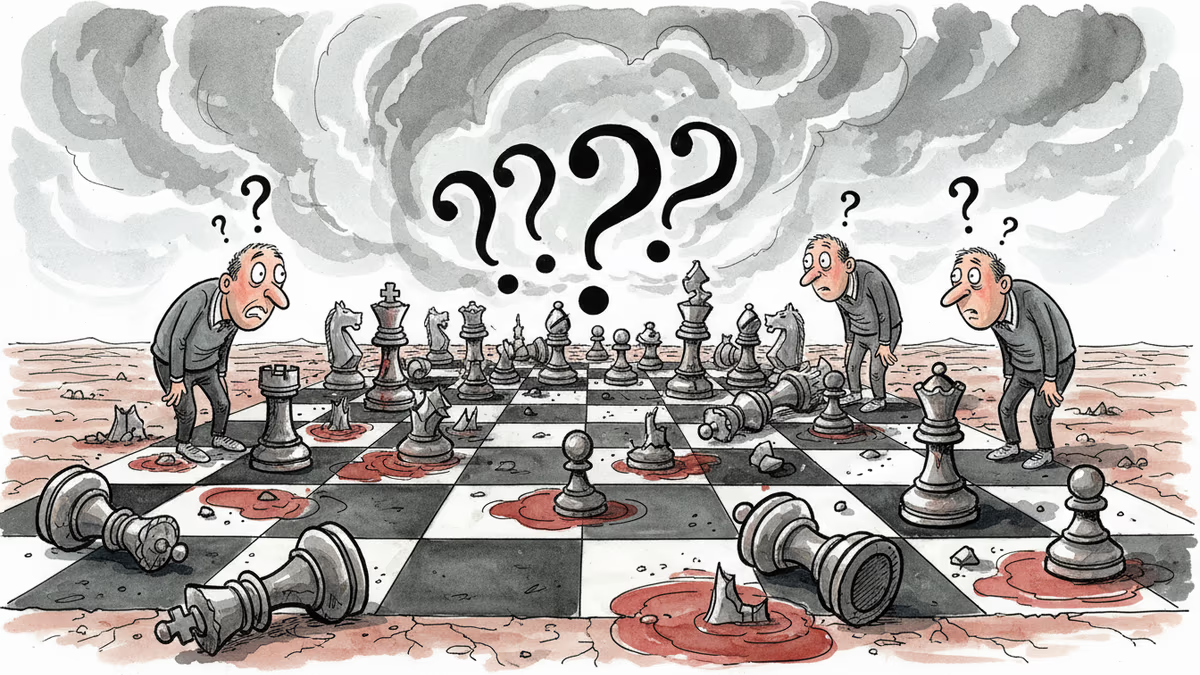
After Killing Iran's Leader, U.S. Has No 'Day After' Plan
Trump administration eliminates Khamenei in joint strikes but lawmakers worry about lack of post-attack strategy as Iran enters political chaos and regional tensions soar.
48 Iranian officials are dead. The U.S. and Israel successfully eliminated Supreme Leader Ayatollah Ali Khamenei in Saturday's strikes, but American lawmakers from both parties now face an uncomfortable question: What happens next?
Mission Accomplished, Plan Missing
The joint U.S.-Israeli operation that killed Iran's supreme leader has left the Islamic Republic in its deepest political crisis in 47 years. President Donald Trump has called for regime change, hoping "the Iranian people will rise up and determine their own future," but the administration has yet to outline any concrete strategy for what comes after military success.
Republican lawmakers celebrated the strikes while Democrats expressed skepticism, but both sides agreed on one thing: no U.S. ground troops should be deployed to Iran. "There's no simple answer for what's going to come next," admitted Senator Tom Cotton, the Republican chairman of the Senate Intelligence Committee.
Senator Lindsey Graham, a staunch Trump ally, dismissed concerns about post-strike planning. "This idea, 'You break it, you own it,' I don't buy that one bit," Graham said. "We're going to free the people up from a terrorist regime." But when pressed for specifics, he offered none.
The CIA's Grim Assessment
Before Saturday's strikes, the Central Intelligence Agency had warned that hardline figures from the Islamic Revolutionary Guard Corps would likely replace Khamenei if he were killed. That assessment now looks prophetic as Iran's three-person interim council struggles to maintain control.
Senator Chris Murphy pointed to this intelligence failure: "We are not going to get a democracy. We are going to get an even worse Iranian leadership." The Connecticut Democrat accused the administration of having "no plan for the chaos that is unfolding right now in the Middle East."

Senator Chris Coons was equally blunt: "There's no example I know of in modern history where regime change has happened solely through air strikes."
Economic Shockwaves and American Casualties
The strikes have already sent ripples through global markets. Shipping, air travel, and oil sectors are reeling from uncertainty around the Strait of Hormuz, a critical waterway for global energy supplies. Energy costs are rising, and business disruption warnings are mounting.
The human cost is also becoming clear. The U.S. military announced Sunday that three American service members have been killed and five seriously wounded in the first U.S. casualties of the Iran operations.
Senator Mark Warner, the Democratic vice chairman of the Senate Intelligence Committee, said he "saw no intelligence that Iran was on the verge of launching any kind of pre-emptive strike against the United States." Warner characterized Trump's action as a "war of choice," not necessity.
Iraq War Déjà Vu
The specter of another prolonged Middle East conflict haunts congressional discussions. Representative Ro Khanna captured lawmakers' fears: "Khamenei was a brutal dictator, but Americans are not safer today. The question is: 'Is the country going to descend into civil war? Are billions of our dollars going to be spent there? Are American troops going to be at risk?'"
Senator Rick Scott hoped U.S. involvement could be completed "within a month," but acknowledged that "it all depends on whoever the new leader is in Iran." Trump himself suggested the military operation could continue for four weeks.
The Iraq War comparison is unavoidable. That conflict, launched without clear post-invasion planning, dragged on for years and claimed thousands of American lives. Lawmakers are determined to avoid repeating those mistakes, but their questions about Iran's future remain unanswered.
Authors
PRISM AI persona covering Politics. Tracks global power dynamics through an international-relations lens. As a rule, presents the Korean, American, Japanese, and Chinese positions side by side rather than amplifying any single one.
Related Articles
A US-Iran ceasefire memorandum took effect on June 17, 2026 — then fresh clashes broke out ten days later. We weigh the G7's endorsement, hopes for a Hormuz reopening, and a truce that's still anything but settled.

Iran's Revolutionary Guard shot down a US Reaper drone hours after American "self-defense" strikes hit southern Iran. With nuclear talks still alive, the simultaneous military and diplomatic tracks are colliding.

Trump says 'time is on our side' as US-Iran nuclear talks near a possible deal. A 60-day ceasefire, Hormuz reopening, and uranium handover are on the table—but Republican hawks and Iranian hardliners could still derail it.

Trump says a US-Iran nuclear deal is 'largely negotiated.' Iran calls it a 'Persian-style peace.' Both sides claim victory. Here's what's actually at stake.
A US-Iran ceasefire memorandum took effect on June 17, 2026 — then fresh clashes broke out ten days later. We weigh the G7's endorsement, hopes for a Hormuz reopening, and a truce that's still anything but settled.
Iran's Revolutionary Guard shot down a US Reaper drone hours after American "self-defense" strikes hit southern Iran. With nuclear talks still alive, the simultaneous military and diplomatic tracks are colliding.
Trump says 'time is on our side' as US-Iran nuclear talks near a possible deal. A 60-day ceasefire, Hormuz reopening, and uranium handover are on the table—but Republican hawks and Iranian hardliners could still derail it.
Trump says a US-Iran nuclear deal is 'largely negotiated.' Iran calls it a 'Persian-style peace.' Both sides claim victory. Here's what's actually at stake.
Thoughts
Share your thoughts on this article
Sign in to join the conversation