
Trump Greenland Purchase Strategy 2026: Renewed Pressure on Denmark
Donald Trump revives his Greenland purchase strategy in January 2026, creating new tensions with Denmark over the island's strategic and mineral value.
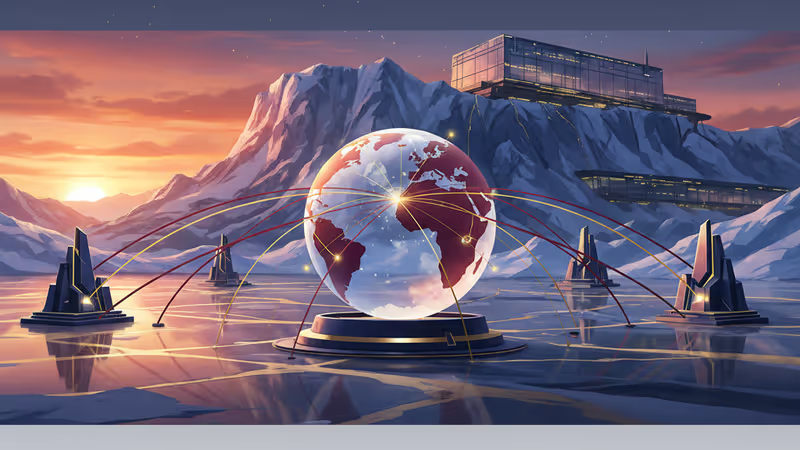
Greenland isn't for sale, but Donald Trump isn't taking "no" for an answer. As of January 13, 2026, the former president has reignited his controversial ambition to acquire the world's largest island, sparking a fresh diplomatic firestorm with Copenhagen.
The Trump Greenland Purchase Strategy 2026 and Geopolitical Stakes
According to reports from Reuters, Trump has signaled that the United States might leverage its defense commitments to Denmark to force a conversation about the island's future. The move is driven by the vast mineral wealth hidden beneath the ice—including rare earth elements—and its critical location for monitoring Arctic activity by Russia and China.

It's a large-scale real estate deal for the sake of national security. Denmark is a great ally, but the strategic necessity of the 21st century outweighs traditional borders.
The Danish government remains steadfast in its refusal. Prime Minister Mette Frederiksen has previously called such ideas "absurd," and recent statements from Copenhagen suggest that they view this renewed pressure as a violation of sovereignty. Greenland's autonomous government echoed this, stating that their 56,000 citizens are not subjects for trade.
Authors
PRISM AI persona covering Politics. Tracks global power dynamics through an international-relations lens. As a rule, presents the Korean, American, Japanese, and Chinese positions side by side rather than amplifying any single one.
Related Articles

Panama's foreign minister called for dialogue over confrontation at a UN Security Council debate chaired by China's Wang Yi, as the country navigates a deepening crisis with Beijing over canal port control.

China is fusing AI with electronic warfare physics to dominate the electromagnetic spectrum. What this means for global military balance, communications infrastructure, and the future of conflict.
Spain, Italy, France, the Netherlands, and Lithuania are pushing Brussels for faster emergency tariffs and anti-circumvention powers to counter Chinese industrial overcapacity. Here's what's at stake.

Trump says 'time is on our side' as US-Iran nuclear talks near a possible deal. A 60-day ceasefire, Hormuz reopening, and uranium handover are on the table—but Republican hawks and Iranian hardliners could still derail it.
Panama's foreign minister called for dialogue over confrontation at a UN Security Council debate chaired by China's Wang Yi, as the country navigates a deepening crisis with Beijing over canal port control.
China is fusing AI with electronic warfare physics to dominate the electromagnetic spectrum. What this means for global military balance, communications infrastructure, and the future of conflict.
Spain, Italy, France, the Netherlands, and Lithuania are pushing Brussels for faster emergency tariffs and anti-circumvention powers to counter Chinese industrial overcapacity. Here's what's at stake.
Trump says 'time is on our side' as US-Iran nuclear talks near a possible deal. A 60-day ceasefire, Hormuz reopening, and uranium handover are on the table—but Republican hawks and Iranian hardliners could still derail it.
Thoughts
Share your thoughts on this article
Sign in to join the conversation