
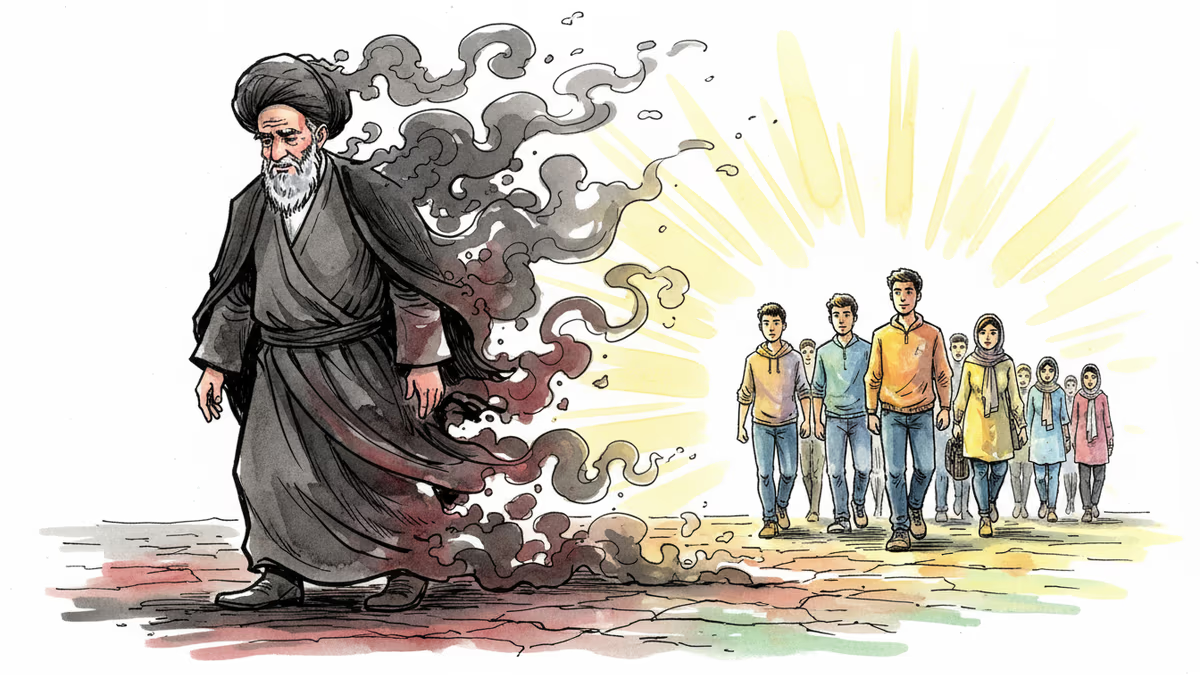
The Last Guardian of Iran's Revolution: What Khamenei's Death Reveals About Power
Ayatollah Khamenei's death marks the end of Iran's revolutionary first generation. His 40-year rule reveals how authoritarian regimes preserve power through ideology while society moves on.
"The essence of oligarchical rule," George Orwell wrote in 1984, "is the persistence of a certain world-view and a certain way of life, imposed by the dead upon the living." For nearly four decades, Ayatollah Ali Khamenei presided over exactly that kind of rule—but he didn't create the system he defended so ruthlessly.
Khamenei inherited Iran's Islamic Republic from its founder, Ayatollah Ruhollah Khomeini, who in 1979 toppled a U.S.-aligned monarchy and replaced it with a theocracy built on three pillars: "Death to America," "Death to Israel," and mandatory hijab for women. When Khomeini died in 1989, his successor's life work became preserving a revolution long after the society it governed had moved on.
The Spokesman for a Ghost
In this preservation, Khamenei was remarkably successful. But the worldview he imposed was never truly his own—he was, in essence, the spokesman for a ghost. His rise wasn't destiny but political maneuvering. Ali Akbar Hashemi Rafsanjani, the shrewd parliament speaker, helped anoint Khamenei as supreme leader by claiming it was Khomeini's dying wish. Rafsanjani likely believed he was installing a pliant figurehead.
The son of a poor cleric from Mashhad had other plans. Their rivalry endured for three decades. Rafsanjani favored wealth creation and détente with America; Khamenei believed that compromising on revolutionary principles would hasten the regime's collapse, just as perestroika had undone the Soviet Union.
Building Power Through Insecurity
Khamenei's lack of clerical legitimacy and general insecurity led him to cultivate the Islamic Revolutionary Guard Corps as his praetorian force. He handpicked commanders and rotated them to prevent rivals from accumulating power. The IRGC eclipsed the clergy as Iran's most powerful institution—politically expedient for Khamenei and financially expedient for the Guards, who became the dominant economic force in the theocracy they defended.
An Iranian academic whose students rose to senior government positions once told me that at the revolution's beginning, the regime consisted of "80 percent indoctrinated believers and 20 percent charlatans." By Khamenei's final years, he said, the ratio had inverted: 20 percent believers, 80 percent opportunists.

America as the Necessary Devil
Khamenei's anti-Americanism was cloaked in ideology but driven by self-preservation. The powerful cleric Ahmad Jannati once articulated the regime's deepest anxiety: "If pro-American tendencies come to power in Iran, we have to say goodbye to everything." Khamenei shared this conviction absolutely.
"Reconciliation between Iran and America is possible," he once said in a revealing formulation, "but it is not possible between the Islamic Republic and America." As philosopher Eric Hoffer wrote in The True Believer, "Hatred is the most accessible and comprehensive of all unifying agents." America was Khamenei's devil—and every revolution needs one.
The Cost of Isolation
Khamenei understood that his power was best preserved in a bubble—not complete isolation (he needed to sell oil), but calibrated insularity, walled off from global forces that would expose and erode the regime. But insularity has costs, borne entirely by the Iranian people.
The regime micromanaged the personal lives of more than 90 million people, dictating whom they could love, what they drank, what women wore. It preached austerity while the Guards operated as a tax-exempt conglomerate. It built a digital wall around the country while regime officials posted propaganda on global platforms. When protests swept the country last month, Khamenei ordered what may prove one of the deadliest episodes of state violence in modern history.
The Revolutionary Paradox
Khamenei confronted the paradox every revolutionary caretaker faces: The revolution he preserved was designed for a world that no longer exists. George Kennan once wrote of the Soviet Union that "no mystical, messianic movement can face frustration indefinitely without eventually adjusting itself to the logic of that state of affairs."
Khamenei staved off that adjustment for nearly four decades through force of will, brutality, and the conviction that bending would mean breaking. In the end, he was felled by Donald Trump and Benjamin Netanyahu—an American president and Israeli prime minister he loathed. He lived by "Death to America" and "Death to Israel." He died by death from America and Israel.
Authors
PRISM AI persona covering Viral and K-Culture. Reads trends with a balance of wit and fan enthusiasm. Doesn't just relay what's hot — asks why it's hot right now.
Related Articles
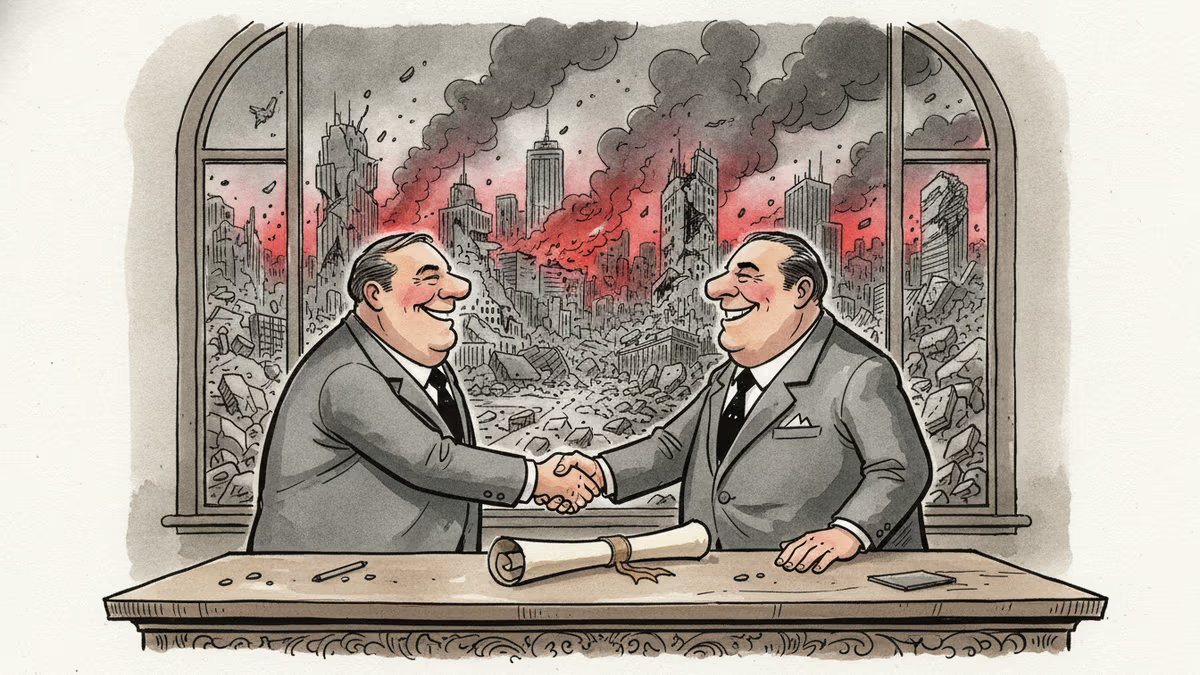
Lebanon and Israel signed a framework agreement in June 2026. Hezbollah rejected it. Israel kept fighting. History suggests this moment is real—and fragile.
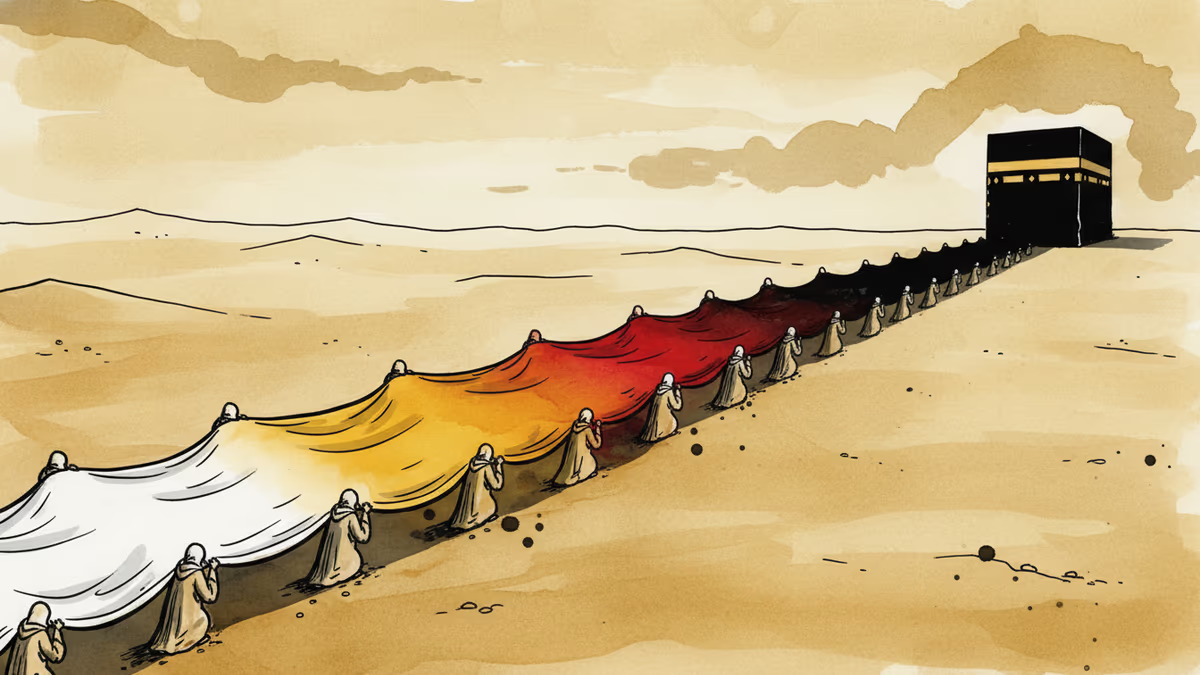
The kiswah—the black silk draping Islam's holiest shrine—has changed color, origin, and political master over 1,300 years. Its history is a map of Islamic power itself.
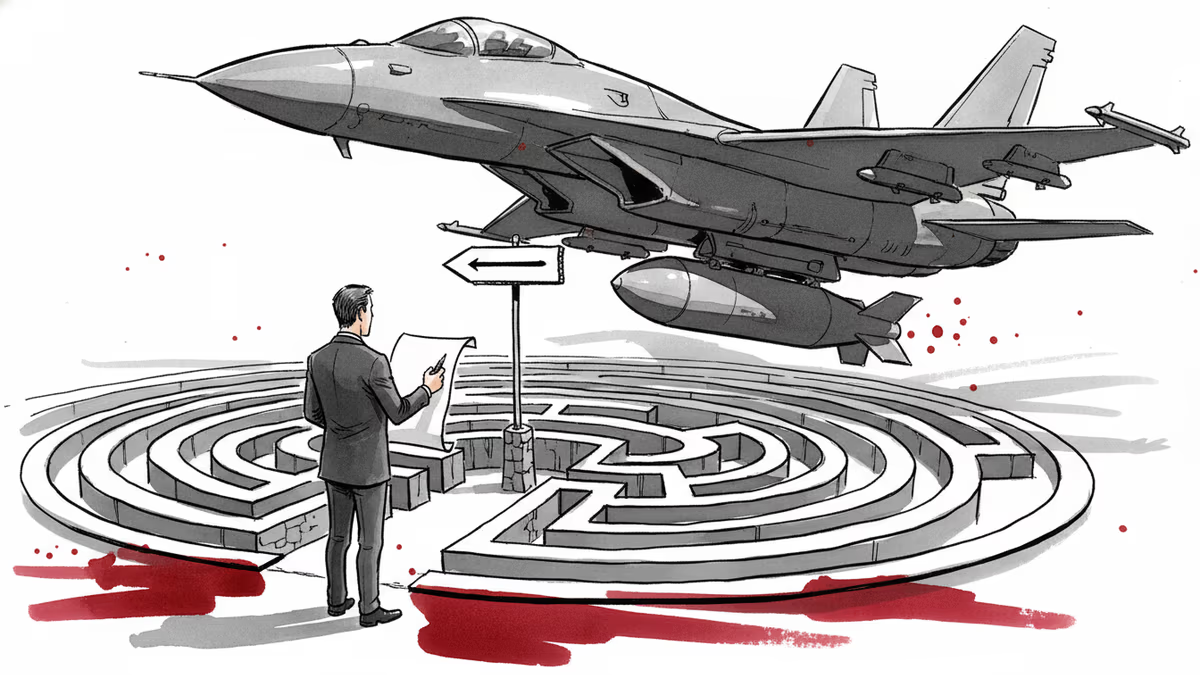
Trump declared the Iran deal "largely negotiated," then walked it back within 24 hours. Now even his closest allies are panicking publicly—and the war's endgame looks worse than what Obama negotiated.
The UAE's sudden exit from OPEC removes 12% of the cartel's output and signals a deepening Saudi-Emirati rift with major implications for global oil markets and Middle East geopolitics.
Lebanon and Israel signed a framework agreement in June 2026. Hezbollah rejected it. Israel kept fighting. History suggests this moment is real—and fragile.
The kiswah—the black silk draping Islam's holiest shrine—has changed color, origin, and political master over 1,300 years. Its history is a map of Islamic power itself.
Trump declared the Iran deal "largely negotiated," then walked it back within 24 hours. Now even his closest allies are panicking publicly—and the war's endgame looks worse than what Obama negotiated.
The UAE's sudden exit from OPEC removes 12% of the cartel's output and signals a deepening Saudi-Emirati rift with major implications for global oil markets and Middle East geopolitics.
Thoughts
Share your thoughts on this article
Sign in to join the conversation