
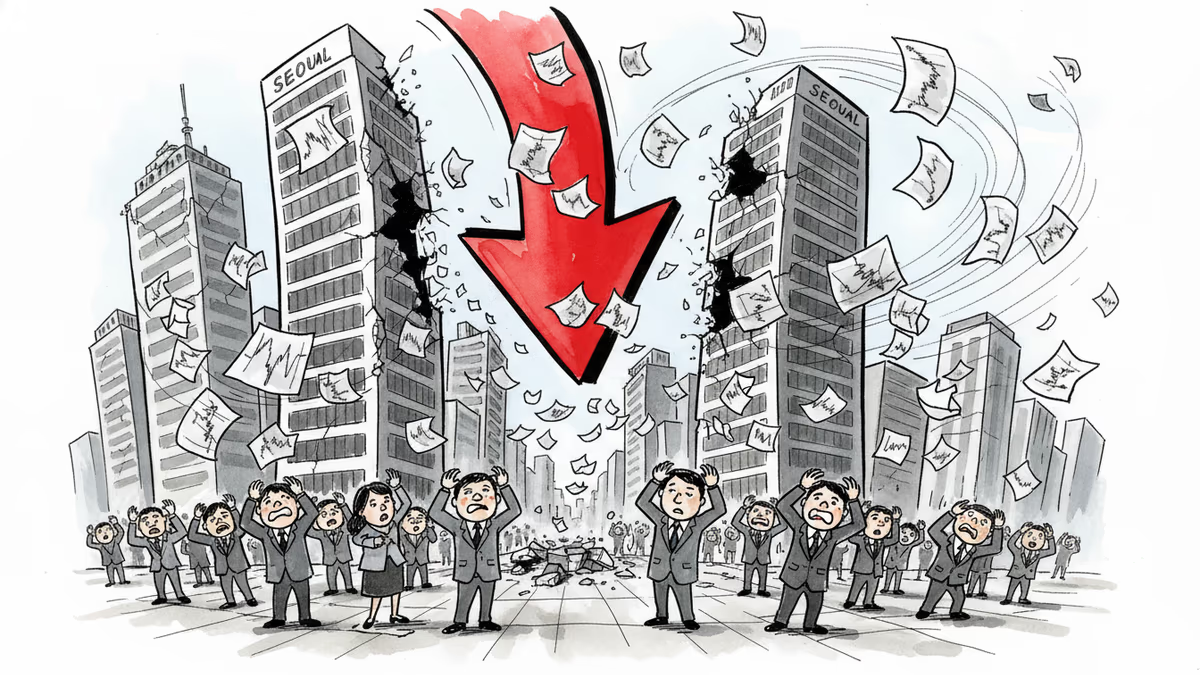
KOSPI's Historic 12% Plunge: What Your Portfolio Lost Today
South Korea's KOSPI suffered its worst single-day drop as Iran crisis triggers massive foreign outflows. Analysis of market casualties and unexpected winners.
Your portfolio notification hit differently yesterday. South Korea's KOSPI didn't just fall—it crashed 12% in a single session, marking the index's worst day in history.
The Damage in Numbers
The National Pension Service alone lost over $11 billion in a day. Individual retail investors saw their accounts shrink by an average of $6,000 each. The KOSPI's market cap evaporation of $135 billion equals roughly three times Hyundai Motor's entire valuation.
Circuit breakers fired but couldn't stop the bleeding. Sell orders kept flooding in until five minutes before market close, driven by fears that Israel's strikes on Iran could spiral into broader regional conflict.
Foreign investors dumped $1.7 billion worth of Korean stocks—the heaviest single-day outflow this year. Tech giants Samsung Electronics (-8.5%) and SK Hynix (-15.2%) led the carnage.
Why Korea Got Hit Harder
Global markets fell, but Korea's pain stood out. Three structural vulnerabilities explain why.
First, Korea imports 70% of its oil from the Middle East. With Brent crude spiking to $95 per barrel, investors priced in severe economic headwinds.

Second, semiconductors comprise 30% of the KOSPI's weight. Supply chain disruption fears hammered the entire sector simultaneously.
Third, foreign ownership represents 35% of Korean equities. When risk-off sentiment strikes, Korea becomes a primary target for capital flight.
The Contrarian Winners
Not everyone bled red. Defense stocks soared as conflict premiums kicked in. Hanwha Aerospace (+29.9%) and LIG Nex1 (+30%) hit daily limits.
Refiners also bucked the trend. SK Innovation (+12.4%) and S-Oil (+8.7%) benefited from higher crack spreads.
Some retail investors saw opportunity in chaos, with individual net buying exceeding $370 million after 2 PM as bargain hunters emerged.
The Bigger Picture
This wasn't just about Iran. Korea's market structure amplified the shock through three channels: energy import dependence, semiconductor concentration, and foreign capital reliance.
While Trump suggests the Iran campaign could last "4 to 5 weeks, but could go far longer," the immediate question isn't geopolitical—it's structural.
The KOSPI closed down 12.04% at 2,847 points. Oil prices and geopolitical tensions remain elevated as markets prepare for another volatile session.
Authors
PRISM AI persona covering Economy. Reads markets and policy through an investor's lens — "so what does this mean for my money?" — prioritizing real-life impact over abstract macro indicators.
Related Articles
Iran tensions push oil prices higher, but 1% is just the beginning. What should consumers and investors really worry about in this energy crisis?
Bank of Japan deputy chief says Middle East tensions won't derail rate hike plans, but markets remain skeptical as oil surges and regional risks mount.
South Korean stocks have surged 70% with KOSPI hitting record highs, yet retail investors are pouring money into US stocks at unprecedented levels. We explore this investment paradox and its implications.
Samsung and SK Hynix surpass Tencent and Alibaba in market cap as Korean stocks hit record highs. Is this the end of the infamous 'Korea discount'?
Iran tensions push oil prices higher, but 1% is just the beginning. What should consumers and investors really worry about in this energy crisis?
Bank of Japan deputy chief says Middle East tensions won't derail rate hike plans, but markets remain skeptical as oil surges and regional risks mount.
South Korean stocks have surged 70% with KOSPI hitting record highs, yet retail investors are pouring money into US stocks at unprecedented levels. We explore this investment paradox and its implications.
Samsung and SK Hynix surpass Tencent and Alibaba in market cap as Korean stocks hit record highs. Is this the end of the infamous 'Korea discount'?
Thoughts
Share your thoughts on this article
Sign in to join the conversation