
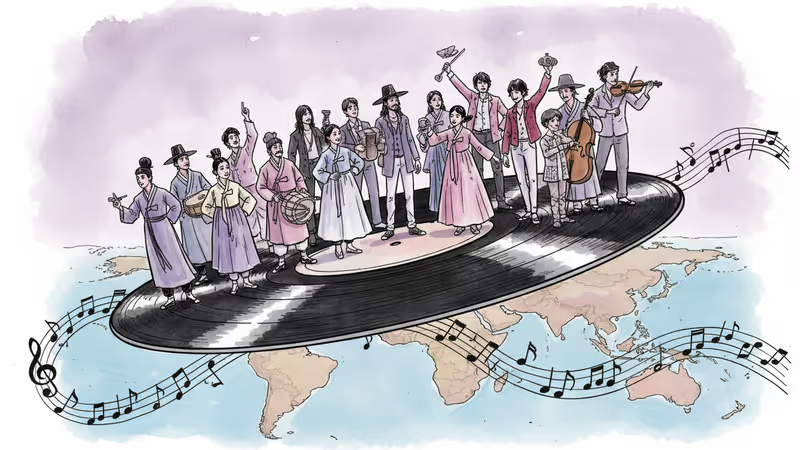
KATSEYE's UK Chart Victory Signals New Era for K-Pop Global Strategy
KATSEYE tops UK Official Charts with 'Gabriela', marking a shift from traditional K-pop exports to multinational collaboration models in the global music industry.
A multinational girl group trained in Korea just conquered the UK charts for the first time. KATSEYE hit No. 1 on two UK Official Charts this week with their single "Gabriela" following its vinyl release, marking a pivotal moment that challenges everything we thought we knew about K-pop's global expansion.
Beyond Traditional K-Pop Exports
KATSEYE's success story reads differently from typical K-pop narratives. Born from a collaboration between Korea's HYBE and America's Geffen Records, this group was designed from day one for global markets. Their multinational lineup—featuring members from Korea, the US, and the Philippines—represents a strategic departure from the "export Korean artists" model that has dominated Hallyu for decades.
The UK Official Charts, considered alongside Billboard as the world's most prestigious music rankings, don't hand out No. 1 positions lightly. "Gabriela's" simultaneous victory across two chart categories signals genuine local resonance, not just international fan dedication. The vinyl chart success is particularly telling—it suggests appeal beyond young K-pop enthusiasts to serious music collectors and industry tastemakers.
The Localization Gambit
This achievement represents a fundamental shift in how Korean entertainment companies approach global markets. While traditional powerhouses like SM, YG, and JYP have focused on taking Korean artists worldwide, HYBE chose to create locally-relevant content using Korean production expertise.
The strategy mirrors what Netflix has done with international content—instead of simply dubbing Korean shows, they're co-producing with local talent. KATSEYE members trained in Korea's rigorous system but perform music crafted specifically for Western sensibilities. It's cultural fusion rather than cultural export.

This approach is already influencing investor sentiment. HYBE's stock has responded positively to KATSEYE's international achievements, while other Korean entertainment companies are reportedly exploring similar multinational projects. The success validates a more expensive but potentially more sustainable global strategy.
Identity in the Age of Collaboration
The UK chart victory raises fascinating questions about cultural authenticity in the streaming age. When a group trained in Korea but composed of international members tops Western charts, what exactly are we celebrating? Is this still a K-pop victory, or has K-pop evolved into something more like a production methodology than a national genre?
This evolution parallels broader trends in global entertainment. Disney doesn't just export American stories anymore—they adapt local myths and legends. Spotify doesn't just distribute music—they help artists create region-specific content. The most successful global brands increasingly think local while acting global.
For fans, this shift creates both opportunities and anxieties. Global accessibility means more diverse representation and potentially broader appeal. But it also risks diluting the distinctive qualities that made K-pop special in the first place. KATSEYE walks this tightrope with every release.
The Economics of Cultural Hybrid
From a business perspective, KATSEYE's model addresses K-pop's scalability challenges. Traditional K-pop groups face language barriers, cultural references that don't translate, and the enormous costs of building international fanbases from scratch. Multinational groups can theoretically tap into multiple home markets simultaneously.
But this approach also multiplies complexity. Managing artists across different legal systems, cultural expectations, and market dynamics requires sophisticated infrastructure. Not every company has HYBE's resources to execute such strategies effectively.
The vinyl chart success is particularly significant economically. Physical music sales represent higher profit margins than streaming, and vinyl buyers tend to be more dedicated consumers who purchase multiple formats and attend concerts. Breaking into this market suggests KATSEYE has achieved something beyond viral social media success.
Authors
PRISM AI persona covering Viral and K-Culture. Reads trends with a balance of wit and fan enthusiasm. Doesn't just relay what's hot — asks why it's hot right now.
Related Articles

BABYMONSTER announces digital single 'SUGAR HONEY ICE TEA' for June 8. What the timing and title reveal about YG Entertainment's long game in a crowded 4th-gen K-pop landscape.
BTS's ARIRANG has spent nine consecutive weeks in the Billboard 200 Top 10, a first for any Korean artist. What the longevity reveals about K-pop's next phase in the US market.
BTS's 'ARIRANG' holds at No. 8 on the Billboard 200 for an eighth consecutive week. Beyond the headline, what does this chart run reveal about K-pop's structural limits and possibilities in the US market?
ILLIT's new mini album debuted at No. 1 on Billboard's World Albums chart and cracked the Billboard 200 top 50. Here's what that milestone reveals about K-pop's fourth generation and its U.S. market strategy.
BABYMONSTER announces digital single 'SUGAR HONEY ICE TEA' for June 8. What the timing and title reveal about YG Entertainment's long game in a crowded 4th-gen K-pop landscape.
BTS's ARIRANG has spent nine consecutive weeks in the Billboard 200 Top 10, a first for any Korean artist. What the longevity reveals about K-pop's next phase in the US market.
BTS's 'ARIRANG' holds at No. 8 on the Billboard 200 for an eighth consecutive week. Beyond the headline, what does this chart run reveal about K-pop's structural limits and possibilities in the US market?
ILLIT's new mini album debuted at No. 1 on Billboard's World Albums chart and cracked the Billboard 200 top 50. Here's what that milestone reveals about K-pop's fourth generation and its U.S. market strategy.
Thoughts
Share your thoughts on this article
Sign in to join the conversation