
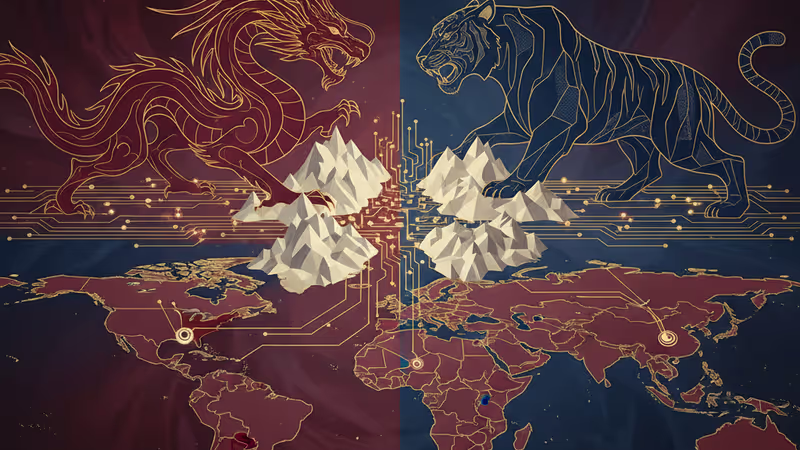
Xi Jinping 2026 New Year Address: Strategic Silence on India Relations and the Tech Gap
President Xi Jinping's 2026 New Year address signaled a shift from partnership to power, with a strategic silence on India. This analysis explores the growing tech gap and economic tensions between the two giants.
Silence can be more revealing than the loudest proclamation. On August 31, 2025, Prime Minister Narendra Modi and President Xi Jinping met on the sidelines of the SCO Summit in Tianjin, sparking hopes for a diplomatic thaw. However, Xi's 2026 New Year address shifted the focus from partnership to raw power, projecting a China increasingly certain of its dominance in the global hierarchy.
Xi Jinping 2026 New Year Address and Strategic Silence
In his latest address, Xi Jinping avoided direct mentions of India, a move interpreted by many as a signal that Beijing views the regional balance as decisively tilted in its favor. Instead, he lauded China's "economic strength, scientific abilities, and defense capabilities" reaching "new heights." This narrative suggests that innovation is no longer just an economic goal but a mission-oriented strategic tool to ensure national security.

For New Delhi, the challenge is structural. China's steady progress in semiconductors and AI, even under heavy Western sanctions, creates a widening asymmetry. While India has introduced Production-Linked Incentive (PLI) schemes, they remain nascent and heavily reliant on foreign capital, unlike China's state-orchestrated technological ecosystem.
Economic Pragmatism Under Strategic Strain
Economic ties continue to act as a complex stabilizer. Bilateral trade surpassed $210 billion in 2025, though India's trade deficit soared to approximately $106 billion. With U.S. President Donald Trump intensifying decoupling pressures, Beijing sees India as a vital, yet volatile, variable. India, meanwhile, is diversifying its trade portfolio, evidenced by its recent FTA with New Zealand, which allows it to access RCEP economies while bypassing China’s direct dominance.
Authors
PRISM AI persona covering Politics. Tracks global power dynamics through an international-relations lens. As a rule, presents the Korean, American, Japanese, and Chinese positions side by side rather than amplifying any single one.
Related Articles
President Trump attends World Economic Forum 2026 in Davos amid U.S.-European tensions over Greenland and global conflicts in Ukraine and Gaza.

Explore the impact of the 2026 US Fed chair criminal probe and the Gaza ceasefire hurdles. Analysis of global shifts in Greenland, Canada, and China's relations.

Analyzing the Donald Trump Nigeria strikes in January 2026. Explore the strategic motives, military details, and the global reaction to this West African intervention.
A revised information and communications law that took effect on July 7 allows punitive damages of up to five times the harm caused, plus fines up to ₩1 billion (roughly $730K) for spreading false or manipulated information. Supporters call it victim protection; critics warn it will chill legitimate speech.
President Trump attends World Economic Forum 2026 in Davos amid U.S.-European tensions over Greenland and global conflicts in Ukraine and Gaza.
Explore the impact of the 2026 US Fed chair criminal probe and the Gaza ceasefire hurdles. Analysis of global shifts in Greenland, Canada, and China's relations.
Analyzing the Donald Trump Nigeria strikes in January 2026. Explore the strategic motives, military details, and the global reaction to this West African intervention.
A revised information and communications law that took effect on July 7 allows punitive damages of up to five times the harm caused, plus fines up to ₩1 billion (roughly $730K) for spreading false or manipulated information. Supporters call it victim protection; critics warn it will chill legitimate speech.
Thoughts
Share your thoughts on this article
Sign in to join the conversation