
Jibba Jabber: The Disturbing 90s Stress Toy That Predicted Our Burnout Culture
An analysis of the Jibba Jabber doll, the bizarre 90s corporate stress toy, and what its unsettling design reveals about the evolution of our burnout economy.
The Lede: A Bizarre Artifact from the Dawn of Corporate Burnout
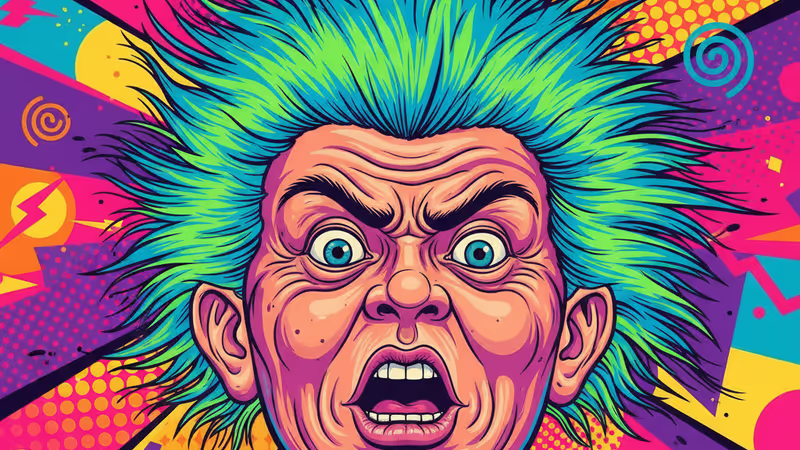
Before meditation apps and corporate wellness platforms, there was Jibba Jabber. Marketed in the mid-1990s not to children, but to stressed-out executives, this doll was a crude, physical tool for catharsis. Its core feature—a deeply unsettling choking sound when shaken—wasn't a bug; it was the entire value proposition. For today's leaders, the Jibba Jabber isn't just a weird pop culture footnote; it's a critical data point on the pre-digital history of the multi-billion-dollar burnout economy we now operate in.
Why It Matters: The MVP of the Wellness Industry
The existence of Jibba Jabber signifies a crucial turning point. It was one of the first mass-market products that explicitly acknowledged and attempted to monetize white-collar anxiety. Its commercial visibility, however brief, validated that a significant market existed for stress-management tools in the corporate world.
- First-Order Effect: It provided a tangible, if disturbing, outlet for workplace frustration at a time when discussing mental health was taboo.
- Second-Order Effect: It laid the primitive groundwork for the corporate wellness industry. Jibba Jabber was the physical ancestor of the digital solutions—from Calm subscriptions to Headspace for work—that companies now deploy to manage employee stress. It proved the demand was real, even if the solution was cartoonishly aggressive.
The Analysis: A Product of Its Time
To understand Jibba Jabber, you must understand the corporate environment of the mid-1990s. This was the era after the "Greed is Good" 80s and before the dot-com bubble's full inflation. Corporate culture was high-pressure, but the vocabulary and tools for managing the resulting stress were primitive.
Competitive Dynamics: Jibba Jabber wasn't competing with other toys. It was competing with the executive desk Zen garden, the Newton's cradle, and the oversized stress ball. While those products offered passive, meditative relief, Jibba Jabber offered active, simulated violence. Its unique selling proposition was a raw, physical catharsis that other products were too genteel to approach. It was a product for an era that still saw aggression as a potential component of ambition, rather than a liability to be managed through mindfulness.
PRISM Insight: From Physical Catharsis to Digital Abstraction
The evolution from Jibba Jabber to modern wellness apps represents a profound technological and cultural shift in how we manage stress. We have moved from tangible, physical interactions to intangible, digital ones.
- The Trend: The core user need—mitigating corporate stress—has remained constant. However, the solution has been dematerialized. We no longer "throttle" a physical object; we follow a guided meditation on a screen. This abstraction allows for scalability, data collection, and a more socially acceptable user experience.
- Investment Implication: The next frontier isn't just more apps, but the potential re-physicalization of digital wellness. Consider the rise of smart rings (Oura) and haptic feedback devices. The market may be signaling a return to tangible interfaces for managing abstract emotional states, creating an opportunity for hardware that bridges the gap Jibba Jabber clumsily tried to fill 30 years ago.
PRISM's Take: An Unsettlingly Honest Product
The Jibba Jabber doll is more than a bizarre relic; it's a monument to an unmet, unarticulated need. Its deeply flawed and disturbing design was, in a way, more honest about the violent nature of extreme stress than any modern wellness app. It acknowledged the raw, primal urge to lash out. Today's solutions have sanitized and productized that same need into a clean, subscription-based service. The Jibba Jabber failed as a long-term product not because the problem it addressed wasn't real, but because its solution was too uncomfortably close to the truth.
Related Articles
The chaotic first U.S. TikTok Awards revealed a critical truth: The platform's algorithmic magic can't be replicated. An analysis of the future of media.

An analysis of South Korea's new illegal video site, a successor to Nth Room. We explore its gamified model, crypto payments, and systemic regulatory failure.
Interstellar comet 3I/ATLAS is here. We analyze why this third visitor matters more for big data and space tech than for alien hunters. A PRISM deep dive.
Analysis of frontline medical advice reveals a $500B 'adherence gap' in healthcare. Learn why your daily habits are a systemic risk and a huge tech opportunity.