
Japan's Rate Shock: The End of Free Money and the Unwinding of a $10 Trillion Trade
The Bank of Japan's historic rate hike ends the global era of free money. Our analysis breaks down the impact on the Yen carry trade, global markets, and investors.
The Lede: The Last Domino Falls
The Bank of Japan (BoJ) has finally pulled the trigger, raising its policy rate to 0.75%—the highest level in three decades. This isn't just another central bank announcement; it's the final, resounding shot in the global war on zero-interest-rate policy (ZIRP). For global executives and investors, this decision closes a multi-decade chapter of ultra-cheap capital and signals a tectonic shift in the architecture of global finance. The era of borrowing Yen for virtually nothing to fund investments worldwide is over, and the aftershocks are just beginning.
Why It Matters: The Great Unwinding Begins
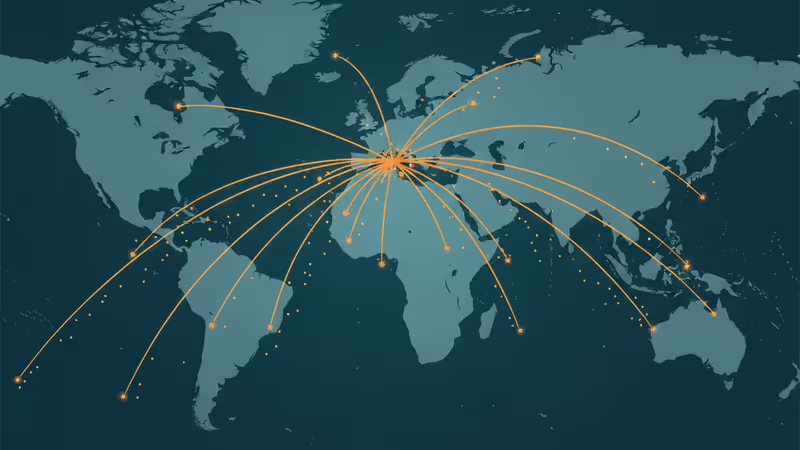
The BoJ's move has profound second-order effects that extend far beyond Tokyo. For years, the world ran on the "Yen carry trade"—a multi-trillion dollar strategy of borrowing cheap Yen to invest in higher-yielding assets globally. The end of ZIRP in Japan directly threatens this foundation.
- Global Liquidity Drain: As the carry trade unwinds, Japanese investors will repatriate funds, selling off foreign assets from US Treasuries to European equities. This creates a vacuum in global liquidity, potentially increasing volatility and borrowing costs everywhere.
- A Resurgent Yen?: While the rate differential with the US remains vast, this marks a fundamental reversal. A stronger Yen pressures Japan's export-heavy giants like Toyota and Sony, but it also increases the purchasing power of Japanese firms, potentially fueling a new wave of outbound M&A.
- Corporate Japan's Cash Hoard: Japanese corporations sit on over $3 trillion in cash. In a zero-rate world, hoarding was rational. With rising rates, that cash becomes a liability. Expect a surge in capital expenditure, R&D, and shareholder returns as companies are finally forced to put their money to work.
The Analysis: Escaping the Deflationary Quagmire
This is not a carbon copy of the Fed or ECB's inflation fight. The BoJ is not slamming the brakes; it's gingerly taking its foot off an accelerator that's been floored for a generation. For 30 years, Japan has been locked in a deflationary spiral where falling prices and wages crushed growth. "Abenomics" threw trillions in quantitative easing at the problem, but it was a blunt instrument.
What's different now? Wages. For the first time in a generation, Japan is seeing sustainable, broad-based wage growth, confirmed by the recent "Shunto" spring wage negotiations. This was the final piece of evidence Governor Ueda needed to declare a tentative victory over deflation. The move from negative to positive rates is a declaration that the Japanese economy finally has a pulse, driven by domestic demand rather than just cheap exports.
PRISM Insight: The Rebirth of Japan Inc. as an Innovation Engine
The end of ZIRP is the catalyst that could finally modernize the Japanese corporate landscape. For too long, zombie companies have been kept alive by free money, and healthy firms have been overly conservative. This policy shift acts as a powerful Darwinian mechanism.
We predict a new wave of investment in automation, AI, and enterprise software as companies race to boost productivity to justify higher wages and capital costs. With a stronger Yen and pressure to deploy cash, Japanese tech giants may become aggressive acquirers of global tech assets. For investors, the narrative on Japan is shifting from a low-growth currency play to a compelling story of domestic transformation and corporate reform.
PRISM's Take: This is a Regime Change, Not a Tweak
Do not misinterpret this as a one-and-done hike. This is the beginning of a slow, deliberate, but irreversible process of policy normalization. The BoJ will move cautiously, but the direction of travel is now clear. For business leaders, this means re-evaluating supply chain costs, currency hedging strategies, and investment hurdles related to Japan.
The most critical variable to watch is the behavior of Japan's colossal pension funds (like the GPIF) and life insurers. As domestic bond yields rise, their appetite for foreign assets will wane. Their retreat from global markets will be gradual but immense. The BoJ's decision wasn't just a move for Japan; it was the final turning point for the global economy, pushing the world fully into a new, more volatile, and more expensive era of capital.
Related Articles

The Bank of Japan's rate hike isn't just a local story. It signals the end of cheap yen, threatening the global carry trade and reshaping investment strategy.

The Bank of Japan's rate hike paradoxically weakened the yen, signaling global liquidity remains intact. Discover why this matters for risk assets like Bitcoin.
The Bank of Japan is signaling an end to negative interest rates as corporate giants unleash investment. We analyze the global impact on the yen and capital flows.

The Fed's 'higher for longer' rate stance is a structural reset for tech. PRISM analyzes the end of the ZIRP era and its impact on valuations and strategy.