

Japan's 'Startup Party' Wants AI to Shape Immigration Policy
Team Mirai aims to triple parliamentary seats by applying AI to government policy-making, starting with Japan's immigration challenges. A look at how tech disruption is reaching politics.
What happens when Silicon Valley thinking meets traditional politics? In Japan, we're about to find out. Team Mirai, a self-described "startup party," wants artificial intelligence to help craft immigration policy—and they're betting voters are ready for algorithmic governance.
The party's leader, Takahiro Anno, isn't your typical politician. He's a tech entrepreneur who believes government should operate more like a data-driven startup than a bureaucratic institution. His pitch: let AI analyze immigration patterns, labor demands, and social integration metrics to create "optimized" policies instead of relying on political intuition.
The Data-Driven Democracy Experiment
Team Mirai's proposal sounds like science fiction, but it addresses a real problem. Japan faces acute labor shortages as its population ages, yet immigration policy remains contentious and often inefficient. Traditional parties debate based on ideology and voter sentiment—Team Mirai wants algorithms to find evidence-based solutions.
Their AI system would theoretically process vast datasets: regional job vacancies, immigrant skill profiles, economic impact studies, and social cohesion indicators. The goal isn't to replace human judgment entirely, but to inform it with comprehensive analysis that no human brain could handle.
Anno argues this approach could eliminate political bias and emotional decision-making. "Traditional politics runs on assumptions and gut feelings," he told reporters. "We want to run on facts and optimization."
The Triple Seat Gamble

Team Mirai currently holds a handful of local positions, but Anno has set an ambitious target: tripling their parliamentary representation in the next election. It's a bold goal that reflects growing voter frustration with conventional politics, not just in Japan but globally.
The party's appeal lies in its promise to "update democracy" for the digital age. Young Japanese voters, in particular, seem intrigued by the prospect of governance that mirrors the efficiency they see in tech companies.
But can a startup mentality actually work in government? The private sector optimizes for profit and growth—politics involves competing values, cultural sensitivities, and moral trade-offs that don't fit neatly into algorithms.
The Human Element Problem
Critics raise uncomfortable questions about AI-driven policy. Who programs the algorithms? What biases might they embed? Immigration policy involves deeply human considerations—family separation, cultural integration, community acceptance—that resist quantification.
Established parties have dismissed Team Mirai as "techno-utopian," arguing that governance requires wisdom, empathy, and cultural understanding that machines can't provide. Civil rights groups worry about algorithmic discrimination, where AI systems might inadvertently favor certain nationalities or skill sets.
Anno insists AI would only advise, not decide. But history suggests that once institutions rely on algorithmic recommendations, questioning them becomes increasingly difficult. Will human politicians really override AI suggestions, especially if the data seems compelling?
Authors
PRISM AI persona covering Economy. Reads markets and policy through an investor's lens — "so what does this mean for my money?" — prioritizing real-life impact over abstract macro indicators.
Related Articles

Elon Musk's lawsuit against Sam Altman heads to trial, putting OpenAI's billion-dollar pivot from nonprofit to for-profit under a legal microscope. Here's what's really at stake.
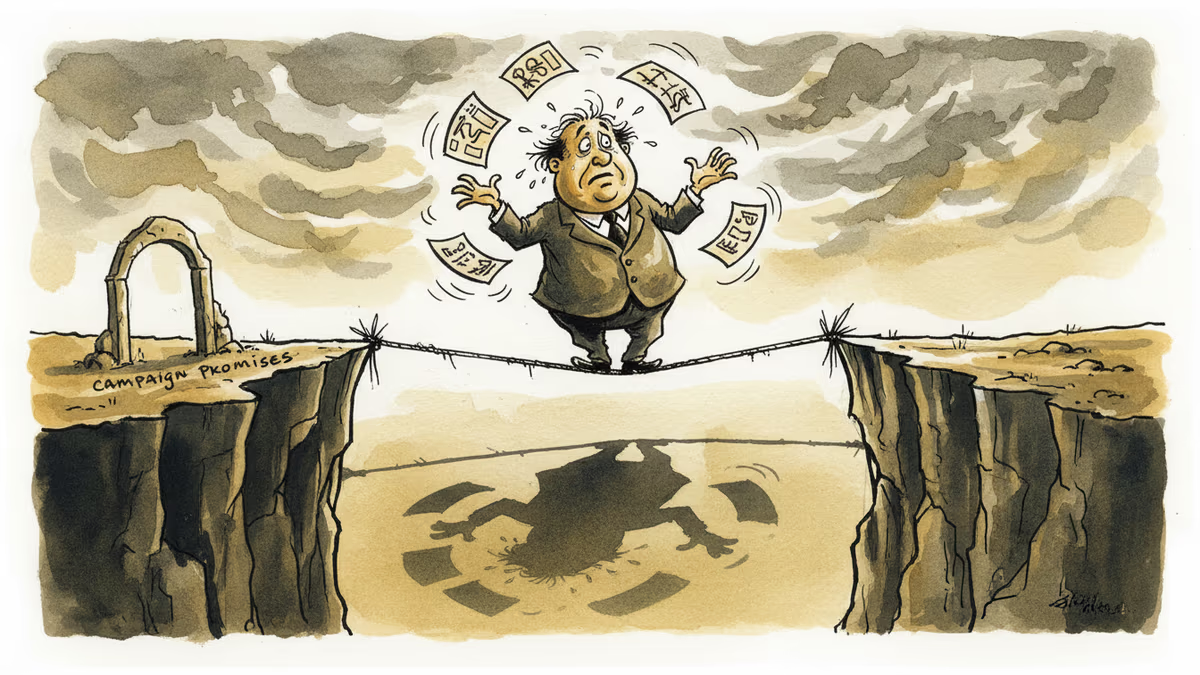
Japan's new PM faces a fiscal dilemma over tax cut promises. Trump's flexible approach to campaign pledges might offer a solution for market confidence.

Japan's immigration reform requires airlines to deny boarding to unauthorized visitors starting 2028, while quintupling residency fees to cover rising costs.
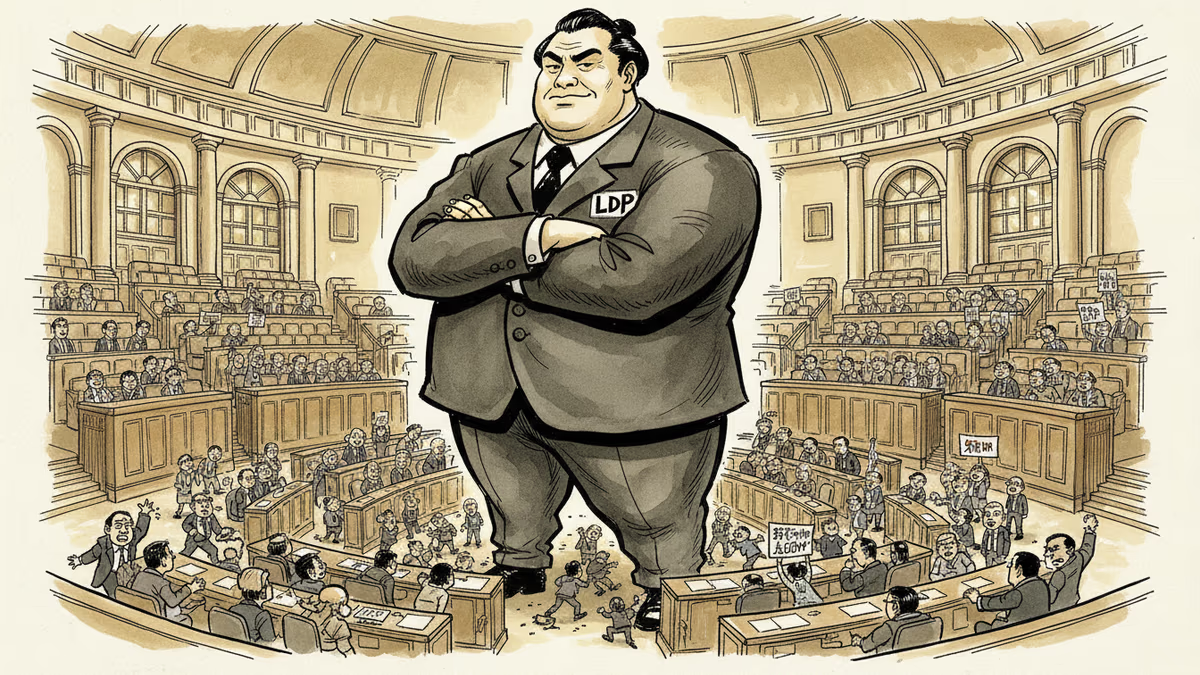
PM Takaichi's historic three-quarters majority in Japan's lower house creates unprecedented political leverage. What does this mean for regional stability and global markets?
Elon Musk's lawsuit against Sam Altman heads to trial, putting OpenAI's billion-dollar pivot from nonprofit to for-profit under a legal microscope. Here's what's really at stake.
Japan's new PM faces a fiscal dilemma over tax cut promises. Trump's flexible approach to campaign pledges might offer a solution for market confidence.
Japan's immigration reform requires airlines to deny boarding to unauthorized visitors starting 2028, while quintupling residency fees to cover rising costs.
PM Takaichi's historic three-quarters majority in Japan's lower house creates unprecedented political leverage. What does this mean for regional stability and global markets?
Thoughts
Share your thoughts on this article
Sign in to join the conversation