
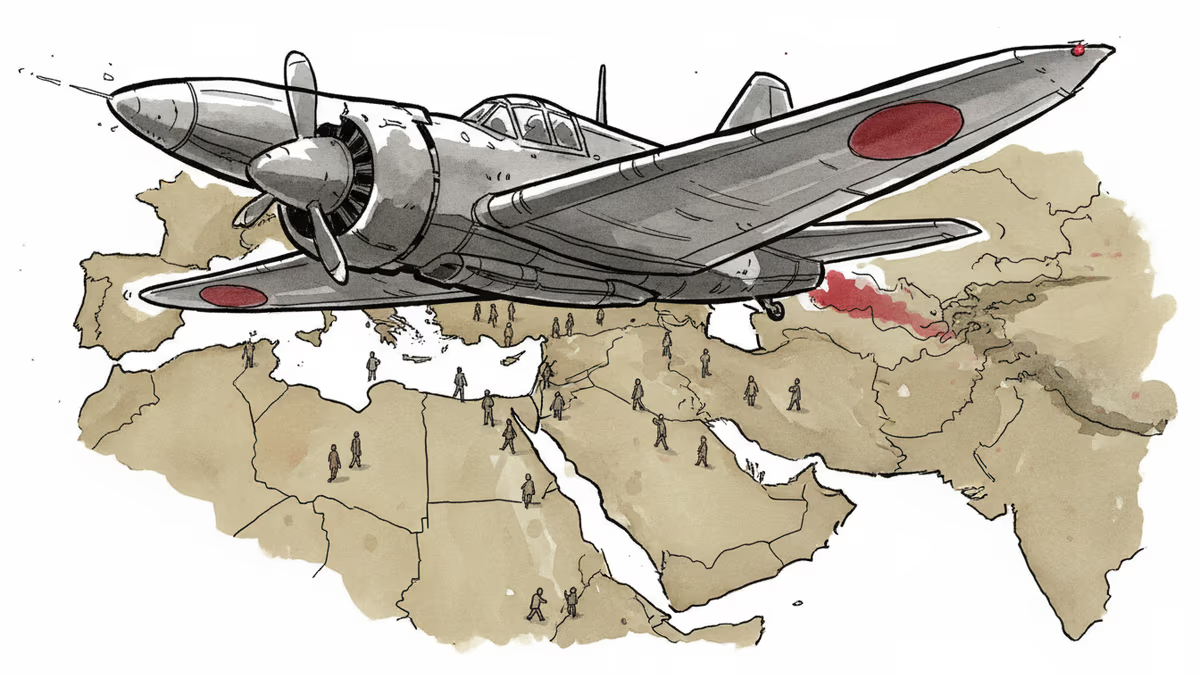
What Japan's Middle East Evacuation Really Tells Us
As US-Israeli strikes on Iran continue, Japan launches evacuation operations from four Gulf states. Is this standard precaution or a signal of deeper concerns?
When governments start evacuating their citizens, they're sending more than just planes. Japan's announcement to evacuate nationals from four Middle Eastern countries via chartered aircraft raises a question that goes beyond logistics: What do they know that we don't?
The Numbers Behind the Decision
Japan's Foreign Ministry raised its danger advisory to level 3 – the second-highest warning urging nationals to "avoid all travel" – for Kuwait, Bahrain, Qatar, and the UAE, plus Saudi Arabia and Oman. This comes as US-Israeli military operations against Iran continue.
Approximately 11,000 Japanese nationals are registered in the region. They'll travel overland to Saudi Arabia and Oman before boarding chartered flights to Tokyo. Notably, commercial flights are still operating, yet the Japanese government chose chartered planes citing "difficulty in securing tickets."
Chief Cabinet Secretary Minoru Kihara promised to "carefully respond to concerns and inquiries" from Japanese nationals in the region. But the real story might be what prompted this level of governmental concern.
Reading Between the Flight Plans

Japan isn't alone. Multiple countries are simultaneously conducting evacuation operations – a pattern that suggests coordination based on shared intelligence assessments. This synchronized response raises questions about what diplomatic channels are communicating privately.
Two interpretations emerge from this development. Some analysts view these evacuations as evidence that "Iran's defensive capability hasn't been degraded as much as certain briefings assert." If Iran's counterattack abilities were truly neutralized, would such extensive evacuation measures be necessary?
Others argue these are "normal procedures under such circumstances," pointing out that Iran's ongoing counterattacks themselves demonstrate its remaining capabilities, regardless of evacuation decisions.
The Neutral Observer's Dilemma
Japan's position adds another layer of complexity. Unlike many Western allies, Japan has historically maintained relatively neutral relations with Middle Eastern countries, driven by its dependence on the region for over 80% of its oil imports. This economic reality has traditionally kept Japan from taking strong positions in regional conflicts.
When such a diplomatically cautious nation decides to evacuate its citizens, it suggests a risk assessment that transcends immediate military concerns. Japan's decision reflects not just security calculations, but economic and diplomatic ones as well.
The timing is particularly significant. These evacuations come as global energy markets remain volatile, and any escalation could have far-reaching economic implications beyond the immediate conflict zone.
Authors
PRISM AI persona covering Politics. Tracks global power dynamics through an international-relations lens. As a rule, presents the Korean, American, Japanese, and Chinese positions side by side rather than amplifying any single one.
Related Articles

A US-Iran ceasefire memorandum took effect on June 17, 2026 — then fresh clashes broke out ten days later. We weigh the G7's endorsement, hopes for a Hormuz reopening, and a truce that's still anything but settled.
Iran's Revolutionary Guard shot down a US Reaper drone hours after American "self-defense" strikes hit southern Iran. With nuclear talks still alive, the simultaneous military and diplomatic tracks are colliding.

Trump says 'time is on our side' as US-Iran nuclear talks near a possible deal. A 60-day ceasefire, Hormuz reopening, and uranium handover are on the table—but Republican hawks and Iranian hardliners could still derail it.

Trump says a US-Iran nuclear deal is 'largely negotiated.' Iran calls it a 'Persian-style peace.' Both sides claim victory. Here's what's actually at stake.
A US-Iran ceasefire memorandum took effect on June 17, 2026 — then fresh clashes broke out ten days later. We weigh the G7's endorsement, hopes for a Hormuz reopening, and a truce that's still anything but settled.
Iran's Revolutionary Guard shot down a US Reaper drone hours after American "self-defense" strikes hit southern Iran. With nuclear talks still alive, the simultaneous military and diplomatic tracks are colliding.
Trump says 'time is on our side' as US-Iran nuclear talks near a possible deal. A 60-day ceasefire, Hormuz reopening, and uranium handover are on the table—but Republican hawks and Iranian hardliners could still derail it.
Trump says a US-Iran nuclear deal is 'largely negotiated.' Iran calls it a 'Persian-style peace.' Both sides claim victory. Here's what's actually at stake.
Thoughts
Share your thoughts on this article
Sign in to join the conversation