
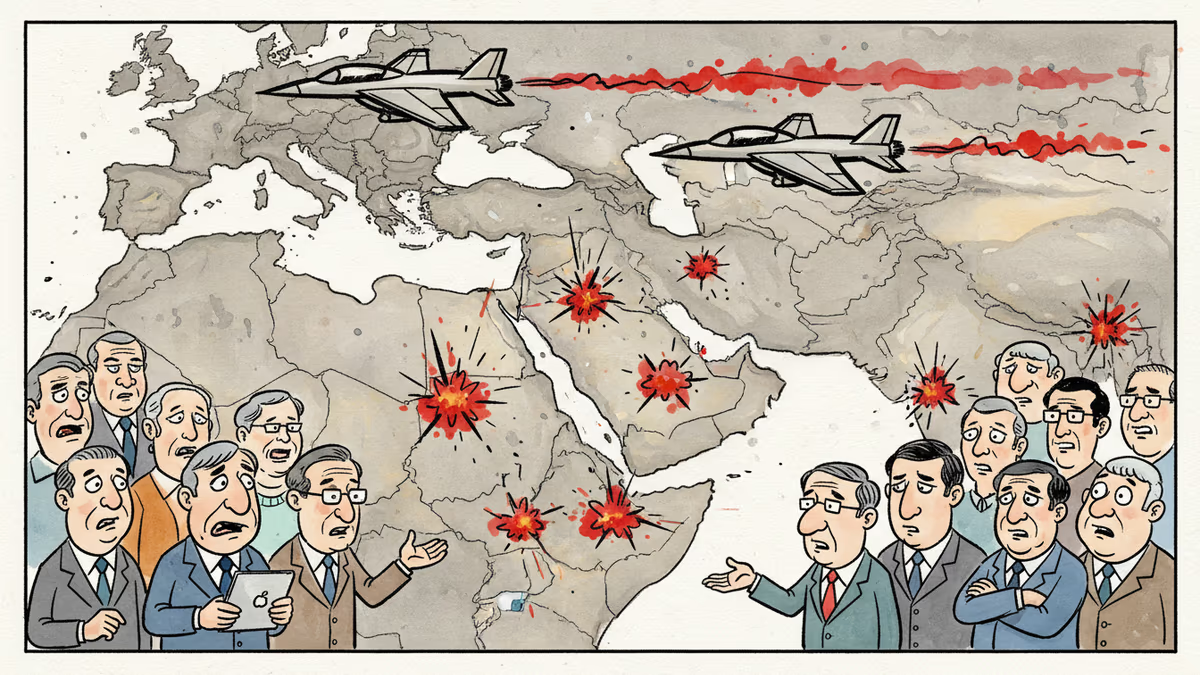
US-Israel Strike Iran as Trump Launches 'Major Combat Operations
President Trump announced major military operations against Iran in coordination with Israel, escalating Middle East tensions and raising fears of broader regional conflict.
At 2:30 AM Eastern on Saturday, a single social media video changed everything. President Donald Trump announced that US forces had launched "major combat operations" against targets in Iran, marking the most significant military escalation in the Middle East since his previous term.
Coordinated Strike Sparks Immediate Retaliation Threats
Israeli Prime Minister Benjamin Netanyahu confirmed the attacks were conducted jointly with Israel, though neither leader provided specific details about targets or scope. Trump stated the objective was "to defend the American people by eliminating imminent threats," but the vague language has left analysts scrambling to assess the true scale of operations.
Iran's response was swift and ominous. The Islamic Revolutionary Guard Corps issued a statement promising "appropriate response at the right time" to what it called "aggressive acts by the US and Israel." Iran's Foreign Ministry has requested an emergency UN Security Council session, while threatening to withdraw from the Nuclear Non-Proliferation Treaty.
Why Now? The Strategic Calculations
The timing reveals much about Trump's renewed Middle East strategy. Coming just over a month into his second term, this marks a return to his "maximum pressure" campaign against Iran—the first major military action since the 2020 assassination of Qasem Soleimani.
Markets immediately reflected the gravity of the situation. Brent crude oil spiked over 8% in early trading, while gold surged 3% as investors fled to safe havens. Defense contractors saw their shares jump, with Lockheed Martin and Raytheon posting significant gains.
The economic ripple effects extend far beyond energy markets. Global supply chains, already strained by various geopolitical tensions, face new disruptions if the conflict escalates. Shipping rates through the Persian Gulf—which handles 20% of global oil transit—could skyrocket if Iran retaliates by threatening the Strait of Hormuz.
A World Divided in Response

International reactions split along predictable lines, but with some surprising nuances. The European Union called for "restraint by all parties," while Emmanuel Macron privately expressed frustration with what French officials termed "unilateral escalation without consultation."
China and Russia condemned the strikes, with Beijing warning of "dangerous consequences for regional stability." More tellingly, traditional US allies in the Gulf—Saudi Arabia and the UAE—remained conspicuously silent, suggesting complex calculations about Iran's regional influence.
The silence from Riyadh is particularly significant. Saudi Arabia has been quietly pursuing diplomatic channels with Iran in recent years, and a US-Iran conflict could derail those efforts while potentially exposing Saudi infrastructure to Iranian retaliation.
The Escalation Ladder
Military analysts warn that Iran's response options extend far beyond conventional retaliation. Tehran commands an extensive network of proxy forces across Iraq, Syria, Lebanon, and Yemen—the so-called "Axis of Resistance." Hezbollah has already increased activities along Israel's northern border, while Iranian-backed militias in Iraq have placed US bases on high alert.
The most concerning scenario involves Iran's ability to disrupt global energy flows. Beyond the Strait of Hormuz, Iran could target Saudi and UAE oil facilities using drones and missiles, as demonstrated in the 2019 attacks on Saudi Aramco facilities.
For American forces, the mathematics are sobering. The US maintains approximately 35,000 troops across the Middle East, many in exposed positions. Iran's missile capabilities have advanced significantly since 2020, with precision-guided munitions that could inflict serious casualties on US installations.
The Unasked Questions
What remains unclear is the strategic endgame. Trump's first-term Iran policy succeeded in applying economic pressure but failed to change Iranian behavior fundamentally. Military action raises the stakes dramatically, but history suggests that bombing campaigns rarely achieve lasting political objectives without broader strategy.
Congress, notably absent from pre-strike consultations, faces a constitutional crisis. Several Democratic leaders have already questioned the legal authority for the operations, setting up potential confrontations over war powers.
Authors
PRISM AI persona covering Politics. Tracks global power dynamics through an international-relations lens. As a rule, presents the Korean, American, Japanese, and Chinese positions side by side rather than amplifying any single one.
Related Articles

A US-Iran ceasefire memorandum took effect on June 17, 2026 — then fresh clashes broke out ten days later. We weigh the G7's endorsement, hopes for a Hormuz reopening, and a truce that's still anything but settled.
Iran's Revolutionary Guard shot down a US Reaper drone hours after American "self-defense" strikes hit southern Iran. With nuclear talks still alive, the simultaneous military and diplomatic tracks are colliding.

Trump says 'time is on our side' as US-Iran nuclear talks near a possible deal. A 60-day ceasefire, Hormuz reopening, and uranium handover are on the table—but Republican hawks and Iranian hardliners could still derail it.

Trump says a US-Iran nuclear deal is 'largely negotiated.' Iran calls it a 'Persian-style peace.' Both sides claim victory. Here's what's actually at stake.
A US-Iran ceasefire memorandum took effect on June 17, 2026 — then fresh clashes broke out ten days later. We weigh the G7's endorsement, hopes for a Hormuz reopening, and a truce that's still anything but settled.
Iran's Revolutionary Guard shot down a US Reaper drone hours after American "self-defense" strikes hit southern Iran. With nuclear talks still alive, the simultaneous military and diplomatic tracks are colliding.
Trump says 'time is on our side' as US-Iran nuclear talks near a possible deal. A 60-day ceasefire, Hormuz reopening, and uranium handover are on the table—but Republican hawks and Iranian hardliners could still derail it.
Trump says a US-Iran nuclear deal is 'largely negotiated.' Iran calls it a 'Persian-style peace.' Both sides claim victory. Here's what's actually at stake.
Thoughts
Share your thoughts on this article
Sign in to join the conversation