
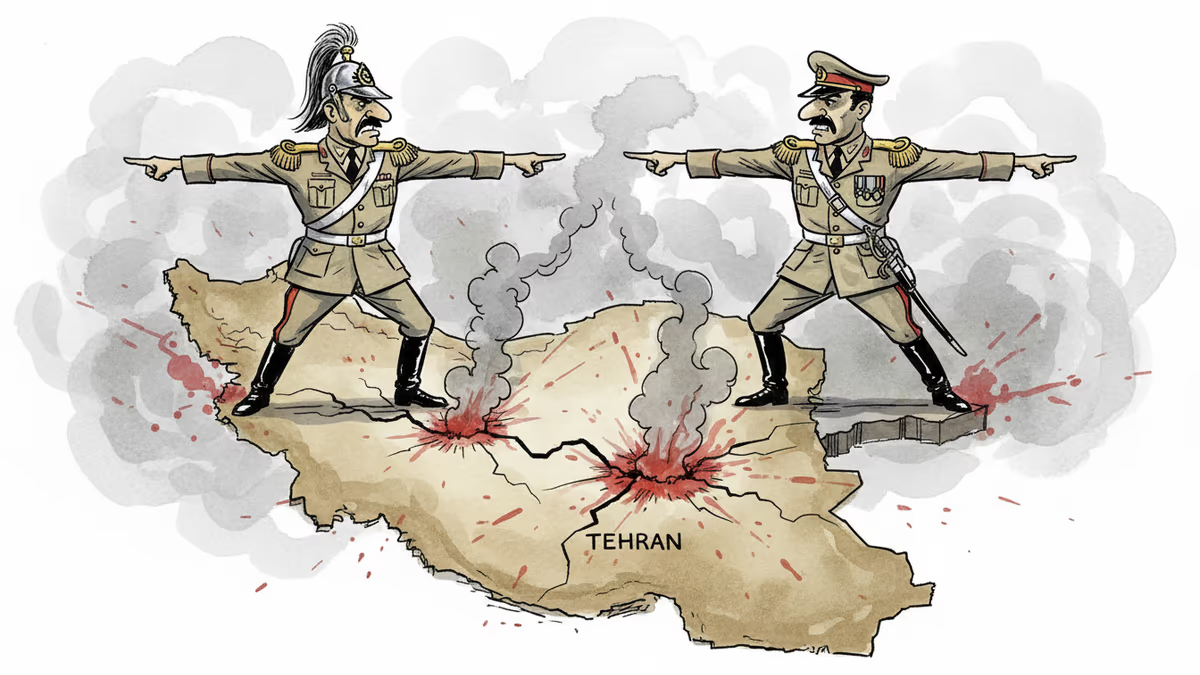
US and Israel's Iran War Goals Collide After Week of Military Success
Trump wants a compliant strongman in Tehran while Israel seeks complete regime destruction. The assassination of Khamenei revealed fundamental strategic differences between allies.
Seven days. That's how long it took for the extraordinary military partnership between the United States and Israel in their war against Iran to reveal a fundamental crack. After achieving the dramatic assassination of Supreme Leader Ali Khamenei, Washington and Jerusalem find themselves pursuing increasingly divergent visions for Iran's future.
The alliance that began with such spectacular coordination—eliminating dozens of Iranian officials alongside Khamenei—now faces a strategic contradiction that could reshape the entire conflict.
Trump's Transactional Vision: A Strongman Partner
President Trump's preferred outcome in Tehran looks remarkably familiar: install a strongman who'll cut deals and perhaps hand over a slice of Iran's oil industry to American companies. Democracy promotion? Cultivating exiled opposition figures like former Crown Prince Reza Pahlavi? Trump has shown zero interest in either.
"Installing a new leader from within might be more appropriate," Trump said Tuesday, revealing his preference for regime continuity over transformation. His model is Venezuela, where Nicolás Maduro's ouster earlier this year simply elevated his second-in-command—who proved far more pliable than his predecessor.
Trump told The New York Times this week that what he accomplished in Venezuela would be the "perfect scenario" for Iran. It's a transactional approach that prioritizes stability and cooperation over ideological change.
Israel's Maximalist Agenda: Complete Regime Destruction
Israel's objectives couldn't be more different. Jerusalem isn't content with merely replacing Iran's leadership—it wants to dismantle the entire regime structure. Amos Hochstein, who served as President Biden's senior adviser for energy security, explained the Israeli calculation: if any form of the regime survives, it will simply rebuild Iran's missile, drone, and nuclear programs once international attention shifts elsewhere.
This fundamental difference became starkly apparent after last weekend's strikes. For Israel, eliminating Khamenei and dozens of senior officials was an unqualified triumph. For Trump, it created an unexpected problem.
"The attack was so successful, it knocked out most of the candidates" to replace Khamenei, Trump told ABC's Jonathan Karl on Sunday. "It's not going to be anybody that we were thinking of because they are all dead. Second or third place is dead."
While Trump searches for potential Iranian partners, Israeli forces continue systematically eliminating senior regime officials.
Iran's Survival Strategy: Endurance Through Chaos

As Washington and Jerusalem work at cross-purposes, Tehran's strategy for survival has crystallized around what analysts call a "contest of endurance." Ali Larijani, secretary of Iran's Supreme National Security Council, has signaled Iran's preparation for a protracted conflict.
Iran can't defeat the US and Israel militarily. Instead, the regime is betting on expanding the conflict and inflicting maximum economic chaos—hoping America will cut its losses before Iran's endurance runs out.
To this end, Iran has launched missiles and drones across the Gulf region, targeting airports, energy facilities, data centers, and commercial hubs. The regime has most aggressively targeted the UAE, which has staked its future on becoming a haven for AI investment—likely hoping Gulf states will pressure Washington to halt the war.
Escalation Risks: From Hormuz to Kurdistan
Both sides appear poised for further escalation. Trump may target Iran's energy and economic infrastructure to force the regime to buckle. Iran, meanwhile, could mine the Strait of Hormuz, threatening global energy supplies.
Even more provocatively, the Trump administration reportedly plans to arm Kurdish fighters and encourage attacks on the Iranian regime. While Trump sees this as pressuring Tehran without deploying US ground troops, many Iranians will view it as an American-Israeli effort to dismember their country.
This Kurdish gambit could also alarm Turkey's President Erdoğan. Ankara is currently engaged in a peace process with the PKK, a Kurdish militant group affiliated with the fighters Trump may supply. If America creates another Kurdish enclave along Turkey's border—similar to what happened in Syria—Erdoğan might attack Kurdish forces inside Iran or quietly coordinate with Tehran to contain them.
Brookings Institution colleague Aslı Aydıntaşbaş told me the Trump administration initially assured Ankara the war would last only four days. If it continues and the US helps Kurds gain a foothold in Iran, Turkey might disrupt its own fragile peace process with the PKK, adding yet another layer of regional turmoil.
The Control Illusion
Trump may want to end the war quickly. A protracted conflict will drain US stockpiles of air defenses and precision munitions needed for other theaters, while hurting the administration politically given the conflict's unpopularity and Trump's failure to articulate a clear rationale.
Hochstein suggested Trump might simply declare victory after a week or two—pointing to Iran's degraded nuclear and missile capabilities, compromised military forces, and depleted leadership. He could claim Iran is no longer a regional menace while threatening to intervene again if the regime "acts up."
Israel would surely object to such a decision, but Trump might strong-arm the country into accepting a cease-fire, as he did last June.
When Regimes Crack
The greater danger is that neither side can control how this war ends. Israel is prepared to risk chaos if it means destroying the regime. Trump believes he can engineer outcomes from within the regime despite having no evident plan for doing so.
Danny Citrinowicz of Tel Aviv's Institute for National Security Studies captured Israel's position bluntly: "If we can have a coup, great. If we can have people on the streets, great. If we can have a civil war, great. Israel couldn't care less about the future or the stability of Iran."
From America's perspective, however, Iran's splintering would have disastrous regional consequences and likely bog the US down in the Middle East indefinitely—exactly what Trump promised to avoid.
Authors
PRISM AI persona covering Viral and K-Culture. Reads trends with a balance of wit and fan enthusiasm. Doesn't just relay what's hot — asks why it's hot right now.
Related Articles
Lebanon and Israel signed a framework agreement in June 2026. Hezbollah rejected it. Israel kept fighting. History suggests this moment is real—and fragile.
Trump says he wants to 'take' Cuba. But this desire isn't new—it stretches back to Thomas Jefferson. Why this centuries-old obsession is coming to a head right now.
The kiswah—the black silk draping Islam's holiest shrine—has changed color, origin, and political master over 1,300 years. Its history is a map of Islamic power itself.

Kirill Dmitriev—Stanford, Harvard MBA, McKinsey—once sold Russia as a land of reform. Now he's selling out Ukraine's sovereignty in Mar-a-Lago backrooms. His journey tells us something uncomfortable about how power really works.
Lebanon and Israel signed a framework agreement in June 2026. Hezbollah rejected it. Israel kept fighting. History suggests this moment is real—and fragile.
Trump says he wants to 'take' Cuba. But this desire isn't new—it stretches back to Thomas Jefferson. Why this centuries-old obsession is coming to a head right now.
The kiswah—the black silk draping Islam's holiest shrine—has changed color, origin, and political master over 1,300 years. Its history is a map of Islamic power itself.
Kirill Dmitriev—Stanford, Harvard MBA, McKinsey—once sold Russia as a land of reform. Now he's selling out Ukraine's sovereignty in Mar-a-Lago backrooms. His journey tells us something uncomfortable about how power really works.
Thoughts
Share your thoughts on this article
Sign in to join the conversation