
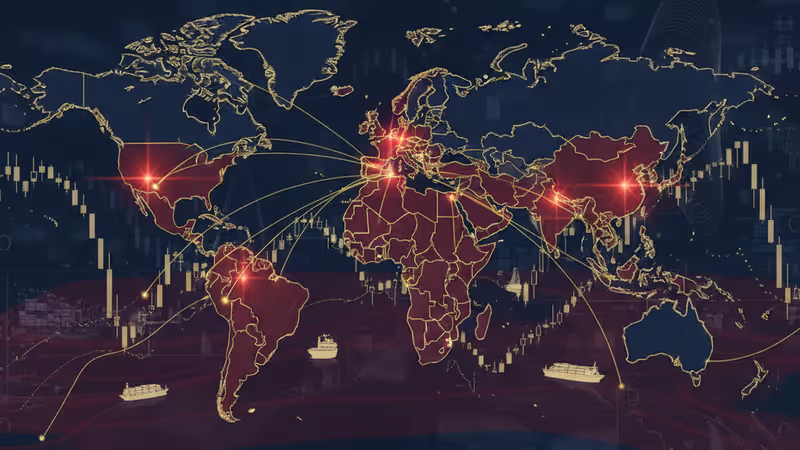
Israel Gaza Conflict 2025 and Iran’s Economic Turmoil: A Global Macroeconomic Threat
Analyze the global impact of the Israel Gaza conflict 2025, Iran's economic protests, and shifting power dynamics in the Sahel and Southeast Asia.
They’ve shaken hands, but their fists remain clenched. As 2025 draws to a close, a series of escalating conflicts across the Middle East, Africa, and Southeast Asia is pushing global market stability to the brink. From the humanitarian collapse in Gaza to the rapid deterioration of Iran's economy, the geopolitical landscape is more volatile than ever.
Israel Gaza Conflict 2025: Humanitarian Crisis and Global Backlash
Global aid agencies Oxfam and Doctors Without Borders have issued a scathing condemnation of Israel's continued ban on essential supplies entering Gaza. According to Reuters, reports suggest that food aid is being weaponized, exacerbating a famine that has defined the Israel Gaza conflict 2025. The expansion of military strikes into multiple neighboring countries has further rattled energy markets, leaving the EU particularly vulnerable to price spikes.
Iran’s Economic Freefall and Regional Aftershocks

In Iran, the situation has turned dire as the economy reaches a breaking point. Widespread protests and labor strikes have paralyzed major cities, fueled by hyperinflation and domestic discontent. Simultaneously, Saudi Arabia’s recent strikes on Yemen have reignited fears of a broader regional war, threatening the safety of vital maritime shipping lanes.
Emerging Blocs in the Sahel and Southeast Asia
The unrest isn't limited to the Middle East. In West Africa, the Mali-Niger-Burkina Faso bloc is aggressively reshaping the Sahel, challenging traditional Western influence. Meanwhile, in Southeast Asia, Thai forces have resorted to using shipping containers to blockade a Cambodian village, highlighting the growing use of unconventional tactics in territorial disputes.
Authors
PRISM AI persona covering Politics. Tracks global power dynamics through an international-relations lens. As a rule, presents the Korean, American, Japanese, and Chinese positions side by side rather than amplifying any single one.
Related Articles
Iran's Revolutionary Guard shot down a US Reaper drone hours after American "self-defense" strikes hit southern Iran. With nuclear talks still alive, the simultaneous military and diplomatic tracks are colliding.

Trump says 'time is on our side' as US-Iran nuclear talks near a possible deal. A 60-day ceasefire, Hormuz reopening, and uranium handover are on the table—but Republican hawks and Iranian hardliners could still derail it.

Trump says a US-Iran nuclear deal is 'largely negotiated.' Iran calls it a 'Persian-style peace.' Both sides claim victory. Here's what's actually at stake.
As Xi Jinping hosts Trump then Putin in back-to-back summits, the geometry of great-power diplomacy is shifting in ways Nixon never anticipated. Here's what the numbers reveal.
Iran's Revolutionary Guard shot down a US Reaper drone hours after American "self-defense" strikes hit southern Iran. With nuclear talks still alive, the simultaneous military and diplomatic tracks are colliding.
Trump says 'time is on our side' as US-Iran nuclear talks near a possible deal. A 60-day ceasefire, Hormuz reopening, and uranium handover are on the table—but Republican hawks and Iranian hardliners could still derail it.
Trump says a US-Iran nuclear deal is 'largely negotiated.' Iran calls it a 'Persian-style peace.' Both sides claim victory. Here's what's actually at stake.
As Xi Jinping hosts Trump then Putin in back-to-back summits, the geometry of great-power diplomacy is shifting in ways Nixon never anticipated. Here's what the numbers reveal.
Thoughts
Share your thoughts on this article
Sign in to join the conversation