
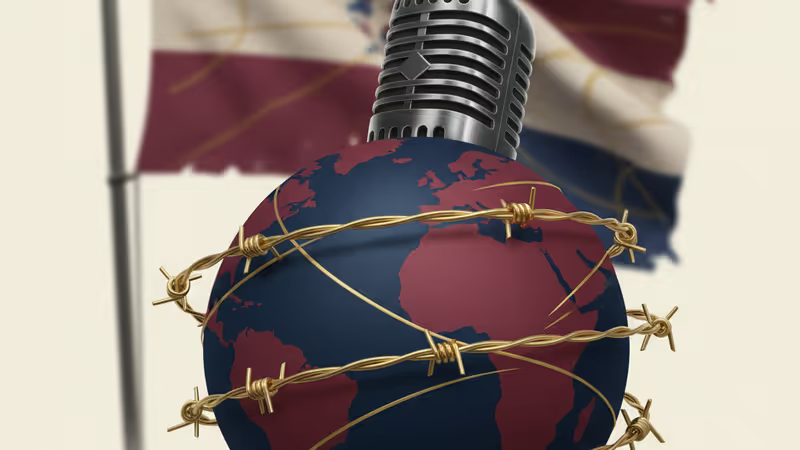
Israel Extends 'Al Jazeera Law' for Two Years and Moves to Shutter Army Radio, Sparking Press Freedom Alarms
Israel's parliament extends the 'Al Jazeera Law' for two years, allowing the shutdown of foreign media, while the cabinet moves to close the independent Army Radio by 2026, fueling concerns over press freedom.
The Israeli parliament has extended a controversial law enabling the government to shut down foreign broadcasters it deems a threat to national security. In a parallel move that deepens concerns over press freedom, the Israeli cabinet also approved a plan to close down the historically independent, state-funded Army Radio.
Broadening Powers Against Foreign Media
The legislation, passed by a vote of 22 to 10, expands temporary powers for the next two years. It allows the government to cease a foreign media outlet's operations even in peacetime and without requiring a court order. The original powers, widely dubbed the 'Al Jazeera Law', were used to shut down the Qatari-owned channel's offices and block its broadcasts in May 2024.
The Israeli government has accused Al Jazeera, a vocal critic of Israel's military campaign in Gaza, of anti-Israel bias and supporting Hamas. The broadcaster has denied these accusations, calling the shutdown a "criminal act" and an attack on press freedom.
The temporary order violated 'freedom of expression, the right to information and freedom of the press, and blocks citizens and residents from receiving a variety of information that does not fit the Israeli narrative...'
— The Association for Civil Rights in Israel (ACRI), in a statement last year
Domestic Scrutiny Turns to Army Radio
Just hours after the vote, the Israeli cabinet approved a plan to shut down Army Radio, also known as Galei Tzahal (GLZ). The station, operated by the Israel Defense Forces (IDF) but editorially independent, is slated to cease operations by 1 March 2026.
Defence Minister Israel Katz justified the move, arguing the station "broadcasts political and divisive content that is not in line with IDF values." Prime Minister Benjamin Netanyahu reportedly stated that a military-run station is highly unusual, adding, "I think it exists in North Korea and maybe a few other countries, and we probably don't want to be counted among them."
A 'Worrying Pattern' for Israeli Democracy
The decisions have triggered strong condemnation from media and civil rights groups. The Union of Journalists announced it would petition the High Court of Justice against the Army Radio closure, calling it an infringement on press freedom. The criticism was echoed by the Israel Democracy Institute (IDI) think tank, which issued a stark warning.
The decision to shut down a public media organisation is not an isolated move. It is part of a broader and worrying pattern of ongoing harm to Israeli democracy.
— Israel Democracy Institute (IDI)
The dual actions against a prominent foreign critic and a historically independent domestic outlet signal a concerted government strategy to tighten control over the information landscape. This move, targeting both external and internal narratives, reflects a growing global trend where national security is invoked to limit media scrutiny during periods of intense political and military conflict. It raises critical questions about the resilience of democratic institutions under pressure.
This content is AI-generated based on source articles. While we strive for accuracy, errors may occur. We recommend verifying with the original source.
Related Articles
Deadly clashes erupt in Aleppo, Syria, as Russia launches new missile strikes on Ukraine's energy grid. An analysis of how these escalating conflicts signal growing global geopolitical instability.

President Donald Trump has declared Greenland essential for U.S. national security and appointed a special envoy, drawing a fierce rebuke from Denmark and Greenland, who called the move a violation of sovereignty.
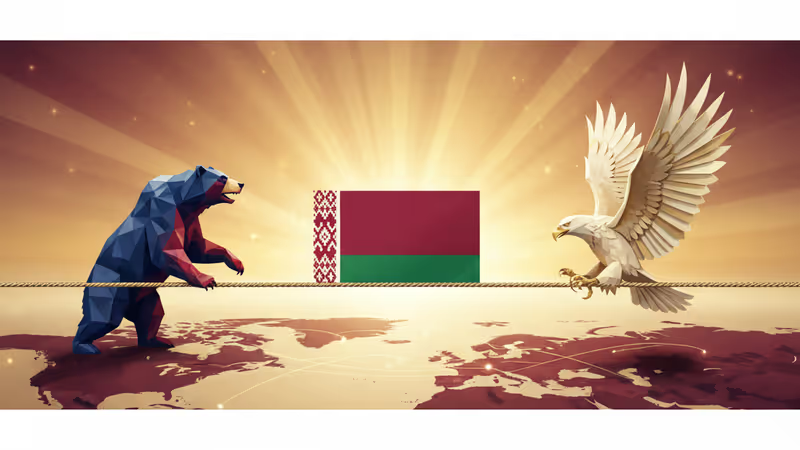
As Russia's war in Ukraine continues, its key ally Belarus is making overtures to the U.S., releasing political prisoners in exchange for potential sanctions relief. The move signals a high-stakes attempt by President Lukashenko to reduce dependence on Moscow.
An AFP journalist injured in a 2023 Israeli attack in Lebanon is in Washington D.C. to demand accountability for the strike that killed a Reuters colleague, reigniting debates on press freedom and U.S. foreign policy.