
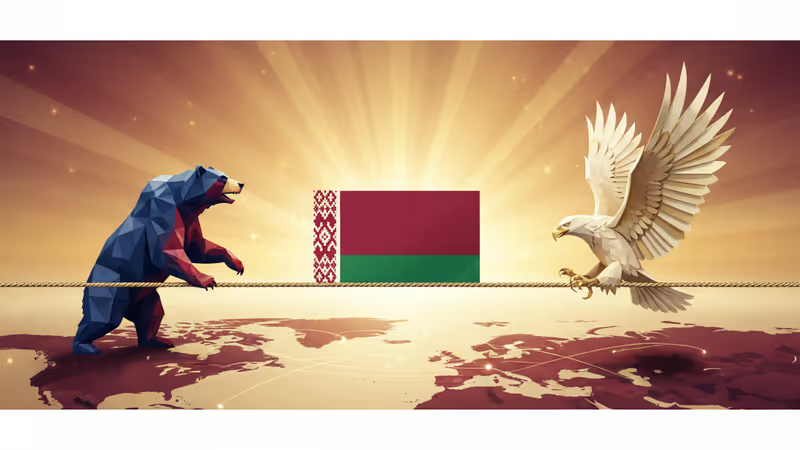
Belarus Courts U.S. in High-Stakes Pivot From Moscow
As Russia's war in Ukraine continues, its key ally Belarus is making overtures to the U.S., releasing political prisoners in exchange for potential sanctions relief. The move signals a high-stakes attempt by President Lukashenko to reduce dependence on Moscow.
With Russia still mired in its war in Ukraine, its sole European ally, Belarus, is making a calculated bid to thaw relations with the United States. In a bid to reduce his nation's heavy dependence on the Kremlin, Belarusian President Alexander Lukashenko appears to be reviving his long-standing "multi-vector" foreign policy, trading the release of political prisoners for the prospect of sanctions relief and diplomatic normalization with Washington.
Throughout 2025, Lukashenko's government has made a series of moves aimed at mending ties with the Trump administration. In early March, he publicly praised President Donald Trump, and by June, he had freed a group of political prisoners, including Siarhei Tsikhanouski, the husband of exiled opposition leader Sviatlana Tsikhanouskaya.
The diplomatic dance continued with an August phone call between Lukashenko and Trump. A month later, another group of prisoners was released. According to a report from the South China Morning Post, these actions prompted a significant response. In September, U.S. representative John Coale announced that the U.S. might soon reopen its embassy in Minsk and work to normalize economic ties, signaling a potential rollback of restrictions imposed after the controversial 2020 Belarusian presidential election.
The most substantial development came this month. Following another meeting with Lukashenko, Coale declared that the U.S. would lift sanctions on Belarusian potassium, the country's key export. In what appears to be a direct exchange, Belarusian authorities released 123 political prisoners. This group notably included Nobel Peace Prize laureate Ales Bialiatski and key opposition figure Maria Kolesnikova. This quid pro quo suggests a serious, if tentative, recalibration of Minsk's foreign policy and a clear strategic opening for Washington to weaken Moscow's influence in its own backyard.
This U.S.-Belarus rapprochement is highly conditional. Lukashenko's survival has long depended on Moscow's security and economic backing, a reality that hasn't fundamentally changed. Washington is betting it can create a lasting wedge, but any serious pressure from the Kremlin or a shift in the Ukraine war could force Minsk to snap back into Russia's orbit, making this a reversible and fragile diplomatic maneuver.
This content is AI-generated based on source articles. While we strive for accuracy, errors may occur. We recommend verifying with the original source.
Related Articles

The US Trade Representative has formally determined China's semiconductor drive is a threat to US commerce, launching a new tariff that starts at 0% and is set to rise in 18 months, on June 23, 2027.

Gaza's top health official warns of an 'unprecedented collapse' as Israeli blockade chokes off vital medical supplies, leaving 20,000 patients waiting for treatment and risking mass casualties.

Russia has launched a deadly attack on Ukraine's energy grid, while a fragile truce holds in Syria and violence escalates in the West Bank. An analysis of the world's major conflict flashpoints.
Deadly clashes erupt in Aleppo, Syria, as Russia launches new missile strikes on Ukraine's energy grid. An analysis of how these escalating conflicts signal growing global geopolitical instability.