

Trump's 'Great Gamble': Can a Businessman Envoy 'Make Iraq Great Again'?
The Trump administration has appointed businessman Mark Savaya as a special envoy to Iraq with a mission to "Make Iraq Great Again." Can this unconventional, transactional approach succeed in stabilizing the nation and curbing Iranian influence?
A New Playbook for the Middle East
President Donald Trump’s second administration has rolled out a bold, unconventional strategy for the Middle East, aiming to recalibrate U.S. influence in a region long defined by conflict. The new approach pivots from 'endless wars' to a transactional, business-centric diplomacy, prioritizing regional stability through economic strength and military consolidation.
At the heart of this ambition is a goal succinctly described by the new U.S. envoy to Iraq, Mark Savaya: to “make Iraq great again.” It’s what some are calling Trump's “great gamble”—an attempt to transform Iraq from a battleground for foreign interests into a stable, sovereign regional hub.
The Twofold Mission: Consolidate and Contain
The administration's plan for Iraq is twofold: first, to consolidate all armed forces under the command of the legitimate state, and second, to drastically reduce the influence of malign foreign actors, most notably Iran. To achieve this, Washington seeks to open Iraqi markets to international investment, upgrade national infrastructure, and secure the independence of its energy sector. The goal is a genuine partnership that respects Iraq's unity while ensuring it ceases to be a node for militia activity and external interference.
This assertive U.S. strategy lands in a highly fractured political environment. Iraq is less a single state than a patchwork of competing powers, with armed militias operating outside the formal chain of command. These groups, major winners in the November 2025 elections, pose a critical question: how can Iraq attract foreign investment if non-state actors challenge the government's authority?
Who is Mark Savaya?To spearhead this high-stakes mission, Trump bypassed traditional diplomatic channels. On October 19, he appointed Mark Savaya, an Iraqi-born, Detroit-based businessman. Lacking a typical diplomatic background—his experience is in the private sector, including the cannabis industry—Savaya gained political prominence as a key Trump supporter in Michigan. He also played a vital role in negotiating the release of Elizabeth Tsurkov, an academic held by an Iraqi militia for over two years.
Navigating a Geopolitical Tug-of-War
Savaya's mission unfolds as Iran's regional “axis of resistance” is under unprecedented pressure. Tehran’s proxies have already lost their foothold in Syria after the Assad regime's fall in late 2024 and saw Hezbollah's power in Lebanon decimated by the 2025 conflict with Israel. For Tehran, maintaining influence in Baghdad is now a final, desperate stand to remain a relevant regional power.
"There is no place for armed groups in a fully sovereign Iraq."— Mark Savaya, U.S. Special Envoy to Iraq
Savaya's call for disarmament has seen some success, with at least three pro-Iran militias publicly agreeing to disarm. However, others have rejected the proposal outright. The success of Trump’s gamble also depends on other players. Turkiye, Saudi Arabia, and the UAE are emerging as key economic partners for Baghdad, offering an alternative to Iran. But they bring their own agendas, such as Turkiye's focus on containing Kurdish movements, which could conflict with U.S. objectives.
PRISM Insight: A Test for 'Transactional Realism'
The “Make Iraq Great Again” strategy is a prime example of “transactional realism”—using economic diplomacy and personal ties as strategic tools to pull a nation from a rival's orbit. It views the U.S.-Iran rivalry as a zero-sum game where restoring a state-centric order in Iraq is paramount. However, this approach faces a significant “security dilemma”: aggressive moves to diminish Iranian influence may trigger a violent defensive response from Tehran. The ultimate success of this high-stakes gambit hinges on whether Savaya can dismantle the shadow economies that fuel foreign interference and help establish an Iraqi state capable of navigating the intense geopolitical crossfire between Washington and Tehran.
Related Articles

President Donald Trump has appointed Louisiana Gov. Jeff Landry as a special envoy to Greenland, tasked with making the Danish territory part of the U.S., escalating geopolitical tensions in the Arctic.
The U.S. State Department is reviving the post of Arctic Ambassador after 8 years, a strategic move to counter growing Russian and Chinese influence and address the impacts of climate change in the High North.

U.S.-led peace talks in Miami aim to find a path to end the war in Ukraine, but intense fighting continues with casualties reported in Kharkiv and Zaporizhia. An analysis of the dual-track strategy of diplomacy and military pressure.
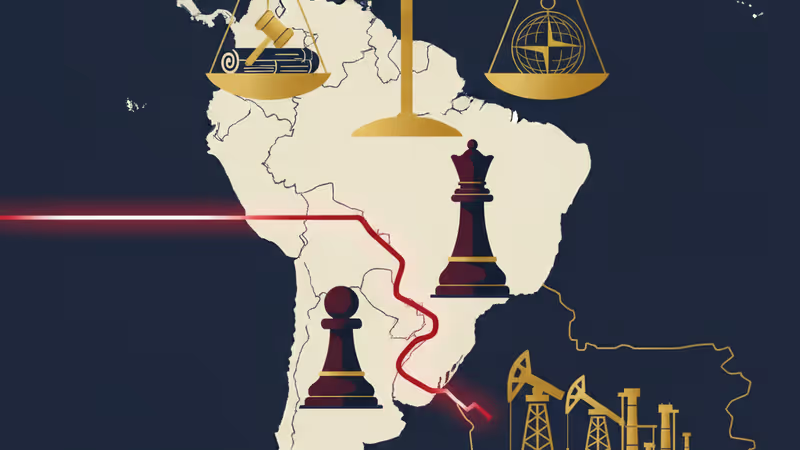
The U.S. and Venezuela are locked in a tense standoff over Guyana's oil-rich Essequibo region. PRISM analyzes the risks of military escalation and the geopolitical stakes for South America.