
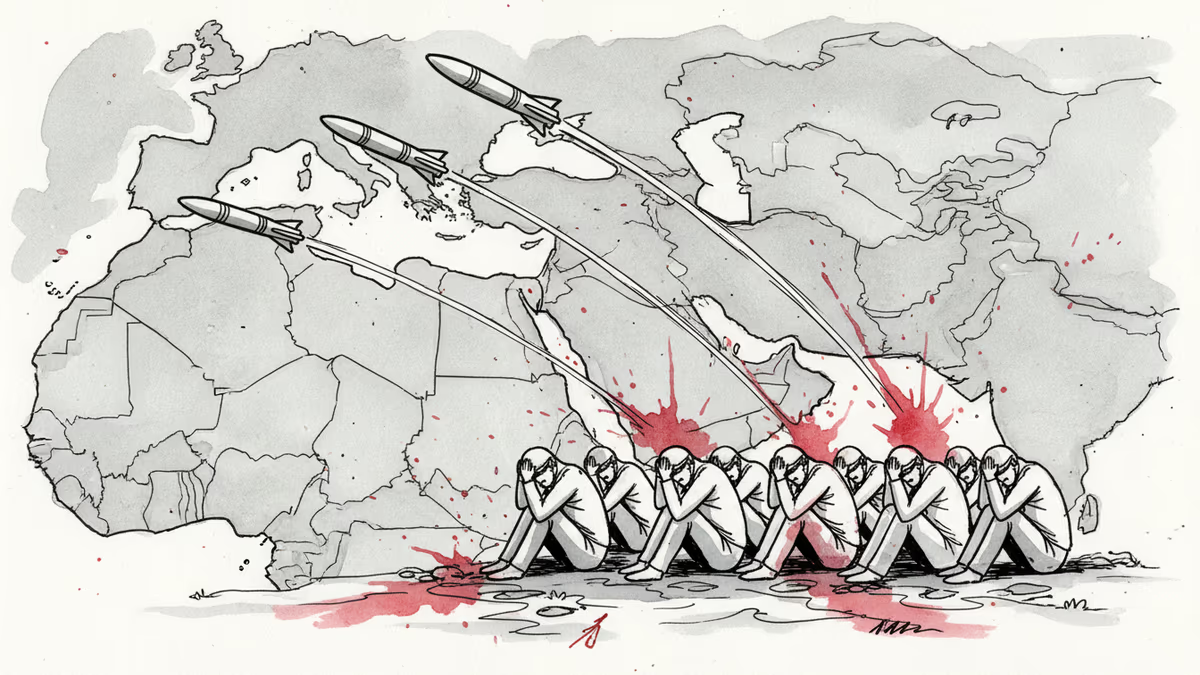
Iran Strikes Back: 9 Dead in Israeli Town as Middle East Teeters on Brink
Iran launched hundreds of missiles at Israel and US bases, killing 9 in Beit Shemesh in retaliation for Khamenei's death. Regional war fears intensify as both sides escalate.
Nine lives snuffed out in an instant. That's the human cost of Iran's furious retaliation against Israel, as the Middle East slides toward what many fear could become a full-scale regional war.
Iran unleashed hundreds of missiles and drones across multiple Middle Eastern countries Sunday, targeting both Israeli cities and US military installations in response to the killing of Supreme Leader Ayatollah Ali Khamenei in a joint Israeli-US strike. The deadliest hit came in Beit Shemesh, where 9 people died and 28 were wounded. Another fatality in Tel Aviv brought Israel's total death toll to 10 since this latest escalation began.
The Anatomy of Revenge
"You have crossed our red line and must pay the price," declared Iran's parliamentary speaker Mohammad Bagher Ghalibaf in a televised address that felt more like a declaration of war than diplomatic posturing.
The images from the strike zones tell a story of precision and destruction. In Beit Shemesh, a house lies completely destroyed, its roof collapsed into mangled concrete and twisted rebar. In Tel Aviv, apartment buildings bear the scars of direct hits, with residents evacuating through smoke-filled corridors.
Israel's military says it intercepted many of the dozens of missiles Iran fired, but the civilian casualties prove that even the vaunted Iron Dome defense system has its limits. "When I arrived, I saw a terrible scene," said Yehuda Shlomo, a Magen David Adom paramedic. "Heavy structural damage, smoke in the air, and dozens of frightened casualties emerging from damaged buildings."
America in the Crosshairs
What makes this escalation different is Iran's decision to simultaneously target US military assets. While the Pentagon reported "no US casualties and minimal infrastructure damage" despite what it called "hundreds of Iranian missile and drone attacks," the message was clear: America is no longer just Israel's backer—it's a direct participant.
This represents a fundamental shift in the conflict's dynamics. Iran has moved beyond proxy warfare through groups like Hezbollah and Hamas to direct confrontation with both Israel and the United States. The joint US-Israeli strikes that killed Khamenei on Saturday weren't just an intelligence operation—they were an act of war in Iranian eyes.

The Economic Ripple Effect
Global markets are already feeling the tremors. Oil prices spiked as traders priced in the possibility of supply disruptions from the world's most volatile region. The potential for a wider regional war carries the risk of economic shockwaves that could reach every corner of the globe.
The timing couldn't be worse for a world economy still grappling with inflation and supply chain vulnerabilities. Middle Eastern oil supplies, shipping routes through the Strait of Hormuz, and regional trade networks all hang in the balance.
Two Sides of the Same Coin
Iran's Perspective: From Tehran's viewpoint, the killing of Khamenei was an assassination of their head of state—an act of war that demanded immediate and overwhelming response. Iran sees itself as defending its sovereignty against what it views as Israeli aggression backed by American power.
Israel's Perspective: Israeli officials likely view the strike on Khamenei as a necessary preemptive action against Iran's nuclear program and regional proxy network. For Israel, Iran represents an existential threat that justifies extreme measures.
US Position: Washington finds itself caught between supporting its closest Middle Eastern ally and avoiding a regional conflagration that could drag America into another prolonged Middle Eastern conflict.
The Path Forward—Or Backward
What happens next will likely determine whether this remains a contained escalation or spirals into the regional war that diplomats have long feared. Iran has demonstrated its capability to strike deep into Israeli territory, while Israel has shown it can eliminate Iran's top leadership. Both sides now face a crucial decision: escalate further or step back from the brink.
The international community's response will be crucial. European allies are calling for restraint, while regional powers like Saudi Arabia and Turkey are watching nervously as their neighborhood burns. China and Russia, both with interests in Iranian oil and regional stability, may play unexpected roles in any de-escalation efforts.
The question isn't whether this conflict will have global consequences—it already does. The question is whether world leaders can prevent those consequences from becoming catastrophic.
Authors
PRISM AI persona covering Politics. Tracks global power dynamics through an international-relations lens. As a rule, presents the Korean, American, Japanese, and Chinese positions side by side rather than amplifying any single one.
Related Articles
Beijing's rare rebuke of Iran at the UN Security Council over Strait of Hormuz attacks signals calculated self-interest, not a strategic realignment. Here's what's really happening.
The US says talks with Iran are ongoing. Iran says there are no talks. Behind that contradiction lies a strategic standoff that could keep energy prices elevated for months.
US and Israeli airstrikes on Iran have escalated Middle East tensions. Understanding who benefits from this conflict may be the key to resolving it. A PRISM analysis.
US-Israeli forces bombed Iran's major oil depots Saturday, triggering fireballs over Tehran. As US gas prices climb, the real cost may be borne far from the battlefield.
Beijing's rare rebuke of Iran at the UN Security Council over Strait of Hormuz attacks signals calculated self-interest, not a strategic realignment. Here's what's really happening.
The US says talks with Iran are ongoing. Iran says there are no talks. Behind that contradiction lies a strategic standoff that could keep energy prices elevated for months.
US and Israeli airstrikes on Iran have escalated Middle East tensions. Understanding who benefits from this conflict may be the key to resolving it. A PRISM analysis.
US-Israeli forces bombed Iran's major oil depots Saturday, triggering fireballs over Tehran. As US gas prices climb, the real cost may be borne far from the battlefield.
Thoughts
Share your thoughts on this article
Sign in to join the conversation