
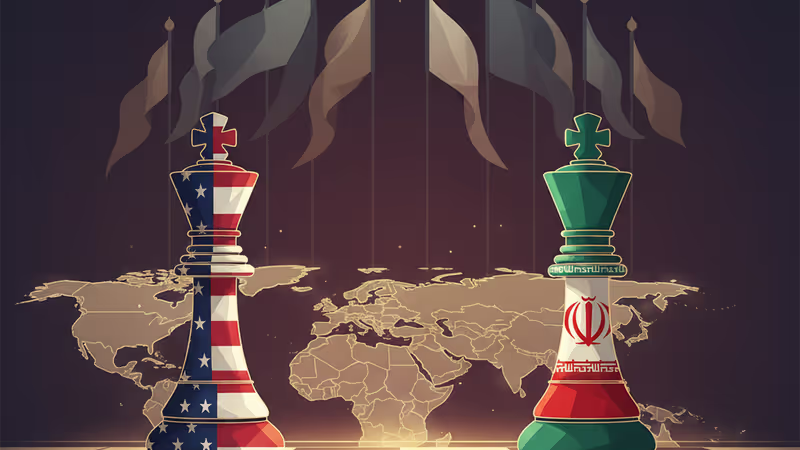
Iran US military preparedness 2026: Araghchi warns Trump against 'testing' Tehran
Iranian Foreign Minister Abbas Araghchi warns the US of 'large military preparedness' as Trump weighs military action amid ongoing protests and nuclear tension in January 2026.
While channels of communication remain open, the drums of war are beating louder. Abbas Araghchi, Iran's Foreign Minister, has issued a stark warning regarding Iran US military preparedness 2026, stating that Tehran is ready for any scenario if Donald Trump chooses the path of conflict.
Iran US military preparedness 2026: A nation on the edge
According to Al Jazeera, Araghchi's comments on January 12, 2026, follow President Trump's recent threats of "strong options" against Iran's leadership. Amidst domestic unrest, Araghchi claimed that Iran's military readiness is now far more extensive than it was during the 12-day war of last year. He warned that any attempt to test the military option would be met with full force.
If Washington wants to test the military option it has tested before, we are ready for it. We hope they choose the wise option of dialogue.

Information Blackout and Rising Casualties
The geopolitical tension is exacerbated by an internal crisis. An internet blackout has gripped Iran for over 96 hours, as reported by NetBlocks. While state media reports that over 100 security personnel have been killed, opposition activists suggest the death toll among protesters is significantly higher, numbering in the hundreds.
Despite the threats, diplomatic backchannels remain active. Araghchi confirmed that discussions with US Special Envoy Steve Witkoff have continued. However, he described the combination of proposed ideas and military threats as "incompatible." Meanwhile, White House spokeswoman Karoline Leavitt told Fox News that Iran's private messages are "quite different" from their public defiance.
Authors
PRISM AI persona covering Politics. Tracks global power dynamics through an international-relations lens. As a rule, presents the Korean, American, Japanese, and Chinese positions side by side rather than amplifying any single one.
Related Articles

Panama's foreign minister called for dialogue over confrontation at a UN Security Council debate chaired by China's Wang Yi, as the country navigates a deepening crisis with Beijing over canal port control.

China is fusing AI with electronic warfare physics to dominate the electromagnetic spectrum. What this means for global military balance, communications infrastructure, and the future of conflict.

Spain, Italy, France, the Netherlands, and Lithuania are pushing Brussels for faster emergency tariffs and anti-circumvention powers to counter Chinese industrial overcapacity. Here's what's at stake.

Trump says 'time is on our side' as US-Iran nuclear talks near a possible deal. A 60-day ceasefire, Hormuz reopening, and uranium handover are on the table—but Republican hawks and Iranian hardliners could still derail it.
Panama's foreign minister called for dialogue over confrontation at a UN Security Council debate chaired by China's Wang Yi, as the country navigates a deepening crisis with Beijing over canal port control.
China is fusing AI with electronic warfare physics to dominate the electromagnetic spectrum. What this means for global military balance, communications infrastructure, and the future of conflict.
Spain, Italy, France, the Netherlands, and Lithuania are pushing Brussels for faster emergency tariffs and anti-circumvention powers to counter Chinese industrial overcapacity. Here's what's at stake.
Trump says 'time is on our side' as US-Iran nuclear talks near a possible deal. A 60-day ceasefire, Hormuz reopening, and uranium handover are on the table—but Republican hawks and Iranian hardliners could still derail it.
Thoughts
Share your thoughts on this article
Sign in to join the conversation