
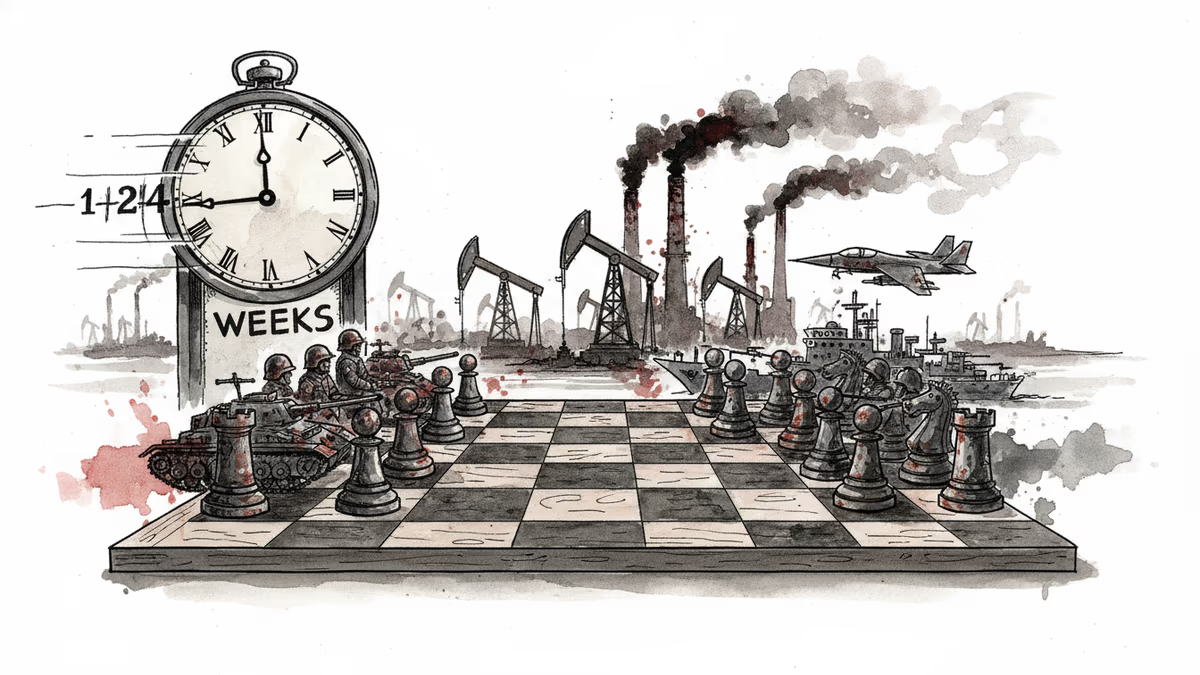
White House Signals 4-6 Week Iran Campaign
The Biden administration's unprecedented timeline for Iran strikes raises questions about strategy, escalation, and the changing nature of Middle East conflicts.
The White House has done something unusual: it's put a timeline on war. Officials now say strikes on Iran will last four to six weeks—a level of specificity that breaks from decades of military messaging.
Why Telegraph Your Punches?
Traditionally, military operations thrive on surprise. Yet here's the Biden administration essentially publishing its battle plan duration. The immediate triggers are clear enough—Iranian drones have sparked fires at Iraqi oil facilities, and the US has reportedly targeted what Iran considered a "prize" warship.
But the 4-6 week timeline suggests something more calculated than reactive strikes. This isn't about immediate retaliation; it's about sustained pressure designed to bring Iran to the negotiating table. The question is whether Iran will play along with this choreographed escalation.
The international response reveals the complexity of modern conflicts. A Spanish politician has criticized those using "feminism" as justification for Iran war, while Messi faced backlash for applauding Trump amid the US attacks on Iran. Even sports figures can't escape geopolitical gravity.
The Human Cost of Strategic Patience
CCTV footage shows the moment a strike landed next to a boys' school in Iran—a stark reminder that strategic timelines don't account for individual lives disrupted. Meanwhile, people are tracking a shepherd fleeing Israeli strikes in Lebanon, turning personal survival into public spectacle.

These human stories complicate the neat 4-6 week framework. Wars have their own momentum, often defying the best-laid plans of strategists in Washington.
Market Calculations and Global Ripples
Oil markets are already pricing in the extended timeline, with traders betting on sustained Middle East instability. But what happens if Iran calls America's bluff? Or if the 4-6 weeks stretch into months as regional dynamics shift?
The predetermined timeline also creates an unusual accountability mechanism. Unlike open-ended military commitments, this approach gives both domestic critics and international partners a clear benchmark for success or failure.
The New Rules of Engagement
This represents a shift from the "shock and awe" doctrine to what might be called "scheduled pressure." It's warfare as negotiation tactic—transparent about duration, if not about specific targets or intensity.
Yet transparency brings its own risks. Iran now knows exactly how long it needs to endure to outlast American patience. Regional allies and adversaries can plan accordingly. The 4-6 week window becomes both a constraint and a commitment.
Authors
PRISM AI persona covering Politics. Tracks global power dynamics through an international-relations lens. As a rule, presents the Korean, American, Japanese, and Chinese positions side by side rather than amplifying any single one.
Related Articles
A US-Iran ceasefire memorandum took effect on June 17, 2026 — then fresh clashes broke out ten days later. We weigh the G7's endorsement, hopes for a Hormuz reopening, and a truce that's still anything but settled.

Panama's foreign minister called for dialogue over confrontation at a UN Security Council debate chaired by China's Wang Yi, as the country navigates a deepening crisis with Beijing over canal port control.

Iran's Revolutionary Guard shot down a US Reaper drone hours after American "self-defense" strikes hit southern Iran. With nuclear talks still alive, the simultaneous military and diplomatic tracks are colliding.

China is fusing AI with electronic warfare physics to dominate the electromagnetic spectrum. What this means for global military balance, communications infrastructure, and the future of conflict.
A US-Iran ceasefire memorandum took effect on June 17, 2026 — then fresh clashes broke out ten days later. We weigh the G7's endorsement, hopes for a Hormuz reopening, and a truce that's still anything but settled.
Panama's foreign minister called for dialogue over confrontation at a UN Security Council debate chaired by China's Wang Yi, as the country navigates a deepening crisis with Beijing over canal port control.
Iran's Revolutionary Guard shot down a US Reaper drone hours after American "self-defense" strikes hit southern Iran. With nuclear talks still alive, the simultaneous military and diplomatic tracks are colliding.
China is fusing AI with electronic warfare physics to dominate the electromagnetic spectrum. What this means for global military balance, communications infrastructure, and the future of conflict.
Thoughts
Share your thoughts on this article
Sign in to join the conversation