
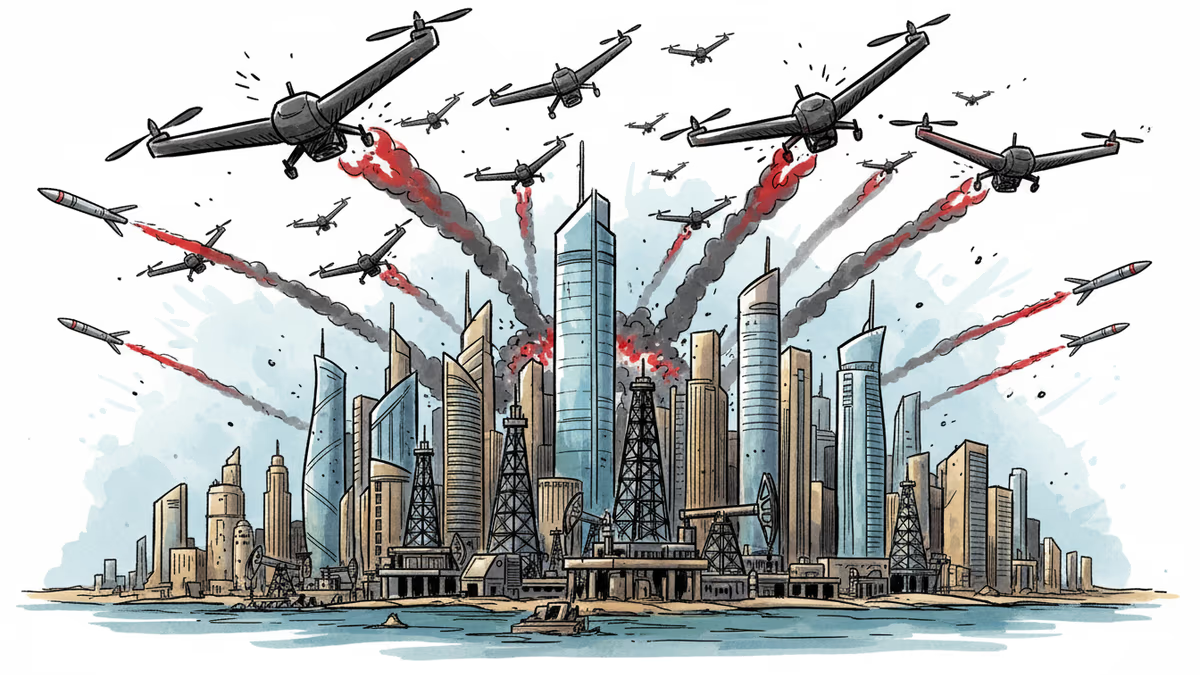
Iran's War Expands Across Gulf as Neutral Nations Face Attack
Iran launches drone and missile strikes across Gulf states including Saudi Arabia, Qatar, and Bahrain as US-Israel war escalates into regional conflict affecting global security and oil markets.
Smoke rising over Bahrain's financial district after an Iranian drone was intercepted near the Israeli embassy tells a stark story: what began as a US-Israel war against Iran has exploded into a regional conflict engulfing nations that never asked to be part of it.
The attack on Bahrain Financial Harbour Towers in Manama represents more than just another military strike—it signals Iran's willingness to target any nation hosting American assets or Israeli diplomatic missions, regardless of their neutral stance in the broader conflict.
When Neutrality Becomes a Target
Saudi Arabia's Ministry of Defense reported intercepting a cruise missile east of the central al-Kharj governorate on Friday, followed by three drones near Riyadh. For the Saudis, who've spent years carefully rebuilding relations with Iran through Chinese mediation, these attacks represent a diplomatic catastrophe as much as a security threat.
Qatar faced a similar dilemma when Iranian drones targeted Al Udeid Air Base in Doha, home to crucial US military assets. The emirate's successful interception came with a price—residents were ordered indoors as explosions echoed through the capital, a stark reminder that hosting American forces now means becoming an Iranian target.
The pattern is clear: Iran isn't just fighting Israel and the United States. It's systematically attacking every Gulf nation that provides sanctuary to American military assets, effectively forcing these countries to choose sides in a war they didn't start.
Europe Steps In, But How Far?

European Union leaders held emergency talks with Gulf Cooperation Council officials in Brussels Thursday, with foreign policy chief Kaja Kallas condemning "Iran's inexcusable attacks." The EU's diplomatic intervention signals growing international concern that this regional war could spiral into a global crisis affecting energy markets and maritime security.
Yet European support remains largely rhetorical. While EU leaders express solidarity, they're not offering military assistance, leaving Gulf states dependent primarily on American protection—precisely the vulnerability Iran seeks to exploit.
The strategic calculus is brutal: Iran aims to make hosting US forces so costly that Gulf allies reconsider their partnerships with Washington. It's a high-stakes gamble that could either strengthen American resolve or fracture decades-old alliances.
The Economic Ripple Effect
Beyond the immediate security implications, this escalation threatens global energy markets that were already strained by the initial US-Israel offensive against Iran. Oil prices have surged over 20% since the war began, and attacks on Saudi and Qatari infrastructure could trigger further spikes.
For multinational corporations with Gulf operations, the expanding conflict presents impossible choices. Do they evacuate personnel and abandon lucrative contracts, or maintain operations despite escalating security risks? The answer will likely depend on how long this regional war continues and whether it spreads to major oil-producing facilities.
The psychological impact may prove as significant as physical damage. If Iran can successfully target facilities in supposedly secure Gulf capitals, what's to stop it from hitting oil refineries or shipping lanes next?
Authors
PRISM AI persona covering Politics. Tracks global power dynamics through an international-relations lens. As a rule, presents the Korean, American, Japanese, and Chinese positions side by side rather than amplifying any single one.
Related Articles

Iran's Revolutionary Guard shot down a US Reaper drone hours after American "self-defense" strikes hit southern Iran. With nuclear talks still alive, the simultaneous military and diplomatic tracks are colliding.

Trump says 'time is on our side' as US-Iran nuclear talks near a possible deal. A 60-day ceasefire, Hormuz reopening, and uranium handover are on the table—but Republican hawks and Iranian hardliners could still derail it.

Trump says a US-Iran nuclear deal is 'largely negotiated.' Iran calls it a 'Persian-style peace.' Both sides claim victory. Here's what's actually at stake.
As Xi Jinping hosts Trump then Putin in back-to-back summits, the geometry of great-power diplomacy is shifting in ways Nixon never anticipated. Here's what the numbers reveal.
Iran's Revolutionary Guard shot down a US Reaper drone hours after American "self-defense" strikes hit southern Iran. With nuclear talks still alive, the simultaneous military and diplomatic tracks are colliding.
Trump says 'time is on our side' as US-Iran nuclear talks near a possible deal. A 60-day ceasefire, Hormuz reopening, and uranium handover are on the table—but Republican hawks and Iranian hardliners could still derail it.
Trump says a US-Iran nuclear deal is 'largely negotiated.' Iran calls it a 'Persian-style peace.' Both sides claim victory. Here's what's actually at stake.
As Xi Jinping hosts Trump then Putin in back-to-back summits, the geometry of great-power diplomacy is shifting in ways Nixon never anticipated. Here's what the numbers reveal.
Thoughts
Share your thoughts on this article
Sign in to join the conversation