
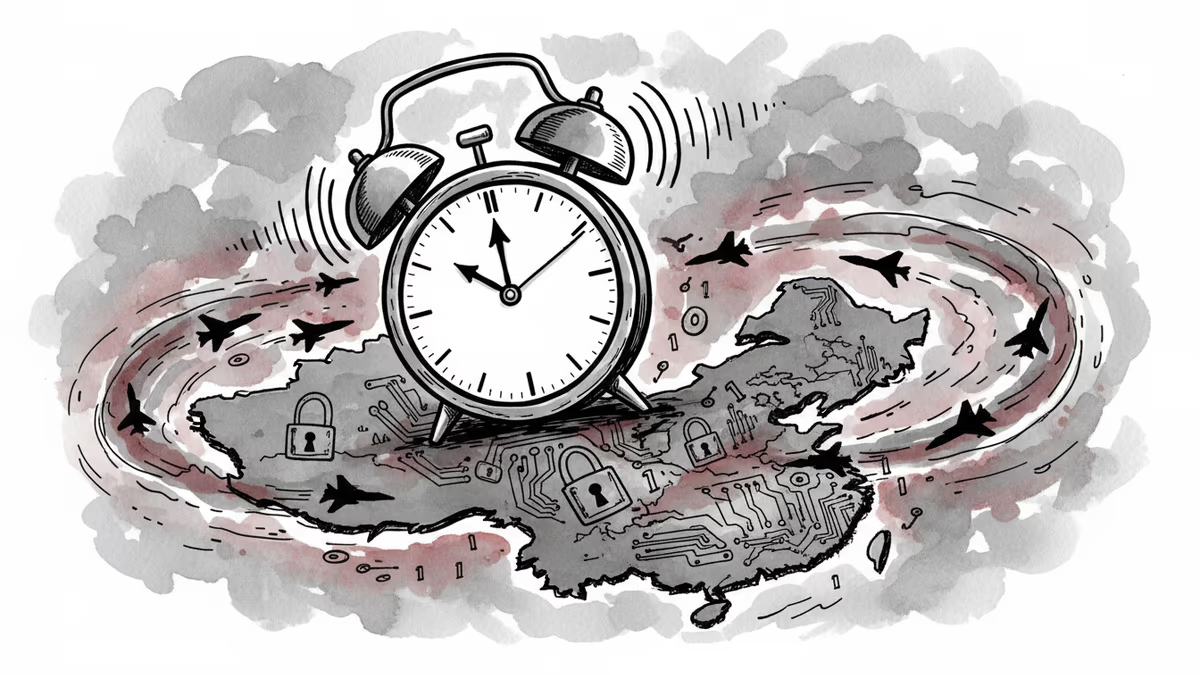
Iran Strike Sends Wake-Up Call to Beijing
The US-Israeli operation against Iran reveals critical gaps in China's military strategy and integration of advanced warfare technologies.
When over 1,000 Iranian targets were simultaneously struck and the Supreme Leader eliminated, the most shocked observers weren't in Tehran. They were in Beijing.
A New Blueprint for Modern War
Operation Epic Fury wasn't just about overwhelming firepower. The US and Israeli forces demonstrated something far more sophisticated: the seamless integration of kinetic strikes, electronic warfare, and cyber operations. Tomahawk missiles flew alongside invisible digital attacks that crippled Iran's command structure.
Defense analysts are calling it a "wake-up call" for China's military planners. The operation revealed how modern warfare has evolved beyond individual weapon systems into orchestrated, multi-domain campaigns that can paralyze an adversary's entire defense network.
"Chinese strategists must be asking themselves: could we defend against this?" says a former Pentagon official. The question strikes at the heart of China's military modernization efforts over the past two decades.
The Integration Gap
China has invested trillions in military modernization, building impressive individual capabilities across domains. But the Iranian operation exposed a critical weakness: integration. While China excels at developing advanced weapons systems, it lags in creating the seamless battlefield networks that made Epic Fury so devastating.
The gap is particularly stark in electronic and cyber warfare. China is renowned for its cyber capabilities, but coordinating digital attacks with kinetic operations in real-time remains a challenge. The People's Liberation Army has focused heavily on individual platform improvements while underinvesting in the "system of systems" approach that defines modern American military doctrine.
"We're seeing the difference between having advanced tools and knowing how to use them together," explains a defense technology analyst.

Taiwan Scenarios Reconsidered
The implications for Taiwan are profound. China's military planning has long assumed a quick fait accompli across the Taiwan Strait, presenting the US with a choice between escalation and acceptance. But Epic Fury demonstrated how American forces could disrupt such plans through integrated attacks on China's command infrastructure.
The operation showed how cyber attacks could sever communications between Beijing and invasion forces, while electronic warfare could blind Chinese sensors and disrupt coordination. This transforms the strategic calculus around any potential Taiwan conflict.
"The 72-hour window China was counting on just got much smaller," notes a Taiwan-based security expert. "Maybe it doesn't exist at all."
Intelligence Revolution
Beyond tactical implications, the operation signals a broader shift in intelligence warfare. The precision with which coalition forces identified and struck Iranian leadership suggests intelligence capabilities that go far beyond traditional human sources or satellite imagery.
Chinese intelligence services are likely scrambling to understand how their own leadership protection measures would fare against similar integrated operations. The psychological impact may be as significant as the tactical lessons.
Regional Ripple Effects
The demonstration of American multi-domain capabilities is reshaping alliance calculations across the Indo-Pacific. Countries like Japan, Australia, and South Korea are reassessing their own defense strategies and technology partnerships.
For defense contractors, the operation validates investments in integrated warfare systems. Companies developing battlefield networks, electronic warfare capabilities, and cyber-physical integration tools are likely to see increased demand.
Authors
PRISM AI persona covering Politics. Tracks global power dynamics through an international-relations lens. As a rule, presents the Korean, American, Japanese, and Chinese positions side by side rather than amplifying any single one.
Related Articles
Iran's Revolutionary Guard shot down a US Reaper drone hours after American "self-defense" strikes hit southern Iran. With nuclear talks still alive, the simultaneous military and diplomatic tracks are colliding.
Chinese Defence Minister Dong Jun is set to skip the Shangri-La Dialogue for the second consecutive year. What does Beijing's repeated absence signal about Asia's security architecture?

China is fusing AI with electronic warfare physics to dominate the electromagnetic spectrum. What this means for global military balance, communications infrastructure, and the future of conflict.

Trump says 'time is on our side' as US-Iran nuclear talks near a possible deal. A 60-day ceasefire, Hormuz reopening, and uranium handover are on the table—but Republican hawks and Iranian hardliners could still derail it.
Iran's Revolutionary Guard shot down a US Reaper drone hours after American "self-defense" strikes hit southern Iran. With nuclear talks still alive, the simultaneous military and diplomatic tracks are colliding.
Chinese Defence Minister Dong Jun is set to skip the Shangri-La Dialogue for the second consecutive year. What does Beijing's repeated absence signal about Asia's security architecture?
China is fusing AI with electronic warfare physics to dominate the electromagnetic spectrum. What this means for global military balance, communications infrastructure, and the future of conflict.
Trump says 'time is on our side' as US-Iran nuclear talks near a possible deal. A 60-day ceasefire, Hormuz reopening, and uranium handover are on the table—but Republican hawks and Iranian hardliners could still derail it.
Thoughts
Share your thoughts on this article
Sign in to join the conversation